

Crl:
JarP
Haifa's Rambam hospital treats, protects,
innovates in the face of looming danger from Syria.
Alina Dain Sharon I JNS.org
of unexpectedly, southern Is-
rael suffered more than other
areas of the Jewish state
during this summer's conflict
with Hamas. Yet up in north-
ern Israel, 30 doctors from the Haifa-based
Rambam Health Care Campus (RHCC) were
drafted into the Israel Defense Forces (IDF).
"Israel is a small country, so everything
affects you whether you are in the conflict
or not," Professor Rafael (Raft) Beyar, a re-
nowned cardiologist and director general of
RHCC, told JNS.org .
Now, in the aftermath of the 50-day sum-
mer war, RHCC is proving that medicine has
"no borders," in Beyar's words. Last month,
doctors at the hospital conducted a success-
ful kidney transplant on a 14-year-old boy
from Gaza.
The largest hospital in northern Israel,
RHCC serves more than 2 million residents
of the area and functions as the primary
medical facility for the Northern Command of
the IDF. In addition to treating Gazan patients
and training Palestinian physicians, the hospi-
tal is receiving wounded Syrian refugees.
Many of RHCC's Gazan patients are chil-
dren facing cancer and kidney diseases.
"These kids don't have any other solu-
tions," Beyar said.
While suffering from kidney failure, the
Gaza boy treated last month also had a blood
condition that obstructed some of his blood
vessels. Doctors needed to first check for use-
able blood vessels, and only then could they
transplant his sister's kidney into his body.
When it became clear that the boy's func-
tioning blood vessels could not sustain the
new kidney, doctors implanted a synthetic
connector that saved his life.
On the Syrian front, RHCC has received
nearly 100 wounded refugees over the past
few months. IDF soldiers provide emergency
treatment for injured refugees at the Israel-
Syria border in the Golan Heights and then
bring them to the hospital.
Most of the Syrian patients have sustained
injuries from shock, bombs and other blasts.
When they are treated and recover, most re-
turn to Syria, but sometimes they don't want
to go back, said Beyar.
Like the patients from Syria, most of the
Gazan patients are thankful for the treatment
they receive from RHCC. Although Beyar
doesn't know what happens to the patients
once they return to Gaza, he said, "Someone
who is treated and whose life is saved knows
how to appreciate that." Bayern added that
he believes Israeli medical treatment of
Gazans "has a long-term impact" on how
Palestinian civilians view Israel.
RHCC's staff and management were tested
continued on page 52
50 I Chai Israel • October 2014
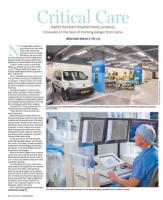
The parking lot at the Rambam Health Care Campus that is a dual-purpose facility capable of converting into a fortified 2,000-bed underground hospital for
times of conflict.
Alt
The robotic catheterization system allows the doctor to open heart blockages and implant stents in patients remotely.