

•V
.
May the coming year be filled
with health, happiness and prosperity
for all our family and friends.
Madelon & Lou Seligman
Melissa Seligman
Adrianne, Jeff, Matthew
and Evan Katz
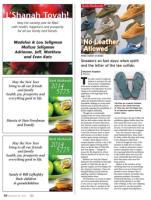
Adidas sneakers on display
Sneakers on fast days: when spirit
and the letter of the law collide.
Binyamin Kagedan
JNS.org
May the New Year
bring to all our friends
and family
health, joy, prosperity and
everything good in life.
Rosh Hashan
2014
57
Marcia & Stan Freedman
and Family
Rosh Hashanah
May the New Year
bring to all our friends
and family
health, joy, prosperity and
everything good in life.
2014
5
ri
‘
- 4
Sandy & Bill Lefkofsky
their children
& grandchildren
50
September 25 • 2014
T
he wider world of traditional
Judaism is moving in fits and
starts toward a renegotiation
of the terms of halachic observance.
At question is the importance of social
change in the understanding and
application of the legal logic of the
sages of old.
In the last several years, voices from
within the Orthodox fold have raised a
formidable challenge to certain estab-
lished norms of Jewish life and law,
especially regarding the possibilities of
female religious leadership.
Though not as emotionally
charged, there are many other points
of striking dissonance between codi-
fied law and modern reality that dot
the landscape of Jewish observance.
One that has caused something of a
stir lately is the ban on legumes and
rice for Ashkenazi Jews on Passover,
a rule that everyone seems to know
and bemoan as an artifact of early-
modern grain storage techniques.
Another, which appears to have
escaped popular scrutiny so far, is the
injunction against wearing leather
shoes on the fast days of Tisha b'Av
and Yom Kippur — though the
reason for the disparity in critical
interest should not be hard to com-
prehend.
Rabbinic law from the Talmud
delineates five prohibitions that apply
equally on Tisha b'Av, the day of
greatest tragedy, and Yom Kippur, the
day of gravest repentance. These are:
eating/drinking, marital relations,
applying cosmetics, bathing and
wearing leather shoes.
The intention is to create an experi-
ence of uncomfortable abstinence,
in one case as a sign of mourning,
and in the other as a method of self-
purification. And yet for the obser-
Flip-flops are a popular footwear
choice on the Jewish fast days
of Tisha b'Av and Yom Kippur due
to an injunction against wearing
leather shoes.
vant Jew living in the age of Nike, the
prohibition against leather shoes has
only meant that twice a year, every
year, on the two most solemn days of
the year, we were allowed to wear our
most comfortable shoes to synagogue.
True, not everyone came in gel-
soled basketball shoes. Many opted
for funky rubber flip-flops with socks
or the ubiquitous white Keds.
It isn't as though the irony of the
situation is totally lost on modern
Jews. I recall my elementary school
teachers taking the time to explain
the reasoning behind the prohibition
as that leather shoes were once the
most comfortable kind of footwear,
back when these rules were first
being written.
Implicit in the inclusion of this
clarifying detail was an acknowledg-
ment that we are now living in the
absolute reverse situation: that at
this point in history, the leather shoe
epitomizes podiatric discomfort.
Traditional halachah, as it often does,
stands firmly planted in an older
order of things, in this case collapsing
upon itself in a way that precludes
any of its original meaningfulness.