
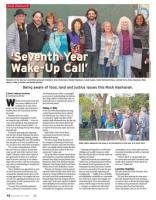

Members of the bus tour committee and panel members: Oran Hesterman, Randall Fogelman, Carole Caplan, Idelle Hammond-Sass, Lucinda Kurtz, Eitan Sussman, Rena
Basch, Linda Jo Doctor and Davita Davison.
Being aware of food, land and justice issues this Rosh Hashanah.
Shelli Liebman Dorfman
I Contributing Writer
W
ith the arrival of the Jewish New
Year comes a different sort of
resolution for an Ann Arbor
group; one that expands a personal goal to
include others, the environment and even
the world.
Members at the Ann Arbor
Reconstructionist Congregation (AARC)
are using the time of shmitah — a once-in-
seven-years sabbatical, when planting and
cultivation of land in Israel is halted — to
focus on ways to bring about positive change
beyond Israel.
During the upcoming year, beginning
with the start of Rosh Hashanah, the land is
rested, with no plowing, planting, pruning
or harvesting taking place and with anything
that may grow on its own accessible to any-
one. It is also a time when debts are forgiven.
"For me, the commandments of shmi-
tah can be seen as a built-in seventh-year
wake-up call," said AARC member Carole
Caplan. "Shmitah, which means 'release', is
the opportunity for those of us outside of
Israel to become conscious of our relation-
ships with each other, with the environment,
and with our understanding of nourishment
and 'enough-ness:
"Just as Shabbat is an opportunity to reset
our ideas about personal production and
consumption, shmitah practice gives us the
exciting opportunity to re-imagine and reset
our practices regarding food production and
consumption on both a personal and a com-
munal lever she said.
"So many Jews are already passionate
about a wide array of social justice issues,
42
September 25 • 2014
and shmitah-practice offers a meaningful
access point to understanding that Judaism
has a long tradition of addressing what we
tend to perceive as contemporary issues of
food, land and justice:'
Taking A Ride
A tour bus, with 30 participants focusing
on food, land and justice issues, wheeled
into Detroit from Ann Arbor on Sept. 14.
Co-chaired by Caplan and fellow AARC
member Idelle Hammond-Sass, the day trip
included visits to the Eastern Market and
D-town Farm, an urban farm that works
to improve food security, equity and social
justice.
Malik Yakini of the Detroit Black
Community Food Security Network
addressed the group.
"He told us much about the history of
the resurgence of farming in Detroit and
inspired us with how much they have been
able to accomplish and the impact that they
have had on the lives of those in the local
community," Caplan said.
The group shared a locally sourced lunch
and heard from a panel that included Eitan
Sussman from Keep Growing Detroit, Oran
Hesterman of Fair Food Network, Randall
Fogelman of the Eastern Market and Davita
Davison from Food Lab/Kitchen Connect.
"Farmers are farming in Detroit and sell-
ing at the Eastern Market where SNAP food
assistance is being doubled on local produce
and small-scale food entrepreneurship is
being developed by locals using local food,"
Caplan said. "It all comes together to address
food availability, food economics and food-
related health issues in a way that is truly
sustainable and strengthens community.
Malik Yakini addresses the group in an introduction to the tour at D-town Farm.
"Inspiring and hopeful in a world where
challenges are usually focused on, rather
than the solutions that are already underway
right here in Detroit:'
Caplan said shmitah-year materials pro-
vided to her and Hammond-Sass by Hazon,
the national Jewish organization for envi-
ronmental awareness and action, "touched
us both on a personal level to take the ques-
tions we were personally addressing and
wrestling with — healthy food accessibility
and affordability; availability of a sustainable
non-GMO; local, organic food supply; envi-
ronmental impact of our food production
system: and fair-wages in the food system
— and gave us a framework with which
we could involve those around us in the
conversation as Jews, where justice and envi-
ronmental stewardship are held as important
spiritual values.
"I believe that if we can get people into
the conversation and make it personal, more
people will be inspired by those shared val-
ues to act:' Caplan said.
Learning Together
This past winter, the AARC formed a shmi-
tah learning group.
"We have been studying the ideas associ-
ated with shmitah this past year, looking to
reconstruct them so that the teachings might
be relevant, raise personal and communal
awareness about food, land and justice
issues, and inspire action in our own lives