
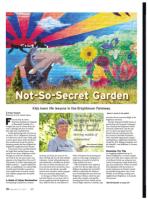

Kids learn life lessons in the Brightmoor Farmway.
Vivian Henoch
Above: A mural in the garden
Special to the Jewish News
"We're like an — -
archipelago. We have
this little lain of
islands — stable and
thriving models of
reclamation."
F
rom the Max M. Fisher
Federation Building on Telegraph
in Bloomfield Township, it's a
straight shot, just 18 minutes down the
road, a Michigan left turn to Fenkell,
then right onto Grayfield Street.
A hand-painted sign tells you that you
are there: This is "Brightmoor Farmway,"
a 15-block area where crops of kale, gold-
en beets, green beans, herbs and flowers
have transformed vacant lots and the
dumping grounds that have blighted the
Brightmoor neighborhood for decades.
Look closely. Listen carefully. Beyond
the bright blue boarded houses desig-
nated for tear-down, Brightmoor winds
through one of the last wooded pre-
serves left in the city and, in part, runs
adjacent to the Rouge River. Here you'll
find patches of creative landscaping and
hidden surprises — a garden planted by
JARC, an amphitheater in a cleared field,
colorful metal butterflies mounted on
trees, bright bursts of artwork, murals
and sculpture, playgrounds and public
park areas.
A Model of Urban Reclamation
Driving along Grayfield on a summer
18 September 25 • 2014
- Riet Schumack, Founder,
ghbors Building Brightmoor
and clear all non-structural blight in the
Brightmoor Farmway.
Recently, Beaumont Health System, in
partnership with Covenant Community
Care, launched the Brightmoor Health
Outreach Collaborative, with the sup-
port of a three-year grant from the
Jewish Fund and contributions from
the Comerica Charitable Foundation.
Other charitable organizations support-
ing Brightmoor neighborhood initiatives
include the W.K. Kellogg Foundation and
the Mandell L. and Madeleine H. Berman
Foundation.
Stemming The Tide
morning, you'll also see scores of resi-
dents working side-by-side with youthful
volunteers. Armed with gardening tools
and paintbrushes, wheelbarrows and lad-
ders, they are artists and educators, fel-
lows and interns from universities, teens
from the city and suburbs, and adult
mentors from churches, Jewish congrega-
tions and community groups alike.
As the legacy of Max M. Fisher lives
in Jewish Detroit, so, too, does it live in
Detroit neighborhoods like Brightmoor.
Since 2008, the Max M. and Marjorie S.
Fisher Foundation has invested gener-
ously in a wide range of programs in
Brightmoor, primarily to benefit its
young children and teens.
Other foundations have stepped in
as well. Over the last eight years, the
Skillman Foundation has invested $3
million to help build the infrastruc-
ture of leadership that now drives the
Brightmoor Alliance, which has part-
nered with a number of nonprofits
including Data Driven Detroit and the
Detroit Blight Authority to identify, map
As struggling neighborhoods go in
Detroit, Brightmoor is a classic example.
Back in the 1920s, this 4-square-mile area
of northwest Detroit was a planned com-
munity of inexpensive single-family hous-
ing, mass-produced for workers recruited
from Appalachia with the promise of
steady employment in Detroit's expand-
ing manufacturing plants. Once a com-
fortable, if not thriving, working-class
neighborhood, Brightmoor is among the
city's poorest.
Not-So-Secret on page 20