
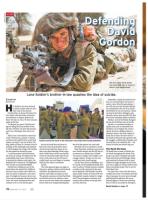

IDF lone soldier David Gordon
was found dead Aug. 19. Cause of
death is still undetermined.
Lone Soldier's brother-in-law quashes the idea of suicide.
I
Aryeh Ho
Aish.com
H
is death has not been declared
a suicide, despite what you may
have read on the Internet.
David Gordon, [a former Detroiter,] the
lone soldier who died under mysterious
circumstances in August, spoke up for
those who have no voice. It's time someone
spoke up for him.
For the past two years, I had the privi-
lege of calling David my brother-in-law.
My time with him was short but precious,
and it was a blessing to have him in my
life.
Many of our conversations centered on
words. Writing was a passion we shared,
and David was a gifted writer, as his loyal
readers can attest. I was one of them. His
blog, Sparks of David, is a treasure trove of
musings on life, philosophy and spirituali-
ty. Each eloquent entry drips with wisdom,
wit and sensitivity beyond his years.
I recall discussions with David about
the power of writing. We talked about the
responsibility that comes with the pen,
its potential to influence and inspire. His
landmark 2013 column for The Huffington
Post was that very potential fulfilled.
David's heart-rending account of the
sexual abuse that claimed his childhood
innocence was a clarion call to fellow vic-
tims too afraid or ashamed to voice their
pain. Overnight, he became a hero to sur-
vivors and an outspoken advocate for their
cause. His words transformed lives and
continue to do so now that he's gone.
Gordon received the honor of his instructor's own purple beret during graduation.
But not all words have the power to
heal. Some have the potential to harm.
And never has that been clearer to me
than in the days following David's tragic
death. Within hours of the news that the
search for David had ended with the dis-
covery of his body near his IDF base in
central Israel, one word began to insinuate
itself into the online conversation:
Suicide.
The word appeared again and again in
blog posts, opinion columns and Facebook
comments. It proliferated across the
Internet, and readers accepted it as fact.
The general consensus was that David had
survived the horrors of warfare in Gaza,
only to lose his inner battle with unspoken
horrors that never stopped haunting him.
But all of that ignores one vital truth:
His death was never declared a suicide.
More than three weeks have now passed
since David's funeral, and the IDF has yet
to announce an official cause of death.
The reason is simple: There simply is not
enough evidence. If there was, the case
would have been closed long ago.
And for those intent on building a case
for suicide, the few published details don't
seem to add up. (Would someone schedule
a wisdom tooth extraction for the same
day he planned to kill himself? And how
many suicide victims are found with mul-
tiple gunshot wounds, instead of a single
one?) The investigation continues, and
scenarios like accident or foul play have
not been ruled out.
Meanwhile, a family devastated by the
loss of a son and brother was forced to
endure a slew of hurtful speculations. I
saw with my own eyes the pain inflicted
by commentators who saw fit to martyr
David before he was even buried. I shook
my head at the hubris of bloggers who
claimed to know more than the IDF, Shin
Bet and the immediate family combined.
Mostly, I cried at the blatant disregard
for how far David had come in his life.
Suicide is a convenient narrative to
explain away such an unbearable loss.
Outsiders can be forgiven for connect-
ing the dots from childhood abuse to
substance abuse to the final comfort of
death. But to those who knew David —
the family and friends who agonized with
his struggles, celebrated his triumphs, and
stood by him as he rebuilt his life — the
notion of suicide just doesn't ring true.
The David We Knew
We heard from so many of David's clos-
est friends throughout the shivah. Kids
he grew up with in Cleveland and South
Bend and Detroit and Pittsburgh. Fellow
soul-searchers he learned with in Israel.
Soldiers he fought alongside in his Givati
unit. Not a single one of them believes that
David committed suicide. That is not the
David they knew.
Yes, there was a time in his life when it
wouldn't have been so far-fetched. But that
time is long past. In recent years, through
unflinching self-reflection, the uncon-
ditional support of loved ones and sheer
force of will, he succeeded in clawing his
David Gordon on page 72
70 September 18 • 2014