
obituaries
Obituaries from page 152
between work and death.
Survivor Ronnie Goldstein-van Cleef
was close with Anne in the Birkenau
labor camp.
"Anne was very calm and quiet and
somewhat withdrawn," she said. "The
fact that they had ended up there had
affected her profoundly — that was
obvious."
After several weeks at Birkenau, the
Frank sisters contracted the skin mites
which cause scabies, a ravenous camp
mainstay.
"The Frank girls looked terrible, their
hands and bodies covered with spots
and sores from the scabies," Goldstein-
van Cleef said.
Lenie de Jong-van Naarden was
another Dutch Jew who knew the Frank
women at Auschwitz. When the sisters
were confined to the scabies barrack,
Lenie helped mother Edith Frank dig
a hole under the structure to smuggle
bread to her daughters.
"In the barracks where [the Frank
girls] were, women went crazy, com-
pletely crazy," said de Jong-van Naarden,
who, along with other witnesses,
observed Edith Frank's tireless devotion
to her children.
"There were people who threw them-
selves against the electric fence," said de
Jong-van Naarden.
Survivor Bloeme Evers-Emden first
met Anne Frank in 1941, when Jewish
children were forced to attend the same
school in Amsterdam. Reunited at
Auschwitz, the teenagers spoke about
the war's toll on their families.
"When [Anne] was in hiding, which
was a very unhealthy situation, her
mother was someone against whom she
rebelled:' Evers-Emden said in her inter-
view. "But in the camp, all of that actu-
ally completely fell away. By giving each
other mutual support, they were able to
keep each other alive — although no one
can fight typhus:' she added.
As the Russian army advanced into
Poland during October, many of the
camp's 39,000 women prisoners —
Anne and Margot among them — were
transported west to Bergen-Belsen, in
Germany. Having been forced to stay
behind, Edith Frank died of exhaustion
and grief in early 1945.
Though not equipped with killing
facilities, Bergen-Belsen became severely
overcrowded and disease-plagued with
the arrival of transports from Auschwitz
ARRANGEMENTS IN THE COMFORT
OF YOUR OWN HOME
We are one of the few Jewish funeral
homes in the country that will make all
funeral and shiva arrangements in your
home, or wherever you would like.
We respect your situation and your time.
When you need us, just call and let us know
where you would like to talk.
THE IRA KAUFMAN CHAPEL
Bringing Together Family, Faith & Community
18325 W. 9 Mile Rd Southfield, MI 48075 • 248.569.0020 • IraKaufman.com
154 September 18 • 2014
Obituaries
and other camps. Dozens of mass graves
were filled during the war's last winter,
including one with the Frank sisters.
Survivor Rachel van Amerongen-
Frankfoorder said, "Typhus was the
hallmark of Bergen-Belsen. [Anne and
Margot] had those hollowed-out faces,
skin over bone. They were terribly
cold. You could really see both of them
dying."
Survivor Janny Brandes-Brilleslijper
said, "At a certain moment in her
final days, Anne stood in front of me,
wrapped in a blanket.
"She didn't have any more tears, and
she told me that she had such a horror
of the lice and fleas in her clothes and
that she had thrown all of her clothes
away.
Three days after her disturbing
encounter with Frank, Brandes-
Brilleslijper learned that both sisters
were dead.
"First, Margot had fallen out of bed
onto the stone floor," said Brandes-
Brilleslijper. "She couldn't get up any-
more. Anne died a day later."
Earlier that winter, with just weeks to
live, the Frank sisters helped Brandes-
Brilleslijper and other women take care
MARGOT
FRANK
Ic)45
NO:
ANNE
FRANK
u9Z9 —1,945"
—
1-
07;: DV]
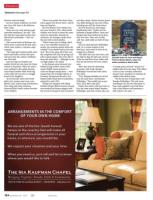
Symbolic grave for Anne and Margot
Frank at Bergen-Belsen, where the
sisters perished in March 1945.
of a large group of Dutch "mixed race"
children placed in the camp. With Allied
victory a near certainty, authorities
found it more expedient to maintain the
children than destroy them.
"We did our best to help them," said
Brandes-Brilleslijper. "Not only Anne
and Margot, but also the other girls we
knew went regularly to provide them
with a little balance and sometimes a
little culture," she said. ❑
Scanned image of the page. Keyboard directions: use + to zoom in, - to zoom out, arrow keys to pan inside the viewer.
September 18, 2014 - Image 154
- Resource type:
- Text
- Publication:
- The Detroit Jewish News, 2014-09-18
Disclaimer: Computer generated plain text may have errors. Read more about this.