

arts & entertainment
Artists Of The Book
Contemporary artists transform books into sculptural objects in new BBAC exhibit.
Suzanne Chessler
I Contributing Writer
ertain Jewish artists have linked their spe-
cialty to cultural heritage.
Moving beyond being "people of the
book:' they have gained attention as "artists of the
book:' and that applies whether or not the books
with which they work have religious relevance.
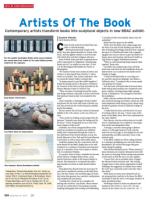
For this exhibit, Huntington Woods artist Lynne Avadenka
Some of those artists and their sculptural pieces
has moved away from Jewish art to create folding screens
will
be represented in "Adaptation: Transforming
inspired by the Japanese.
Books into Art," an exhibit on view Sept. 19-Nov.
7 at the Birmingham Bloomfield Art Center in
Birmingham.
"We wanted a broad cross-section of artists, and
I believe we have found them with the 17 whose
works are included:' says curator Linda Ross, who
co-owned the Sybaris Gallery in Royal Oak.
"In doing research to put this exhibit together, I
looked for people known in this genre. It followed
my research on the history of pop-up books for the
Dennos Museum Center in Traverse City.
"There are layers of meaning beyond the words
and design elements, especially as artists used books
that had been found as they were headed for the
Doug Beube: Interlocutors.
trash:"
Lynne Avadenka, a Huntington Woods resident
long known for her work with books of Jewish con-
tent, has moved into the world of Japanese publish-
1 ing for this display.
She has chosen Tale of Genji, written by Murasaki
Shikibu in the 11th century, as the core of her art-
istry.
"I have made two folding screens inspired by the
Japanese," Avadenka says about the background for
her piece. "I have reorganized text as a nod to the
many chapters of this novel."
Avadenka, one of four inaugural fellows of the
American Academy in Jerusalem, has exhibited
Lisa Kokin: Room for Improvement.
widely and is represented through her works in
the collections of the Detroit Institute of Arts, the
Jewish Museum in New York and the Israel Museum
in Jerusalem as well as many other public places.
Avadenka explains that her connections with the
book altered for the BBAC display have to do with
viewing it as a container of narrative and experienc-
ing it as a reminder of her visit to Japan in celebra-
tion of a milestone birthday.
In a project closer to home, Avadenka has become
artistic director of Signal-Return Press, a com-
munity letterpress studio at the Eastern Market in
Detroit. The enterprise is a nonprofit that offers
opportunities for artists to make limited-edition
Buzz Spector: Marcel Broodthaers (detail).
prints.
Doug Beube has altered books for more than 40
"Adaptation: Transforming Books into Art" will be on
years and is considered a pioneer in the field, Ross
view Sept.19-Nov. 7 at the Birmingham Bloomfield Art
says. The New Yorker cuts and folds pages of books
Center, 1516 S. Cranbrook Road, in Birmingham. Hours
into forms that generate new narrative combinations
are 9 a.m.-6 p.m. Mondays-Thursdays, 9 a.m.-5 p.m.
and metaphorical associations.
Fridays-Saturdays, and 1-4 p.m. Sunday, Oct.12. An
"Looking into a book can be a metaphor for
opening reception runs 6-8 p.m. Friday, Sept.19. (248)
looking into ourselves," says Beube, whose interest
644-0866; www.bbartcenter.org .
in book art reaches back to his keeping a journal,
studying photography and working on bookbinding.
C
124
September 18 • 2014
JN
"I transform books from familiar objects into the
unfamiliar."
Beube has three pieces in the exhibit.
Whole, from the Kylix series, shapes pages into
the form of an early Greek drinking cup with the
idea of drinking knowledge instead of wine. Suspend
has parts of 12 hardbound books with a magnify-
ing glass and concave mirror to give the illusion of
deeper space and meaning. Interlocutors builds on
Lego forms to suggest interlinked narratives.
"What we call repurposing brings separate ideas
together;' Beube says.
Lisa Kokin has sculpted pages from self-help
books into rock forms for her installation Room for
Improvement. An occasional word stands out for
thought or laughs.
"I noticed self-help books at a recycling cen-
ter, and they started me thinking:' says Kokin, a
California artist. "I wondered why so many people
were getting rid of them!"
Sure that some self-help books had sound ideas,
Kokin found many promises she considered outra-
geous, whether covering losing weight, gaining
money or finding love. The outrageous motivated
the installation.
Kokin, who has worked with other art forms that
have involved drawing and textiles, started out with
book adaptations while doing a project about being
Jewish for graduate school at California College of
the Arts.
"I really liked the form, and that led to 23 years
of working with it," she says. "I know some of the
artists in the BBAC show. We've been represented in
the same exhibits:'
Buzz Spector, who has written about art in addi-
tion to completing his own sculptures, tears pages
from books and manipulates them.
A Passage, a narrative about going to Hebrew
school, is a 360-page hardcover book with the
same text on every page. It was designed to be torn
systematically and offers innovative views of the
printed words.
In the BBAC exhibit, he will be calling attention
to a catalogue spotlighting poet and artist Marcel
Broodthaers. He covered each page with gesso
before doing the ripping.
With Michael Burkard's poem "White Insistence,"
about obsession, he created a letterpress book with
the poem on each page before tearing away portions
of each sheet so that the text is in exact register.
"I assert that I am an excellent tearer of pages:'
the Missouri-based artist has said. "My excising
of pages leaves a form whose organization in itself
challenges the suggestion of random harm within
the word 'tear: commonly used to describe what I
have done:'
While there are many more talented book art-
ists showing their creativity in the show, the BBAC
would like to lead the way to even larger numbers of
these specialized artists.
Workshops related to books are planned with
Sundays @ the Center (1-4 p.m. Oct. 12) and
Seniors @ the Center (10 a.m.-noon Oct. 14).
❑