

>> ... Next Generation ... >> on the cover
nisproving Stereotypes
Designer hires homeless women to make special coats
to keep those on the streets warm.
CONTINUED FROM PAGE 1
SHARON LUCKERMAN I SPECIAL TO THE JEWISH NEWS
lilt
P' hat happens to a
22-year-old design
student who creates
a coat that turns into
a sleeping bag that is given free
to the homeless and who starts a
nonprofit that employs homeless
women as full-time seamstresses to
make the coats?
Not yet three years later, Veronika
Scott of Detroit attracts admirers
from Warren Buffet to Madonna.
She was awarded the 2014 Diller-
Von Furstenberg $50,000 People's
Choice Award and Caroline Kennedy
presented her with the 2012 John F.
Kennedy New Frontier Award.
At every turn, she was told the
venture would not succeed — not
because of her lack of experience
but because the homeless people
she wanted to employ would be
worthless on the job.
However, Scott says the true heroes
of this story are the women from
homeless shelters hired and trained
to make the coats. When given the
opportunity, they disproved all the
stereotypes against them — not
unlike Scott herself.
"I grew up in poverty," Scott
says, adding that she was lucky her
grandparents, Marshall and Sharon
Charlip of Huntington Woods,
took her in when her parents were
unemployed and struggling with
addiction. The Charlips provided
"a good, stable home," Scott says.
There, her exposure to Judaism
deepened.
"I spent every Jewish holiday —
and still do — there," she said. "I
love the Jewish holidays, especially
the sense of family; everyone, Jewish
or not, is welcomed at their table."
Scott had a lasting impression of
Judaism as a way of giving back. "Not
screaming it from the rooftops," she
says, "but how you lived your life for
the community good."
She also understands the shame
of poverty, what it was like to have
a limited view of self and to feel
valueless. It's important for everyone,
she believes, to have a clean slate,
not defined by being homeless.
50 September 11 • 2014
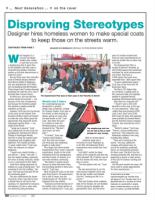
The Enpowerment Plan team at their space in the Ponyride in Detroit
Warmth And A Salary
Her coat/sleeping bag was
designed for a product
design class at Detroit's College
for Creative Studies. Scott was on
the streets so often testing her
design, giving out coats, that
she was known as the "Coat
Lady." But when she went
to a shelter to share her
finished product, a woman
shouted at her, "We don't
need coats; we need
jobs!"
"It clicked," Scott says.
"Anyone could design a
coat. But what was unique
and necessary was employing
people to make them."
Thus began the Detroit-based
Empowerment Plan, Scott's nonprofit
organization, thanks to the initial
investment from her grandparents
and their friends. Its mission is to
serve the homeless community.
"We believe in giving second
chances to those who want them,
and providing warmth to those who
need it," Scott says.
Most exciting for Scott, as the plan
grew from three to 18 seamstresses
and a staff of seven, was the
transformation of "the ladies" she
employed from the shelters.
"Everyone we hired moved out of
the shelter [into a home] within six
months of working here," Scott says.
The sleeping bag coat can
also be tied up into a small
package for easy storage.
With an income above
minimum wage and a
microloan for each employee up
to $1,500, all Endowment Plan's
seamstresses have turned their lives
around.
Scott didn't realize the deep
impact of the nonprofit until she met
Annis Maxwell, 58, of Detroit, one of
the first women she hired, who had
been in prison.
"She was patient with me," Scott
says.
The two learned how to run the
new business together: Annis was
like the den mother and thanked
Scott for "treating me like I'm a
person."
Then last October Annis suddenly
died. At her funeral, her son thanked
Scott for giving his daughter her
grandmother back. And the three
years his mother worked with
Scott, he said, had allowed him to
meet his mother like no other time
in his life.
The Empowerment Plan is
located in Detroit's Ponyride, an
old 30,000-square-foot warehouse
reclaimed for social entrepreneurs
and artists. They have a
3,000-square-foot work area,
expanded from 1,800 square feet.
"A great collaborative space,"
Scott says of the more than 40
businesses there.
The Plan's CFO, Edgar Faler,
44, of Detroit, is eating lunch at
the communal table. He originally
worked in corporate finance,
reviewing 200 business plans a year.
Why leave his corporate job?
"I haven't seen a CEO with
Veronika's vision and, at her age,
it's very impressive," Faler says,
adding they now produce 6,000
coats a year. Each costs $100,
which pays for labor and materials,
some provided by General Motors
and the Dearborn-based company
Carhartt, also attracted by Scott's
vision.
"Detroit's unique," Scott says.
"There's a strong collaborative
spirit here." Big companies and
individuals invested in her early,
including Dan Gilbert.
"Now we're bursting at the
seams," she says, adding the
company will expand soon. As
one of her professors predicted,
there's an international potential
for these coats. The Red Cross has
already purchased 500. And they are
preparing to launch a retail version
of the coat for fashion, hunting and
camping.
But the goal remains the same: Sell
more coats to create opportunities
for more seamstresses.
❑
To learn more, go to www.
empowermentplan.org. Veronika Scott
will speak at 11 a.m. Thursday, Sept. 18, in
Bloomfield Hills for a luncheon for Tikvah
Hadassah, her grandmother's chapter.
Space is limited and there is a cost for
lunch. For details, call (248) 481-9580.