

r
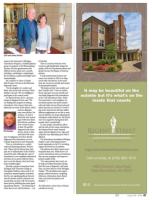
Cliff and Anita DeVine
ments at the University of Michigan
Scleroderma Program, a multidisciplinary
group of caregivers in the Rheumatology
Division. She has appointments with
different doctors about once a month,
including a cardiologist, a nephrologist
for her kidneys, a gastroenterologist and a
rheumatologist.
She continues to usher at Temple
Beth El and is a docent at the Holocaust
Memorial Center.
"I'm the daughter of a mother and
father who are the sole survivors of their
families:' she said. "It's very fulfilling to
participate in the center's events':
Dr. Martin Pevzner, M.D., a rheuma-
tologist in Bingham Farms, said, "We
are making slow progress in treating
scleroderma. One reason is that more
physicians are aware of the disease, which
means a diagnosis
may come quicker. For
instance, we used to
think that only women
ages 20-40 were identi-
fied with the condition.
Now we find women
in their 70s and 80s
diagnosed with sclero-
Dr. Pevzner
derma, which is often
associated with some
type of malignancy. For those already
diagnosed with scleroderma, we now
evaluate lung function more frequently.
"Even so, scleroderma is a compli-
cated and depressing disease Pevzner
said. "Many with the disease have joint
pain due to inflammation of the tendons
around the joint. Although the cause of
scleroderma is not completely understood
and there are no proven effective thera-
pies to cure the disease, there have been
many breakthroughs:'
Recently, a group of researchers from
Michigan State University College of
Osteopathic Medicine and several U-M
researchers teamed together and identi-
fied the core signaling pathway that acti-
vates the disease and the chemical com-
pounds that can turn it off. The research
shows that by inhibiting this main signal-
ing pathway, fibrosis — the thickening of
tissue that occurs with the disease — can
be blocked.
There is consensus that the newer
research could significantly change the
quality of life for scleroderma patients and
greatly increase the lifespan of systemic
patients.
It took Jennifer Israel (not her real
name), five months in 2010 to be diag-
nosed with scleroderma. In the mean-
time, she was put on steroids and treated
for rheumatoid arthritis.
"My hands and feet were swollen and
hurt:' Jennifer said. "I went to another
doctor who gave me more steroids and
was finally diagnosed with scleroderma
at the U-M Scleroderma Clinic. Today
I'm much better. I can't straighten out
my hands anymore and must contend
with acid reflux, but my blood work and
kidney function are normal. I've tried to
stay active and exercise and have added
different supplements to my diet to main-
tain my lifestyle. I'm always adjusting but
nothing has really limited me. My friends
were very supportive during those first
months when I needed help:'
In some people, scleroderma affects
only the skin, but for many, scleroderma
also impacts blood vessels, internal
organs and the digestive tract. Signs and
symptoms vary depending upon what is
affected.
The Scleroderma Foundation Michigan
Chapter is part of the largest patient-
based organization in the U.S. providing
support and advocacy for patients.
Scleroderma does affect women more
frequently than men. While there is no
cure for scleroderma, there are treatments
that can ease symptoms and improve a
patient's quality of life.
"Too many patients don't reach out
for help and isolate themselves during
their first year of diagnosis," said Laura
Dyas, executive director of the Michigan
Chapter. "The foundation has support
groups, medical resources, caregiving
references, information about clinical
trials, and events for patients and
families."
111
lo
It may be beautiful on the
outside but it's what's on the
inside that counts
BEET
REGE
LS
O
IVING
regentstreetwestbloomfield.
•
Call us today at (248) 683-1010.
4460 Orchard Lake Road
West Bloomfield, MI 48323
❑
For information, contact Dyas at ldyas@
scleroderma-mi.org.
Ask about our dedicated Memory Care Unit
JN
August 28 • 2014
•
61