
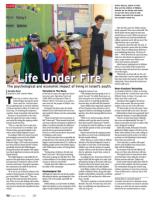

Esther Marcus, author of Code
Red, and the children of Kibbutz
Alumim (on the border with Gaza)
act out the story wrote to help
children cope with the traumas of
the constant rocket fire.
Lr
The psychological and economic impact of living in Israel's south.
Zenobia Ravji
Special to the Jewish News
T
here was an elusive calm in the
Eshkol Region during the Israel
Gaza cease-fire. And just when
life was getting back to normal, militants
of Hamas launched volleys of rockets into
Israel Aug. 19, breaking the temporary
ceasefire. Israel responded with airstrikes.
Because of its proximity to the Gaza
Strip, the region has been under continu-
ous rocket fire during the ongoing conflict
between Israel and Gaza.
"This is a cease-fire, but it is also time
for us to rest; time for us to breathe," said
Tamara Cohen, personal assistant to the
mayor of the Eshkol Regional Council.
According to Niki Levy, head of security
and emergency services for the Eshkol
Region, in the 32 days of Operation
Protective Edge, 3,350 rockets and mortars
have been aimed at Israel and 857 of them
specifically aimed at the Eshkol Region.
During this period, the people of the region
have faced significant economic and psycho-
logical turmoil.
The Eshkol Region is responsible for 60
percent of the agriculture produced in Israel
and exported to countries in Africa, North
America and Europe. During the operation,
the community was unable to harvest its
normal amount of produce.
"If we are in war, it directly influences the
market in Israel because our farmers cannot
go to their fields," Cohen said. "They can
only go if the army provides them permis-
sion. They are not only dealing with rockets
and mortars, but also are targeted by snipers.
And we have already had causalities because
of that:'
52
August 28 • 2014
JN
Terrorism Is The Norm
In the last six years, the region has faced
two prior wars: Operation Cast Lead
(2008-2009) and Operation Pillar of
Defense (2012). Terrorism is an unfortu-
nate norm for the people of Eshkol, even
between wars.
During the last three years, the Israeli
Defense Forces (IDF) found five terror tun-
nels created by Hamas near the communities
of Eshkol.
"These tunnels have just one purpose: to
kill," Cohen said. "These tunnels were built
over years with the investment of millions of
dollars. And this is basically the difference:
They invest the dollars in concrete under-
ground and our government decided to
invest in us with concrete above the ground
in building us safe rooms:'
The safe rooms have been responsible for
saving the lives of the citizens in the Eshkol
Region. Israel invested about $15.5 million in
building a high school in the Eshkol region,
with 10,000 square meters of it being bomb
shelters.
"During times of distress, the kids stay
there Levy said. "They keep on learning.
They keep on going on with their lives. This
is what enables us in the Eshkol community
to keep on with our normal life:'
Overall, about $85 million was invested in
the safety of the community.
Psychological Toll
Although the region has not faced consider-
able physical injuries, psychologically it has
taken a toll on the people, especially the
children.
Debbie Massel, a social worker in Eshkol,
helps train leaders in each community of the
region to help residents deal with the psy-
chological trauma of war.
"This situation has been going on for 14
years," she said. "So within those years, we
have been given a lot of expert training and
various tools to try and help people learn
how best they can deal with this situation:'
Some children have expressed symptoms
of Post-Traumatic Stress Disorder, such as
regressive behavior and feelings of paralysis
and fear. Also, their learning skills have been
affected.
"What we try and encourage is that the
children need to get the sense of security
from their parents:' Massel said. "Instead
of working a lot with the children, we work
a lot with the parents so they can best help
their children:'
Massel stressed that the ongoing anxiety
has effects on every level, including family
life and marital relations.
Esther Marcus, a social worker in Kibbutz
Alumim of the Sderot Regional Council, is
the author of Color Red, a book that helps
children cope with the anxiety of constant
warfare. Marcus wrote the book to help chil-
dren be optimistic, to give them a sense of
control and unity.
According to Levy, 30 percent of those liv-
ing in Eshkol left the region to be safer. And
among those living on the border with Gaza,
70 percent fled to the Israel's north. Most
who left are families with small children.
Anat Hefetz, mother of two children and a
resident of Kibbutz Nirim, along with other
families of the kibbutz, relocated to a kibbutz
in the north. She was there for a little more
than a month.
"We tried to maintain a normal routine for
the kids:' she said. "It wasn't easy. Every few
days, we readjusted our expectations as to
what was to go on:'
After the first cease-fire, Hefetz and her
family returned. Then more rockets fell. The
family didn't relocate again because they
missed home so much. Hefetz says she isn't
happy with the way Israel has handled the
military operation and is still not sure if the
right decision was to come back.
"In general, I don't feel safe she said. "A
military operation cannot solve the problem
in Gaza. They are talking about deterrence
and establishing deterrence. We know ifs
bull----. We've lived here for years and years.
And even when there's an appearance of
calm, we get rockets every week or two.
There isn't real peace and quiet:'
Adele Raemer, spokesperson for Kibbutz
Nirim, is most afraid of the tunnels from
Gaza that extend and end into the communi-
ties of the region.
"Objectively, my brain tells me I'm a lot
safer today than I was five weeks ago before
they knew about the tunnels:' she said. "But
subjectively, I know about the tunnels now
and ifs really scary:'
Near - Constant Rocketing
According to Raemer, it takes on average
of 10 seconds for a rocket from Gaza to hit
Kibbutz Nirim. In these 10 seconds, resi-
dents must find a safe room.
Sometimes she's caught in the shower
when a siren sounds. She sets up towels
nearby so she can run to her safe room.
"If I don't make it to the safe room, I have
to hope it doesn't fall on my nose," she said.
Hefetz believes Israel never genuinely tried
solving the situation in Gaza diplomatically.
"I know we tried many times militarily,
but it was not diplomatically; she said. "I
think at some point you have to realize what
you're doing isn't working:'
Earlier this month, thousands of Israelis
gathered in Rabin Square in Tel Aviv in soli-
darity with residents of the south, calling on
the government and the army to do what is
necessary to end Palestinian rocket attacks
from Gaza once and for all.
A few days later, a smaller rally urged
Israel to end hostilities and resume peace
talks with the Palestinians.
It's uncertain if all who left Eshkol will
return or if those who did return will stay.
"We [Israel] tried, we tried and we tried,
and I don't have more safety for my kids. I
feel less and less safe here Hafetz said.
Social worker Massel added that while 90
percent of the residents who had evacuated
the communities during the month-long
military operation in Gaza have returned,
"most of them have a suitcase that is still
packed:'
❑
Zenobia Ravji is a journalist based in
Jerusalem. She was born in Mombasa, Kenya,
to a Zoroastrian family and moved to suburban
Chicago as a child. She also lived in suburban
Detroit with her extended family for a year.