

metro
A Synagogue's New Identity
Isaac Agree Downtown Synagogue continues to grow with new siddurim.
Michael Higer
even those who do not still provide their
input.
"What's so wonderful about working
with Joe and also this community is this
level of customization that we can bring
into the process," Kohn said. "It's not just
about the features that were requested;
it's also about this feeling of collabora-
tive authorship. We asked our commu-
nity to send in some of their favorite
readings, and as a team we started vet-
ting them and saying, 'Well this one fits
and this one may not: We've been really
patient listeners to our community:'
JN Intern
W
alking down Griswold Street
in Downtown Detroit, you
are bound to see an end-
less array of history and future. There's
the Guardian Building, known as the
"Cathedral of Finance"; the Penobscot
Building, once the largest skyscraper in
the country outside of New York and
Chicago; and the Chrysler House, which
Dan Gilbert has developed into an inno-
vative Quicken Loans hub. On the corner
of Griswold and Clifford Street stands a
building with a storied past and limit-
less future. Its urban exterior is lined
with beautiful and colorful stained-
glass windows. The interior contains a
congregation, a family that continues
to thrive as Detroit's lone free-standing
synagogue — the Isaac Agree Downtown
Synagogue.
In recent years, the Downtown
Synagogue has established itself
as a thriving Jewish community in
Downtown Detroit — membership
growth and building projects have
helped to attribute to these develop-
ments. The latest addition to the
synagogue is set to help it individualize,
giving it its own identity — its own sid-
durim.
"Several years ago,
the Ritual Committee
agreed the synagogue
was in need of a new
siddur. We had hand-
me-downs from other
congregations that we
had been using for sev-
eral years," explained
Martin
Martin Herman, imme-
Herman
diate past president and
ritual director at the synagogue.
"A subcommittee of the Ritual
Committee was created, and we dis-
cussed the specifications we wanted. It
had to have the complete Hebrew text
of the traditional liturgy; it had to have
the complete English translation and
the complete transliteration as well,"
Herman said.
Other specifications for the siddur
included it being egalitarian (includ-
ing the matriarchs and patriarchs) and
a small introduction explaining each
portion of the liturgy. After looking at
several examples, the committee eventu-
ally decided on a siddur designed by Joe
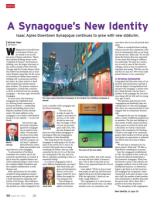
The Isaac Agree Downtown Synagogue is the longest free-standing synagogue in
Detroit.
Lewis, a member of the synagogue and
the Ritual Committee.
"The aim is just
to make it easier for
people to participate in
services, so if I could
do that in some way
then I'm happy. I think
I've met my personal
goal;' said Lewis, who
Joe Lewis
has also designed sid-
durim for Adat Shalom Synagogue in
Farmington Hills and Congregation
B'nai Moshe in West Bloomfield.
"But doing this for the Downtown
Synagogue is really going to be the pin-
nacle of my activity. It's so nice to be
involved with people who are doing
something for Detroit, who are really
committed to the city. It's as if the Jews
are coming back to the city, and to be
able to contribute something to that is a
wonderful feeling:'
As a diverse congregation with so
many different backgrounds, one aspect
that Anna Kohn, pro-
gram and development
director at the syna-
gogue, looked for was a
siddur that taught les-
sons along the way.
"One of things so
wonderful about Joe's
Anna Kohn
siddur is the instruc-
n 1- 7 11'717
T
Siddur for Shabbat
The cover of the new siddur
tional value it offers. One of the reasons
we went with Joe's siddur is because it
says, 'This is why we say what we say:
That's a very important feature for a lot of
newcomers:'
Lewis added, "I'd like to have a book
that people can pick up and find mean-
ingful without any Jewish background.
With the right book, I think you can
make a huge difference:'
The congregation is so close because
each and every member has a say. Many
members serve on committees, and
A Growing Community
Congregants feel that same sense of con-
nectivity and inclusiveness, and that is
what has helped to bring families back
and grow the synagogue. A prime exam-
ple is Noah Resnick, who has been a
member of the synagogue for two years
now, along with his wife and two young
sons, ages 3 and 6.
"The openness and diversity of the
congregation and leadership [kept me
coming back]. It is the only synagogue
that I have ever experienced that is truly
engaged with its community," Resnick
said.
Throughout the year, the synagogue
offers a variety of different programs for
its members. The first two Mondays of
each month, it holds a lunch and learn,
where guests are invited for lunch and
a discussion on various social action
topics in the community. On Tuesdays,
it holds a work night at its community
garden, Eden Gardens in Detroit, giving
participants an opportunity to volunteer
and deliver their own dose of tikkun
olam.
"We also have a reputation for our
dance parties," Kohn said. "We like to
think there's something for everyone:'
Since the synagogue's establishment
in 1921, the number of Jews in the city
has directly affected membership at
the Downtown Synagogue. When Jews
left Detroit to move to the suburbs, the
synagogue suffered a loss in both mem-
bership and resources. As Detroit has
begun to get back on its feet, however,
the synagogue has recognized a major
turnaround. In the span of about a year
and a half, the number of paid member
units (individuals or families that paid)
has grown from 186 to about 300, a
growth of more than 40 percent.
"The atmosphere of the congregation
New Identity on page 24
22
August 28 • 2014