
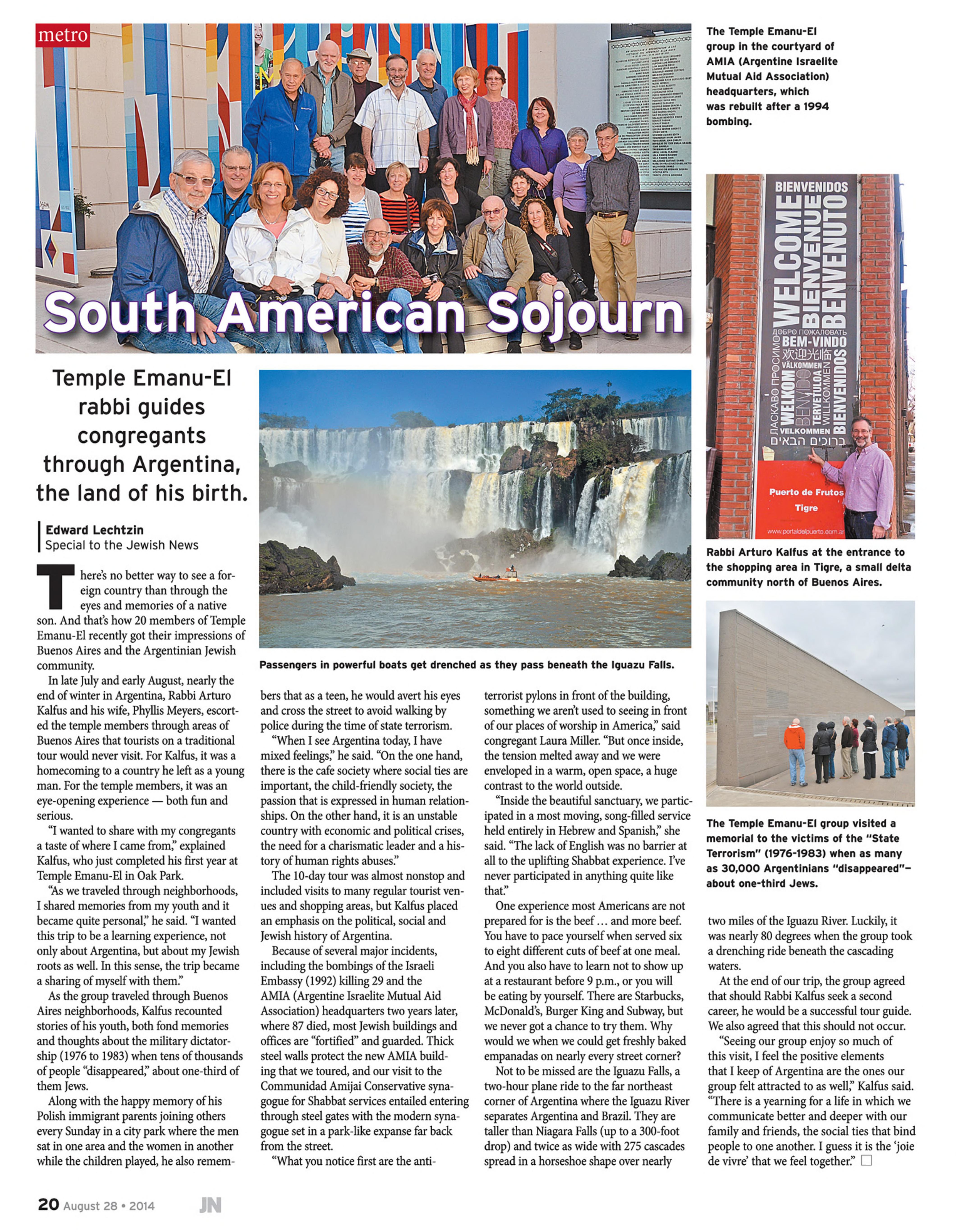
The Temple Emanu-El
group in the courtyard of
AMIA (Argentine Israelite
Mutual Aid Association)
headquarters, which
was rebuilt after a 1994
bombing.
BIENVENIDOS
LLI W O
Z
= ."
6
ILI I=
1.1.1
UJ
Z
lad
BEM-VINDO
VALKOMMENZ CI
0 -
E
rn
Temple Emanu-El
rabbi guides
congregants
through Argentina,
the land of his birth.
_.0.1t-
<
8
'
k id ‘-.1n wrc' -21
VELKOMMEN
Puerto de Frutos •
Tigre
Rabbi Arturo Kalfus at the entrance to
the shopping area in Tigre, a small delta
community north of Buenos Aires.
T
20 August 28 • 2014
ie0
Iowan Dorn
Edward Lechtzin
Special to the Jewish News
here's no better way to see a for-
eign country than through the
eyes and memories of a native
son. And that's how 20 members of Temple
Emanu-El recently got their impressions of
Buenos Aires and the Argentinian Jewish
community.
In late July and early August, nearly the
end of winter in Argentina, Rabbi Arturo
Kalfus and his wife, Phyllis Meyers, escort-
ed the temple members through areas of
Buenos Aires that tourists on a traditional
tour would never visit. For Kalfus, it was a
homecoming to a country he left as a young
man. For the temple members, it was an
eye-opening experience — both fun and
serious.
"I wanted to share with my congregants
a taste of where I came from," explained
Kalfus, who just completed his first year at
Temple Emanu-El in Oak Park.
As we traveled through neighborhoods,
I shared memories from my youth and it
became quite personal," he said. "I wanted
this trip to be a learning experience, not
only about Argentina, but about my Jewish
roots as well. In this sense, the trip became
a sharing of myself with them:'
As the group traveled through Buenos
Aires neighborhoods, Kalfus recounted
stories of his youth, both fond memories
and thoughts about the military dictator-
ship (1976 to 1983) when tens of thousands
of people "disappeared," about one-third of
them Jews.
Along with the happy memory of his
Polish immigrant parents joining others
every Sunday in a city park where the men
sat in one area and the women in another
while the children played, he also remem-
w CI
-. 2 z
Passengers in powerful boats get drenched as they pass beneath the Iguazu Falls.
bers that as a teen, he would avert his eyes
and cross the street to avoid walking by
police during the time of state terrorism.
"When I see Argentina today, I have
mixed feelings," he said. "On the one hand,
there is the cafe society where social ties are
important, the child-friendly society, the
passion that is expressed in human relation-
ships. On the other hand, it is an unstable
country with economic and political crises,
the need for a charismatic leader and a his-
tory of human rights abuses:'
The 10-day tour was almost nonstop and
included visits to many regular tourist ven-
ues and shopping areas, but Kalfus placed
an emphasis on the political, social and
Jewish history of Argentina.
Because of several major incidents,
including the bombings of the Israeli
Embassy (1992) killing 29 and the
AMIA (Argentine Israelite Mutual Aid
Association) headquarters two years later,
where 87 died, most Jewish buildings and
offices are "fortified" and guarded. Thick
steel walls protect the new AMIA build-
ing that we toured, and our visit to the
Communidad Amijai Conservative syna-
gogue for Shabbat services entailed entering
through steel gates with the modern syna-
gogue set in a park-like expanse far back
from the street.
"What you notice first are the anti-
terrorist pylons in front of the building,
something we aren't used to seeing in front
of our places of worship in America," said
congregant Laura Miller. "But once inside,
the tension melted away and we were
enveloped in a warm, open space, a huge
contrast to the world outside.
"Inside the beautiful sanctuary, we partic-
ipated in a most moving, song-filled service
held entirely in Hebrew and Spanish," she
said. "The lack of English was no barrier at
all to the uplifting Shabbat experience. I've
never participated in anything quite like
that:'
One experience most Americans are not
prepared for is the beef ... and more beef.
You have to pace yourself when served six
to eight different cuts of beef at one meal.
And you also have to learn not to show up
at a restaurant before 9 p.m., or you will
be eating by yourself. There are Starbucks,
McDonald's, Burger King and Subway, but
we never got a chance to try them. Why
would we when we could get freshly baked
empanadas on nearly every street corner?
Not to be missed are the Iguazu Falls, a
two-hour plane ride to the far northeast
corner of Argentina where the Iguazu River
separates Argentina and Brazil. They are
taller than Niagara Falls (up to a 300-foot
drop) and twice as wide with 275 cascades
spread in a horseshoe shape over nearly
ati
41.
" • ,,,
, „ ,,,
The Temple Emanu-El group visited a
memorial to the victims of the "State
Terrorism" (1976-1983) when as many
as 30,000 Argentinians "disappeared"—
about one-third Jews.
two miles of the Iguazu River. Luckily, it
was nearly 80 degrees when the group took
a drenching ride beneath the cascading
waters.
At the end of our trip, the group agreed
that should Rabbi Kalfus seek a second
career, he would be a successful tour guide.
We also agreed that this should not occur.
"Seeing our group enjoy so much of
this visit, I feel the positive elements
that I keep of Argentina are the ones our
group felt attracted to as well," Kalfus said.
"There is a yearning for a life in which we
communicate better and deeper with our
family and friends, the social ties that bind
people to one another. I guess it is the 'joie
de vivre' that we feel together:'
❑