

arts & entertainment
A Problem That
Won't Go Away
Jeffrey F. Barken
I JNS.org
What is involved here is the differ
B
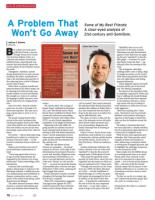
en Cohen's new book, Some
of My Best Friends: A Journey
Through Twenty-First Century
Anti-Semitism (Edition Critic), is a
collection and analysis of previously
published essays, reporting and com-
mentary that meticulously capture the
current climate of anti-Semitism around
the world.
Throughout a turbulent, modern
decade dominated by war and economic
instability, the author consistently pro-
vides a fair and balanced perspective of
the coalescing forces critical of Judaism
and the State of Israel.
Where there is unjustly founded and
abhorrent hatred, the subject matter can
be alarming, but Cohen provides clear-
headed analysis of events and attitudes.
His strength as a writer is to confront
the language of public discourse, track-
ing the trajectories of creeping intoler-
ance.
Amos Oz writes: "Israel is a dream-
come-true. As such, it is bound to be
flawed and imperfect. The only way to
keep a dream intact is never to try to
fulfill it?'
The award-winning Israeli author
arrived at this witty conclusion after
traveling throughout Israel in the 1980s,
a time when Israelis were still amazed by
their own military success and yet were
increasingly uneasy about their collective
future.
Oz's notion — that an ideal stops being
beautiful and is subject to criticism the
moment it becomes reality — in this
reviewer's estimation frames Cohen's col-
lection.
Modern anti-Semitism does tend to
reveal itself amid condemnations of
Israel.
"I have long argued that we live in
an age of Jewish empowerment, dis-
tinguished by the existence of a strong
Jewish state:' Cohen acknowledges in his
introduction.
Conscious that resentful propa-
ganda is taking shape in response to the
Palestinian situation, a stalled peace pro-
cess, disillusionment and assimilation in
diaspora communities, and as a conse-
quence of the violent Arab Spring, Cohen
deconstructs the dialogue.
The author uncovers instances where
Zionism is confused with Judaism and
where anti-Semitism lurks beneath the
70
July 24 • 2014
ence between what call 'bier
keller" and "bistro" anbsemiOsm.
The crude, violent antiseminsm In-
cubated in the German bierkellers
where the NaziS guzzled beer and
shouted themselves hoarse was a
hallmark of the twentieth century.
Polite, modulated, ostensibly rea-
sonable antisemitIsm, often calling
itself "anti-Zionism," and ex-
pressed in the progressive chatter
across the tables of fashionable
bistros, is a hallmark of the twen-
ty-first
Ben Cohen
"In a political milieu in which lies
are routinely deployed in defence
of indefensible positions, Cohen is
unusual in his restraint. He is both
a stalwart defender of Israel's es-
sential interests and an engaging
commentator on the Middle East
scene. He can be read with profit
by both friends and enemies of
the various parties in that region."
BEN COHEN
Some of My Best Friends:
A clear-eyed analysis of
21st-century anti-Semitism.
Author Ben Cohen
SOME OF
MY BEST
FRI
A Journey
Through
Twenty—First
Century
ntisemitism
Foreword by
Anthony Julius
Anthony Julius, author of Trials of
the Diaspora
Edition Critic
Sophle-Charlotten-Sitr. 9-10
14059 Berlin
http://www.EditionCritic.de
surface.
The articles titled "The Courage of
Ronnie Fraser:' published in November
2012, and "How British Justice Failed
Ronnie Fraser:' published in March 2013,
recount the controversy surrounding
England's University and College Union
(UCU), an anti-Zionist organization
sympathetic to the plight of Palestinians.
Beginning in the early 2000s, the
group pursued an academic boycott of
Israel, isolating Israeli professors and
refusing to deal with Israeli institutions.
Fraser, a Jewish mathematics lecturer
whose parents escaped Nazi Germany,
spoke up about the discrimination he
felt, causing a stir.
"When the core themes of anti-
Zionism are unmasked — the denial,
uniquely to the Jews, of the right of self-
determination; the portrayal of Israel as
a racist and, therefore, illegitimate state;
the presentation of Palestinians as vic-
tims of a second Holocaust; and the use
of the term "Zionist" as code word for
"Jew" — we move far beyond the domain
of permissible policy criticism into open
defamation," Cohen writes, analyzing the
legal struggle that ensued.
Indeed, insensitive remarks circulated
throughout the hearings that stemmed
from Fraser's complaint.
When UCU commentators suggested,
"Any legal action [against the UCU]
would be financed by those with bank
balances from Lehman Brothers that
can't be tracked," their speech indicated
the ridiculous belief shared among their
members that millions of dollars had, in
fact, been transferred from the bank to
Israel in the days prior to its failure dur-
ing the 2008 financial crisis.
The claim, of course, is false, but the
tone of the statement revives old myths
about Jewish wealth and money prac-
tices, perpetuating a dangerous anti-
Semitic stereotype that is shocking in
modern times.
Cohen is correct. Poorly chosen terms
and phrases, used recklessly in a context
of constructive criticism, quickly devolve
into hurtful rhetoric. In the words of
Jean-Paul Sartre, "Words are loaded pis-
tols?'
Another problematic definition that
Cohen confronts is the use of the word
"apartheid" to describe the perceived
unequal status of Palestinians in Israel.
"What made the apartheid system
peculiar [in South Africa, where the term
originates] was the manner in which rac-
ism was enshrined in law," Cohen writes.
"Through such measures as the Group
Areas Act (1950), the Bantu Education
Act (1953) ... and the Prohibition of
Mixed Marriages Act (1954), the apart-
heid regime micromanaged the lives of
its subjects on the basis of their skin
color. ... If apartheid is understood as
the rule of racist law, any comparison
with Israel — or any other country —
needs to begin at the point of the law."
Thankfully, there are no such
racist laws on the books in Israel.
Palestinians may feel discriminated
against in their daily lives, but apply-
ing the term "apartheid" to describe
their plight — as former U.S. presi-
dent Jimmy Carter has done — sig-
nificantly alters the meaning of that
word.
This is linguistic subterfuge,
enabling Israel's critics to hang a high-
ly charged accusation on the country
while distracting attention from their
own civil rights abuses and fueling
perpetual animosity.
Cohen diligently explores the battle
of words and the rise of anti-Israel
and "Jew-baiting" propaganda.
His reports on the incendiary flotil-
la campaigns organized by Turkey and
Iran to challenge the Israeli blockade
of Gaza indicate that forces opposed
to the existence of Israel as a sover-
eign nation will stop at nothing to
create situations in which Jews are seen
as the aggressors.
"More than anything else," Cohen
notes, "[protesters] want to put Israel's
defenders in the position of having to
open fire so that images of Zionist bru-
tality can then be broadcast around the
world."
The author is frustrated that Israel
has been subjected to a double standard,
forced to demonstrate rigid adherence to
a moral code its neighbors mock.
While fervent, some arguments grow
redundant. But Cohen provides sound
examples of where anti-Semitism is
either influencing a contentious debate
or evolving out of charged discourse, and
he highlights the challenges facing mod-
ern Jews around the world.
Many people view the fulfilled dream
of a sovereign Jewish state as an utterly
flawed entity. Their criticism is toler-
ated, if not welcomed by a democratic
people — Jews in Israel and the diaspora
alike — but Some of My Best Friends
reminds readers that the specter of anti-
Semitism still haunts us in a modern era
of intolerance and toxic rhetoric, laced
with hatred.
The best we can do is to remain vigi-
lant. Cohen's book provides quality anal-
ysis, and it is a worthy source.
❑
Full disclosure: Ben Cohen is a columnist
for JNS.org.