

arts & entertainment
Shooting The 'Promise'
Of 'This Place'
Photographer Frederic
Brenner's massive Israel
project seeks to see
beyond the conflict.
of land, the place where three major narratives have been
in conflict." He adds, "I look at it as the theater of the
world!'
In a series of conversations, Brenner explains the
themes that drive his work and his love of Israel, easily
shifting between art and philosophy.
"Everything starts with the idea that there's a promise
attached to the land, for all people, for all three narratives:'
Sandee Brawarsky
he says, referring to those of the Jewish, Christian and
Special to the Jewish News
Muslim faiths. "What have we done with this promise?"
He alludes to longing, otherness, belonging and exclu-
hen photographer Frederic Brenner decided
sion; tenderness and violence; redemption and intimacy;
to invite a group of the finest photographers
and shadows and fault lines in the promise. For him,
in the world to spend time in Israel and the
Israel is a place of wrestling and embrace.
West Bank to create their own portraits of the place,
Brenner, 55, grew up in a secular Jewish home in Paris;
some were intrigued and others were wary of being used
his grandparents came from Algeria on his mother's side,
for political gain — or were just not interested enough.
and Russia and Romania on his father's. The Six-Day War
But Brenner, a man of huge enthusiasm,
aroused his parents' interest in Judaism
persistence and vision, ultimately con-
and Israel, and Brenner finished his stud-
vinced 11 men and women to take up his
ies in a Jewish school before going on to
invitation to see a land more complicated
study social anthropology and French
than headlines suggest.
literature at the Sorbonne. His camera
At the same time, he convinced funders
became a tool of his studies.
to contribute several millions of dollars.
In 1978, he traveled to Israel for the first
The result is an unprecedented interna-
time. Mea Shearim left him speechless,
tional creative initiative, which launched
and he kept returning. He photographed
this spring.
the neighborhood, its rabbis and residents,
"These are seers who ask difficult ques-
and later published his first book.
1
tions:' Brenner says of the photographers,
But it was the diaspora that really drew
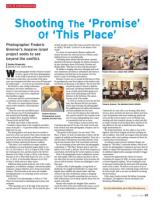
Frederic Brenner:
who include Josef Koudelka, Jungjin
him, and he traveled to 40 countries in the
Photographing Israel's
Lee, Stephen Shore, Rosalind Solomon,
next 25 years, photographing Jews, many
shadows and fault lines.
Thomas Struth and Jeff Wall.
in communities that are no more.
He didn't expect them to find answers.
"I was trying to reclaim a history that
"I wanted to expose them to the complexity and disso-
I had been deprived or he says. The result was his epic
nance of the place — to get them totally confused on a
book of black-and-white photographs, Diaspora, also an
high level:' he says.
international exhibition.
The photographers each spent about six months in
"The genesis of this project:' he says about "This
Israel over a four-year period. Their styles, formats and
Place is those "25 years of exploration of what I call the
areas of interests varied greatly, and Brenner suggests
complex of multiple and dissonant identities:' Now, he's a
that their art looks far beyond political perspectives.
self-described "embodiment of portable identity:' divid-
Rather, it's about exploring the human condition.
ing his time between New York, Amsterdam and Israel.
"This Place to be introduced in stages, includes
For An Archeology of Fear and Desire, his photographic
an exhibition of several hundred images slated to run
contribution to "This Place Brenner shot in color. His
Oct. 24, 2014-March 2, 2015, in Prague at DOX: Centre
palette, in his words, is delicate. For all of his eloquence in
for Contemporary Art, and then travel to the Tel Aviv
conversation, the book has few words. Captions are spare.
Museum of Art (May 14-Sept. 6, 2015), to the Norton
Most of the photographs involve collaborative encoun-
Museum of Art in West Palm Beach, Fla. (Oct. 15, 2015-
ters with people. Often, his subjects lead him to tell sto-
Jan. 15, 2016), to the Brooklyn Museum of Art (Feb.
ries other than the ones he intended. In his portraits, the
12-June 5, 2016) and on to other venues.
eyes are full of emotion. Viewers are challenged to meet
Additional plans include books by each of the 12 pho-
their gaze.
tographers, an exhibition catalogue, international public
In Judean Hills, he photographs a young family of
programs, campus initiatives and a strong social media
shepherds, the straggly-bearded father in a large white
presence. The first books in the series are available,
kippah, three children, the seated mother with hair
including Brenner's An Archeology of Fear and Desire
covered in the style of Orthodox women, a sheepdog
(MACK, 2014).
at her feet. Their beautiful, unsmiling faces are inscru-
In Brenner's own photography, as well as in "This
table. Behind them, lots of sheep separate them from the
ancient rocky hills.
Place he's interested in examining Israel as place and
metaphor.
Brenner also includes his daughter Elior, seated in
"What fascinates me is at the edge of the particular
woods the color of the army uniform she wears; a couch
and the universal:' Brenner says. "It's not just this piece
full of women kibbutzniks; a portrait labeled Identity
W
Frederic Brenner: Judean Hills (2009).
Frederic Brenner: The Weinfeld Family (2009).
Undisclosed of a man with a scar forming a line down
his face, above and below his dark eye; Shlomi and Oren,
a pair of handsome male lovers embracing amidst tall
cacti; and Ben Gurion Airport, a trio of Chasidic men
standing with their wheeled suitcases in what looks like
an empty terminal. Each has black fabric attached to his
hat pulled over his eyes to shield him from things he
might inadvertently see.
The book's final photo, Tel Aviv, offers a view of the
highway with all cars stopped and drivers standing out-
side in stillness. Time itself was stopped when this photo
was taken, with a siren marking a moment of silence for
a national day of remembrance.
According to project director Matthew Brogan, the
budget for "This Place" is about $6 million, with $4 mil-
lion for the photographers' residencies and more than $2
million to support the dissemination of the project, with
its ambitious digital media campaign intended to trigger
conversations.
Brenner first approached the Charles H. Revson
Foundation for support in 2008. As senior program offi-
cer Nessa Rapoport explains, "We are looking for ways
to showcase Israel beyond the black-and-white shouting
match of the conflict. We believe in the power of art to
change consciousness. These enduring images will always
be in the world. And so we were not afraid to be among
the first funders:'
Other major funders include the Nathan Cummings
Foundation, The Righteous Person Foundation and
Bloomberg Philanthropies.
❑
For more information, go to http://this-place.org .
July 24 • 2014
67