

arts & entertainment
Music In His Genes
Conductor Michael Stern brings a sense of history to the concert
celebrating the 50th anniversary of the Meadow Brook Music Festival.
Suzanne Chessler
I Contributing Writer
M
0
"Our program N
*.
,....01
ichael Stern grew up immersed
in instrumental music as the
son of famed violinist Isaac
Stern. But he majored in American his-
tory at Harvard before deciding that con-
ducting was the field for him.
Although Stern has worked with the
Detroit Symphony Orchestra, he has
not appeared at Meadow Brook, which
opened as the DSO's summer home in
1964.
To mark the 50-year milestone, Stern
will conduct a program planned for
Thursday evening, July 24. It will feature
the DSO performing Stravinsky's Firebird
Suite, Glinka's Overture to Ruslan and
Ludmila and Kodaly's Dances of Galanta.
Superstar violinist Joshua Bell, who
has a sense of area history thanks to
his mom, who grew up in Detroit with
the maiden name Shirley Levine, will
play Ravel's Tzigane and Bruch's Violin
Concerto No. 1.
"Our program will be incredibly color-
"The IRIS Orchestra is a coalition of
ful with a theatrical bent:' Stern says in a
musicians from all over the country, and
phone conversation from New York. "My
we reconstitute each time we meet for
friend Joshua Bell always makes an event
concerts:' Stern says. "It's an experiment
special. We have worked together many
in musical democracy [with acclaimed
times and known each other for about 30
musicians and those who are emerging].
years.
There is no hierarchy:'
"I like all the connections
Stern easily recalls his aca-
and look forward to hav-
demic priorities.
ing a wonderful summer
"I didn't go to university
evening:' says Stern, in
thinking I was necessarily
his ninth season as music
going to be a musician:' he
director of the Kansas City
says. "I started taking courses
Symphony in Missouri. "An
that interested me. My major
outdoor concert is a differ-
chose itself.
ent experience than one in
"I wrote my thesis on
a concert hall, and there's
American music and how it
a lot to be said for that
was affected by the New Deal
relaxed, less formal setup:'
in the 1930s. It was interest-
Over recent seasons in
ing to see how a world that
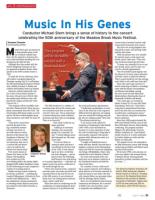
Conductor Mi chael
Kansas City, Stern and the
was truly changing — and an
Stern
Kansas City Symphony
America that was redefining
have worked out of the
itself between wars and during
new Helzberg Hall in the Moshe Safdie-
an economic depression — could have an
designed $400-million Kauffman Center
impact on the arts and be a reflection of
for the Performing Arts and completed a
the world through the arts.
number of recording projects.
"There were musical events, composers
Besides serving as guest conductor
and ways music was made, perceived and
for diverse orchestras — including the
consumed that set the tone for the rest
London Philharmonic, Orchestre de Paris of the 20th century. It was a historical
and the Israel Philharmonic — Stern
thesis, but I was writing about American
music, which I really love:'
has maintained a strong commitment
as founding artistic director and princi-
What drew Stern to conducting was the
pal conductor of the IRIS Orchestra in
combination of understanding the devel-
Tennessee.
opment of pieces to be performed with
will be incredibly
colorful with a
theatrical bent."
the actual performance opportunities.
"Conducting is performance in every
sense of the word, but it also requires a
different kind of approach, not making
your own sounds but working with peo-
ple who are making sounds:' Stern says.
"The alchemy attracted me.
"I ran across a book called The
Grammar of Conducting by Max Rudolf
(1902-1995), and it fascinated me
because it is a clear exposition of what
the craft of conducting is: being able to
elicit specific responses with specific
gestures while delving into music in a
fundamental way.
"I sought out Rudolf and went to
study with him. Rudolf, who had been a
longtime conductor at the Metropolitan
Opera and with the Cincinnati Symphony,
was living in Philadelphia, where I also
attended the Curtis Institute of Music:'
Set on his musical path, Stern was
hired early on as assistant conductor at
the Cleveland Orchestra and built his
career from there.
For a number of years, while travel-
ing as a guest conductor and working as
music director of a German orchestra, he
made his home in Ann Arbor. His then-
wife, Jeanette Bittar, was principal oboist
with the Michigan Opera Theatre.
Stern, 54, now divides his time between
Connecticut and Missouri. He is married
to Shelly Cryer, who has built a career
in nonprofits and established a free
concert series, Curiosity Concerts, with
Connecticut's Greenwich Arts Council.
They have two young daughters also
interested in music, one favoring violin
and the other piano.
"Both my parents were civic-minded
for musical causes, social causes and
Jewish causes:' Stern says. "They were
very involved in Israel and met there.
"It comes very naturally for me to sup-
port Jewish causes, and I've done con-
certs for [Jewish organizations].
"One of my father's great legacies was
his advocacy for music, music education
and other causes in which he believed.
That is a good model for our day and age,
and I think we all could learn from that:'
Those who want to get a preview of
Stern's conducting can listen to recordings
made with the Kansas City Symphony
on Reference Recordings. Among
the most recent has been Miraculous
Metamorphoses, featuring the music of
Hindemith, Prokofiev and Bartok.
"Two weeks ago, we recorded an
album of music by [33-year-old] Adam
Schoenberg," Stern says. "It has three
works that I commissioned from him,
and it's the first time our orchestra has
recorded more contemporary music:'
Stern will join a long line of Meadow
Brook conductors.
More than 5,000 people attended the
DSO's first Meadow Brook concert with
then-DSO Music Director Sixten Ehrling
conducting. The program included
Wagner's Die Meistersinger Overture,
Sibelius' Symphony No. 2 and Brahms'
Double Concerto in A minor performed
by Gordon Staples on violin and Ialo
Babini on violoncello.
The original concert was repeated for
the 20th anniversary season with Ehrling
conducting and Staples and Babini repris-
ing their performances.
By the early 1970s, rock and pop con-
certs were added to the summer lineup
at Meadow Brook, which gradually
expanded to include comedians and fam-
ily events.
❑
The Detroit Symphony Orchestra will
hold its 50th anniversary Meadow
Brook concert at 7:30 p.m. Thursday,
July 24, at the Meadow Brook Music
Festival on the grounds of Oakland
University in Rochester. Tickets start
at $15 for lawn seats and $25 for
the pavilion. (313) 576-5111; dso.org .
July 17 • 2014
51