

>> ... Next Generation ...
Animal Enthusiast
Michelle Rosen's dream of working with animals
brings her to the Department of Natural Resources.
MICHAEL HIGER I IN INTERN
G
rowing up, Michelle Rosen
always knew that she wanted
to work with animals.
"I always wanted to be
a veterinarian," Rosen said. "Growing
up, for school projects I would always
interview veterinarians and said I'd really
like to do what they're doing."
In pursuit of her dream to become a
veterinarian at Michigan State University,
she discovered the Fisheries and Wildlife
Department.
"The university recommends a few
different majors for pre-vet students, and
fisheries and wildlife was one of them; so
I spoke with the adviser for fisheries and
wildlife and he was really great, really
informative and enthusiastic about the
field, so I said, 'Sure why not; I'm just
doing this to fulfill the requirements for
pre-vet," she said.
Rosen soon discovered that this unique
opportunity was the best option to help
her achieve her goals.
"As I got further along in my course
work and major, I realized this was
another way that I could be outside, still
have an impact on the environment and
still have that interaction with wildlife,
just in another way and another venue,"
she said.
Rosen spent some time working
with a Ph.D. student, now Dr. Sarah
Hamer, an assistant veterinary professor
at Texas A&M University. As part of
Hamer's project studying Lyme disease
in Michigan, Rosen worked on capturing
small wildlife including mice, opossums
and raccoons to anesthetize them, look
for ticks and take blood samples. She
also spoke with the local public about
the project and why it is important to
understand the environment.
"It gave me a well-rounded experience
of working in the wildlife field, and I think
with her [Hamer] and her mentors I really
got excited about work in disease ecology
and wanted to continue moving in that
route."
After graduating from Michigan State
in the winter of 2006, Rosen went on to
earn her master's degree in wildlife and
fisheries sciences from the University of
Tennessee.
After six months of working at the
44 July 17 • 2014
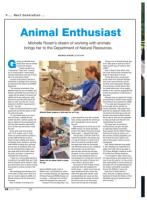
Michelle Rosen prepares a bald eagle for an X-ray.
Rosen cuts an animal tooth to study
its age.
National Wildlife Health Center in
Madison, Wis., she transferred to where
she is currently employed, the Department
of Natural Resources Wildlife Disease Lab
in Lansing — right down the road from
where she discovered her career path.
"I enjoyed it from the beginning. It was
a great experience to be able to handle
those animals, especially the animals you
don't normally get to see so close up,"
she said.
Now working for her fourth year at the
Wildlife Disease Lab, Rosen specializes
mainly in the aging of furbearers through
tooth analysis — primarily black bears.
"We get about 2,000 bear teeth from
hunter-harvested bears. My primary duty
is to age all of those, so I spend a lot of
time in the tooth lab cutting the teeth
and aging them under the microscope.
That information gets put into a database
where hunters can see their bear's
age and other animals they may have
harvested. It's also used for population
models to help understand where our
bear population is moving, like if we need
to increase the number of licenses that
are out there or decrease them."
The process of tooth analysis includes
cutting the teeth and visualizing the
tooth's annuli — similar to how trees are
aged. Besides black bears, Rosen also
works with aging other animals' teeth,
including bobcat, elk, moose and deer.
She explains that the variety of animals
that she has seen is one of the many
factors that has kept her in Michigan.
"We get a lot of [animal] diversity here
so it's really great to work here. Not all
states have this type of facility for their
wildlife."
Some of Rosen's other duties at the
lab include testing hunter-harvested deer
heads for tuberculosis in the fall.
"During deer season, we get loads
of deer heads from northeast Michigan
that come in every other day, and we
test them all for tuberculosis. Michigan
is the only place in North America that
has bovine tuberculosis in free-ranging
animals, in this case free-ranging deer. We
monitor the prevalence of tuberculosis in
those deer."
Although many are against the hunting
and harvesting of animals, Rosen explains
that hunting is very important for wildlife.
"It's a really good management tool,
and we make sure the animals are
hunted sustainably. I help support that
goal with our population models, which
are based on the tooth ages, sexes and
locations from these harvested animals.
We are able to track how the population
is doing and make sure that we're not
overharvesting the animals."
The money spent on purchasing
hunting licenses and guns also goes
to supporting habitat conservation.
Rosen explains that the federal Pittman-
Robertson Act levies an excise tax on
the purchase of hunting equipment, and
the revenue from that is given to the
state to help support natural resources
management.
Since Pittman-Robertson was started
in 1937, Michigan has received $303.5
million, the fourth-most of any state. In
2014 alone, Michigan is slated to receive
$25 million from Pittman-Robertson.
"A lot of people in Metro Detroit may
not enjoy hunting as other people do and
may not see the need for it or have a hard
time understanding it, but the hunters are
the people who are actually helping fund
the research and habitat conservation
that we [the DNR] do," Rosen said.
Rosen lives in Howell with her
fiance. They plan on getting married in
September at Temple Shir Shalom in West
Bloomfield, where she attends services
with her family.
❑