

arts & entertainment
Made In Michigan
Detroit-bred filmmakers use famed institution
as backdrop for new film.
Suzanne Chessler
I Contributing Writer
he Wayne County medical com-
plex known as Eloise closed
before Sanford Nelson and David
Weintraub were born, but their recent
awareness of its history touched off an
idea for a fictional feature film.
Nelson and Weintraub, working on the
production side, are in the editing stages
of Eloise, set in current times and follow-
ing four friends who break into a closed
institution in hopes of finding a death
certificate.
The friends, who believe the document
will provide one of them with the right to
claim a sizable inheritance, discover that
the institution holds a horrifying history
along with the truth about their own tragic
pasts.
Starring in the film, made in Michigan,
are Chace Crawford (Gossip Girl), Eliza
Dushku (True Lies), Brandon T. Jackson
(Tropic Thunder) and P.J. Byrne (The Wolf
of Wall Street).
"This is not a horror film:' says Nelson,
25, in his first major production project
since gaining film experience working
with dad Linden Nelson, CEO of Michigan
Motion Picture Studios in Pontiac.
"It's a thriller — suspenseful, smart,
T
elevated, dramatic and scary. The themes
have to do with family and mental illness."
Sanford Nelson, who has handled
stage managing and marketing responsi-
bilities for other projects, envisioned plot
opportunities after learning about Eloise
from a friend and doing research online
and through people connected to facility
operations.
"I found it very fascinating that Eloise
had a 150-year history, 1832-1982:' Nelson
explains about the complex that at vari-
ous times housed the poor, tuberculosis
patients and the mentally ill in addition to
offering general treatment services.
"It came to be one of the largest places
of its kind consisting of [dozens] of build-
ings and [hundreds] of acres of land. It
was its own city."
Nelson learned that a relative had com-
pleted a medical residency at Eloise and so
had another information resource. He also
talked with the relative's fellow residents
and representatives of Wayne County his-
torical societies.
"I looked at Eloise as a perfect backdrop
for a dramatic thriller, and I went to Los
Angeles to find a screenwriter who had
experience in that genre Nelson explains.
"I chose Chris Borrelli and flew him to
Michigan to look at what remains of the
Eloise location:"
Together, the two came up with a nar-
rative and worked on the screenplay for
eight months, finishing in April 2013.
Robert Legato, a two-time Academy Award
winner for visual effects, was selected as
director.
To advance the production process,
Tripp Vinson and his company, Vinson
Films, agreed to be part of the business
team.
The Michigan Film Office approved
Eloise for a financial incentive from the
state. The project was slated to receive up
to $1,950,000 on projected in-state expen-
ditures of up to $7,217,980 and employ-
ment of 117 Michigan workers.
Administrative offices — and consider-
able filming — have been based at the
Masonic Temple in Detroit.
"It has been great working in Michigan:'
Nelson says. "Of our entire cast and crew,
more than 80 percent were from Michigan.
It was great for me to hire Michigan
people and spend money on Michigan
businesses.
"The Masonic Temple has tremendous
production value. The space and looks
were huge benefits. It has large rooms to
film full-blown sets, like a long hospital
hallway. It was built in the 1920s and had
similar characteristics to Eloise:'
A special value had to do with being
_s of
MICHIGAN ROUSE 4. 4
-rimy
"I'm looking to use this
film as a platform to do
something large in raising
awareness of mental
illness on a global level."
— Sanford Nelson
close to home. Nelson, who is single, lives
in Downtown Detroit.
Always interested in film, he says the
idea to build a movie studio in Pontiac was
his. It came when the state launched a film
incentive program as his dad was looking
for a new initiative.
The studio, built in an area that had
lacked infrastructure for large-scale
motion picture work, has been the loca-
tion for Disney's Oz the Great and Powerful
and Paramount's Transformers: Age of
Extinction. In May, Warner Bros. entered
the facility with Batman v. Superman:
Dawn of Injustice.
Internet Casualty
Jewish computer prodigy Aaron Swartz's principled saga
propels potent documentary.
Michael Fox
Special to the Jewish News
C
hicago native Aaron Swartz was
both an idealist and a realist. The
Internet prodigy had the highest
aspirations, but he also realized that fel-
ons weren't allowed to work in the White
House.
Swartz's brief, brilliant life, and the
seemingly noncontroversial principles
for which he was prosecuted by the gov-
ernment, are the provocative subject of
Brian Knappenberger's detailed and often
infuriating documentary, The Internet's
Own Boy.
The Internet's Own Boy, which opened
June 27 in some cities across the country,
currently doesn't have a Detroit showing
scheduled, but the film is now available
to all on VOD (video on demand).
44
July 10 • 2014
The unrelenting pressure of a two-year
federal prosecution and the increasing
likelihood of incarceration almost cer-
tainly factored in the 26-year-old Swartz's
suicide in Brooklyn in January 2013.
Just two days earlier, the hardline U.S.
Attorney had refused to accept a plea
agreement without prison time.
"There was a looming trial;'
Knappenberger says. "I think Aaron was
scared to lose his physical freedom. I
think he was immensely frightened that
he'd be labeled as a felon and all the con-
sequences of that, which really means he
can't do any of the political things that he
wants."
The impression one gets from the film
and the director is that Swartz grew up in
an affluent, observant Jewish household
in which technology and thinking for
one's self were emphasized.
"I think his family thought and
argued a lot about technology and poli-
tics:' Knappenberger said in a recent
interview.
"It seemed to me a kitchen table that
was constantly engaged in issues of
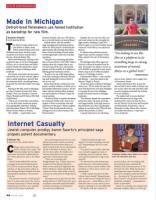
Computer prodigy Aaron Swartz in a scene
technology, and you could see where
from The Internet's Own Boy
Aaron got his propensity to dig in and
question."
The Internet's Own Boy features poi-
Aaron's mother, who was dealing with
gnant interviews with Aaron's parents,
some physical issues, attended the
Robert and Susan, and his brothers, Ben
Sundance Film Festival premiere of The
and Noah, as well as home movies and
Internet's Own Boy. While the Swartzes
photographs.
unambiguously support the film, one
"I really couldn't have done the film
observer at Sundance noted that the fam-
without Aaron's family:' Knappenberger
ily — devastated by "the government's
said. "It took a lot of courage for them to
abuse of power" and protective of Aaron's
open up to me — particularly so soon. I
reputation and legacy —responded cau-
made this film in a year, which by docu-
tiously to journalists.
mentary standards is just incredibly fast:'
Swartz was a prodigy who adopted and
The family, with the exception of
mastered computer skills at an early age