

Standing Tall from page 16
"of their brothers and sisters being murdered
in Kashmir, Chechnya and the Middle East,"
Hafeez said.
"It also was the first time I began to see
the use of very interesting, and very clever,
propaganda methods — namely, the use of
imagery to manipulate a person's emotions:'
he said. "You were handed a leaflet with
an image of a dead child, for example, and
it read: 'This child was murdered by Israel
occupation forces. Why are you silent?"'
Hafeez added, "Your first reaction was not
to question it. This radical kind of stream
started to gain traction."
When Hafeez then visited family in an
extremist-indoctrinated Pakistani town
along the India border, the idea of using vio-
lence to achieve an objective confronted him.
He fell for the allure of the Pakistani-based
terrorist organization called Lashkar-e-Taiba,
the Army of the Pure. The organization later
gained infamy for masterminding the 2008
terrorist attacks on Mumbai, India.
Hafeez, himself fooled by the drumbeat of
hate toward Jews, Israel, America and India,
was swayed by the 2000 call of Lashkar-e-
Taiba "to fight the good fight" and "defeat
those who oppose Islam:' He had come from
a democratic country rich with freedoms yet
still was transfixed by the radical notion that
he was a victim of Israel and the West purely
because he was a Muslim.
"It was really a strange mindset:' he said.
"You see very violent images and make
excuses to relate to them. You see the orga-
nization as fighting back. Yes, it is killing
innocent people, but you believe the West
has been killing innocent people for a long
time. You kind of rationalize
Dangerous Impressions
Struck by Lashkar-e-Taiba's jihadist world-
view, Hafeez headed back to the U.K. con-
vinced every major ill in the world went back
to the Jews and to Israel — with support
from the U.S. and the West.
"It was very black and white, basically very
meaningful," he said.
He thus became engrossed in this terror-
laced way of thinking.
A year after the 9-11 terrorist attacks
on America in 2001, Hafeez entered the
University of Nottingham. He quickly bought
into the anti-Israel spin of the local Islamic
Society, which showed a 20-minute video
fueled with images painting the Israeli
Defense Forces as the assailant against inno-
cent Palestinians in their reignited conflict.
"The video:' Hafeez said, "ended with the
caption, 'What are you doing for your broth-
ers and sisters in Palestine?' You might argue
this shouldn't affect people. But emotive
images do elicit an emotive response. They
help build a foundation for years of hatred"
On campus, Hafeez became an activist,
handing out leaflets branding Israel as an
apartheid state and denouncing Zionism as
the new Nazism. He witnessed anti-Israel
proponents injecting anti-Israel invec-
tive into classroom discussion no matter
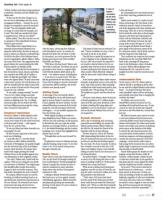
A view of
modern
Jerusalem.
On his first
visit, Kasim
Hafeez saw
Israel to be
a land of
coexisting
opportunity.
what the topic, advancing their bullying
and intimidation tactics. In London, he
attended Al Quds Day (Al Quds is Arabic
for Jerusalem), an event sponsored by the
Iranian government and which extolled
Hezbollah and Hamas.
"With those who hate Israel," Hafeez said,
"the truth is irrelevant. The intent was just to
get people to hear Israel in a negative light.
And if Jewish students didn't stand up for
Israel — for whatever reason, including fear
— it was seen as a moral victory. This also
laid the groundwork for the future; you knew
if you tried to bring in a boycott, divestment
and sanctions [BDS] resolution, the Jewish
students were already scared:"
Shifting Sands
At that stage of his swerving life, Hafeez
acknowledged he was an anti-Semite pack-
aged as an anti-Zionist to somehow make
it more palpable. He knew Zionism was the
national liberation movement of the Jewish
people for a Jewish homeland with Jewish
sovereignty — so you couldn't separate Jews
from the Zionist cause.
While happily handling out leaflets to
help delegitimize Israel, Hafeez was unsure
what he was truly achieving. At this juncture,
he decided the only way to get the world's
attention was through violence, as horrific as
9-11, the Madrid bombings and the London
bombings were. At least they highlighted the
jihadist issues, he felt.
"I thought that was the way forward:' he
said.
He planned to return to Pakistan and join
a jihadist training camp to learn "to do what
I have to do:' So he started saving money
through a Saturday job.
Reality Check
That's when he read Alan Dershowitz's book
The Case for Israel. He thought reading the
book would disprove "Zionist propaganda:'
Instead, it piqued his curiosity because of
what he considered so many ridiculous
claims about why and how Israel gained
statehood in 1948.
Looking to debunk Dershowitz's posture
that Israel was a survivor against constant
Arab/Muslim aggression, Hafeez found the
task physically grueling and emotionally
draining. It took almost 2 1 /2 years as holes in
his truth emerged.
"My hatred of Israel was an obsession," he
said. "I had to revalidate my view, a view I
was ready to die for at one point:'
That led him to spend his savings not on
a trip to Pakistan to join a jihadist camp,
but on a 2007 trip to Israel. He expected to
see Israel for what he believed it to be: an
apartheid state. But his arrival in Jerusalem
revealed anything but that infamous South
Africa model, which effectively collapsed
with the democratic South African voting of
1994.
In the Israeli capital, Hafeez didn't witness
examples of apartheid, such as Arab-only bus
stops. And Arabs and Jews alike repeatedly
confided that while Israel wasn't perfect, they
invariably said, "We get along. We coexist.
The healthcare is good. And the schools are
good:'
Of course, Arab citizens, about 20 percent
of Israel's population of 8.1 million people,
enjoy all of the same basic freedoms as Jews
in Israel, including full voting rights and
eligibility to serve in the Knesset. Arabs can
serve in the Israeli Defense Forces, but are
not required to.
Dynamic Moments
After a day of wandering and conversing
around the ancient hilltop city awash with
biblical undercurrents, Hafeez trekked to
the Old City. He visited the Church of the
Sepulchre and the Al Aqsa Mosque.
He then chanced a visit to the Western
Wall. Approaching that holiest of sites for
Jews, he mimicked the man next to him and
put his arm and then his forehead against
the cool stone. He chose to ponder in silence
how virtually everyone he had met, of all
ethnic and religious stripes, were basically
talking not about hatred, but about peace or
just being left alone.
Recounted Hafeez: "I thought I have spent
so much of my life hating this place to the
point of wanting to kill for it. At that point, I
realized how wrong I had been:'
What struck a lasting chord during this
epiphany were the six stars of David he saw
atop the wall to mark the 6 million Jews who
had perished in the Holocaust.
"That's when it hit home that Israel
isn't the result of the Holocaust, but that
Israel could have prevented the Holocaust:'
Hafeez said. "When we talk about being lib-
eral and we talk about human rights, Israel
is that safe haven:'
He contemplated how the Jewish presence
in the Holy Land long predated the rise of
Islam.
Hafeez spent another 21/2 weeks in Israel
before journeying to the West Bank. In the
settlement areas he visited, he found Jews
and Arabs shopping at the same markets and
interacting. There are no Jews in Ramallah,
but he found the Arabs there at least imagin-
ing peace with Israel and expressing frus-
tration with the Palestinian Authority and
certainly with Hamas' terrorism. He said
young Arabs around the ages of 12 and 13
were enraged with hatred toward Israel, a
grim signal of the poisonous nature of the
P.A. education system, which North America
and the European Union help fund.
That confirmed my suspicion that younger
Palestinians are the most hate-filled West
Bank Arabs, meaning it'll take genera-
tions for the Palestinian culture of disdain
to reverse. Hafeez offered glimpses into
Palestinian life, but I yearned for more
insights from this would-be terrorist turned
Zionist.
Ambassadorial Role
On his return to the U.K., Hafeez opted to
dedicate his life to speaking up about what
he saw and felt to dispel Islamist myths about
Israel — to properly framing "this demo-
cratic, pluralistic nation with its technology
and scientific innovation that is changing the
world for the better:'
For Hafeez, who served on the
StandWithUs advisory board in the UK.,
standing with Israel hasn't been easy. To stay
current, he visits the Jewish state regularly
and went to the West Bank for a second time
last year.
He believes Zionist voices need to be loud-
er and more informed (he has had success
converting beliefs toward Israel among some
relatives and friends). He wishes more Jewish
leaders were bolder and assertive in grabbing
prime spaces at the forefront of the battle
to staunch the anti-Israel movement. He's
concerned about Jewish students on North
American campuses not being equipped to
counter the immense pressures of the BDS
campaign. I sense that he really wants to
help young North American Jews rise above
apathy, fright or ignorance to muster proudly
and earnestly on Israel's behalf.
Kasim Hafeez grasps the simple yet chal-
lenging concept that Zionists, really all
inclusive, civilized people, whether Jewish
or otherwise, should take up the gauntlet to
help Israel stay the course against the build-
ing tides of global anti-Semitic sentiment.
As he put it: "You've got to stand up for
Israel because it's a democracy — our fur-
thest outpost in democracy. If today you
don't say anything, if today you stand there
helplessly, regardless of what your leadership
does, then tomorrow, when your children
are afraid to wear a kippah or wave an Israeli
flag, don't look around and ask what hap-
pened because we'll all be responsible'
❑
July 3 • 2014
17