

4
Planting is
complete
throughout
the entire
garden.
TheraGardens joins with culinary center
to offer therapeutic gardening programs.
Stacy Gittleman I Contributing Writer
ith sights set on the dual goals
of creating a farm-to-table
produce source for Detroit
restaurants joining the locavore (locally
produced food) movement and providing
members of the community with physical
or mental disabilities with a therapeutic
gardening experience, the Great Lakes
Culinary Center (GLCC) recently con-
structed a new raised-bed garden on
the acre side lot that occupies its new
Southfield headquarters.
GLCC's foray into organic gardening is
a joint venture between its president Marc
Israel and Carol Shapiro Havis, creator of
TheraGardens of Franklin, a company that
assists backyard and urban farming. Just
months ago, Israel shared his vision with
Shapiro Havis about creating a garden
where food could be grown for his busi-
ness' cooking classes. He also wanted a
garden that could be used as a learning and
therapeutic environment for schoolchil-
dren, seniors and those with disabilities.
By late May, thanks to some dedicated
workers and the artisanship of Israeli
carpenter Shimon Amir of Brookside
Renovations in West Bloomfield, the
beds were built and a variety of crops was
planted.
Shapiro Havis designed this garden
keeping sustainability and accessibility in
mind. Rain barrels catch water runoff from
the building's roof to water the garden. She
adorned the exterior of the building facing
the garden with window planters growing
lettuce and herbs set at the perfect height
for someone to reach in a wheelchair. The
garden also contains a three-bin compost-
ing system for resident chefs to dispose of
compostable kitchen scraps like greens,
eggshells and coffee grinds.
In approximately 24 raised beds grow
rows of varieties of lettuce, chard, tomatoes
and peppers. A long raised box that runs
the entire length of the garden houses
berry bushes from which chefs hope to cre-
ate wonderful desserts from their harvests.
Another large bed stands at the height of
a wheelchair, complete with an attached
bench where those with disabilities can sit
as they garden. A fine mesh fence designed
to keep critters away encloses the entire
garden.
"To garden is the most ancient form
of therapy:' said Shapiro Havis, a master
gardener who designed gardens for the
Friendship Circle in West Bloomfield, local
senior residencies and various private cli-
ents.
A firm believer of the health benefits
that gardening provides from not only the
food but also tending to the garden itself,
Educational Growth
Adat Shalom's garden grows
more than herbs and vegetables.
Stacy Gittleman
Contributing Writer
p
lant a garden on the grounds of
a synagogue and a congregation
can reap so much more than a
hefty crop of tomatoes. Gardens are one
more way for a congregation to come
together, to study and to practice tikkun
olam as a Jewish community. These days,
wander onto the grounds of synagogues
like Temple Israel in West Bloomfield or
Temple Emanu-El in Oak Park and you
will find garden plots.
The newest community garden to grace
the grounds of a synagogue is at Adat
Shalom Synagogue in Farmington Hills.
Melissa Ser, director of congregational
learning for the Adat Shalom/Beth Achim
Learning Community, was gleeful as she
walked from bed to bed opening up bags
of fresh topsoil for the volunteers working
to start the synagogue's new garden over
Memorial Day weekend.
12 July 3 • 2014
"It is so great to see that after all the
work and grant writing, this project is
finally coming into fruition:' Ser said as
she and about 30 volunteers helped plant
and water the new raised beds.
Ser plans to use the garden as an
opportunity to bolster Jewish education
programming at the synagogue over the
summer.
"Each time we will gather as a commu-
nity to work in the garden, we will explore
a short text:' Ser said. "Perhaps one time
we will study Jewish obligations of Ba'al
Tashchit, the Jewish value of not destroy-
ing the world, or learn about the shmita
year Israel is going through now, when we
are commanded by the Torah to let the
land rest and rejuvenate itself"
As the food is harvested, a large portion
of it will be donated to Yad Ezra kosher
food pantry in Berkley, she added.
Ser said that children in the younger
grades started seedlings in their class-
rooms and watched them grow from
the heat of the class radiators and light
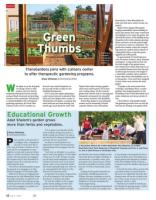
In the garden: Melissa Ser of West Bloomfield, Toby Gittleman, 10, of West
Bloomfield, Maria Pacis Biederman of Bloomfield Township, with Erin, 6, and Ethan,
12, Amy & David Strauss of Farmington Hills.
provided by both natural sunlight and the
classroom's florescent lights. Seedlings of
assorted herbs, cucumbers, beans, peas
and squash were chosen because of their
heartiness and ability to produce prolific
harvests "to feed as many people as pos-
sible"
Funding for the garden materials was
provided by a $6,000 grant from the
William Davidson Foundation as well as
additional funding by the Mandell L. and
Madeleine H. Berman Foundation for
family programming.
Everything was purchased keeping local
communities in mind. For example, rath-
er than buying a raised garden kit from a
big-box hardware store, Adat Shalom pur-
chased garden beds designed by students
of the Dewy Middle School of Detroit, a
vocational school for children with special
needs.
In the fall, the beds will be covered with
a greenhouse dome to extend the grow-
ing season. Ser added that she hopes this
coming winter will not be as harsh as the
last so they can get a jump on next year's
planting by March or April.
Volunteers are needed to tend the gar-
den through the growing season. Contact
Adat Shalom at (248) 851-5100.
❑