

arts & entertainment >> on the cover
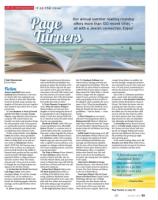
Our annual summer reading roundup
offers more than 100 recent titles —
all with a Jewish connection. Enjoy!
tea
BM&
Gail Zimmerman
Arts Editor
fiction
Aharon Appelfeld's latest novel,
Suddenly, Love (Pantheon), is the story
of a lonely older man making his way
from Ukraine to Israel after World War
II and his devoted young caretaker, the
daughter of Holocaust survivors; together,
they transform each other's lives in unex-
pected ways.
In I Am Abraham: A Novel of Lincoln
and the Civil War (Liveright), Jerome
Charyn, using biblically cadenced prose,
cornpone 19th-century humor and
Lincoln's own letters and speeches, brings
the 16th president to life, in first person,
as a profoundly moral but troubled man,
seized by melancholy and imbued with
an unfaltering sense of human worth.
Prolific mystery/thriller writer Harlan
Coben (the author, whose grandfather
was born in Jerusalem, lists his favorite
author as Philip Roth) is out with two
new works: In Missing You (Dutton
Adult), NYPD Det. Kat Donovan sees a
photo of her ex-fiance on a dating site
and soon finds herself in the middle of
Internet fraud, psychos and her cop dad's
unsolved murder; Six Years (Signet;
paperback) follows a college professor's
search for answers when "the woman
who got away" turns out to be not who
he thought she was (Hugh Jackman has
signed on for the film version).
In No Book but the World (Riverhead),
Leah Hager Cohen writes about
estranged siblings: Ava and her younger
brother, Fred. As Ava embarks on a
journey to understand her brother and
herself, her husband grapples with their
marriage, and her jailed brother relives
his crime.
0, Africa! (Hogarth), Andrew Lewis
Conn's sweeping historical adventure,
with brotherhood and forbidden love
playing out against the backdrop of the
birth of the movies, digs into the sepa-
rate cultures of Jews, gays and African
Americans in the early 20th century and
how they intersect yet remain outside
the mainstream. Part of the plot includes
Jewish twin brothers who attempt the
first studio film made in Africa.
In Yvette Manessis Corporon's first
novel, When the Cypress Whispers
(HarperCollins), an American-born
daughter of Greek immigrants learns of
her grandmother's role in helping save a
family of Corfu Jews during World War
II; it is based on stories the author heard
from her own grandmother.
Elizabeth de Waal's (1899-1991) pre-
viously unpublished novel, The Exiles
Return (Picador), is a postwar story of
Austria's fallen aristocrats, unrepentant
Nazis and a culture degraded by violence.
In Andrew's Brain (Random House),
E.L. Doctorow, author of the sweeping
Ragtime saga, goes into the mind of one
man, a cognitive-science professor, as he
grapples in a dialogue with his therapist
over issues including memory, conscious-
ness and perception.
The Train to Warsaw (Grove Atlantic),
by Gwen Edelman, delves into the
psyches of Jascha and Lilke, who sur-
vived the Warsaw Ghetto, and upon their
return to Poland must cope with both the
brutal force of history and their own self-
destructive tendencies.
Joshua Max Feldman's debut novel,
The Book of Jonah (Henry Holt), is
a retelling of the biblical story with a
young, ambitious Manhattan lawyer
named Jonah Jacobstein at its center, who
deals with love, failure and unexpected
faith while asking an age-old question:
How do you know if you're chosen?
In The Angel of Losses (Harper Collins;
July 29), Stephanie Feldman inter-
weaves history, theology and both real
and imagined Jewish folktales. When Eli
Burke dies, he leaves behind a mysterious
notebook full of stories about a magical
figure named the White Rebbe, a miracle
worker in league with the enigmatic
Angel of Losses, protector of things gone
astray and guardian of the lost letter of
the alphabet, which completes the secret
name of God. When his granddaughter
Marjorie discovers Eli's notebook, every-
thing she thought she knew about her
grandfather — and her family — comes
undone.
In Boris Fishman's at-once funny
and heart-wrenching literary debut, A
Replacement Life (Harper), failed jour-
nalist Slava Gelman becomes the "Forger
of South Brooklyn," faking Holocaust res-
titution claims for old Russian Jews living
in New York.
Judith Frank's forthcoming novel, All
I Love and Know (William Morrow; July
15), set against the backdrop of timely
issues including Israel/Palestine, gay
marriage and international adoption,
tells the story of how Daniel Rosen and
Matthew Green's quiet, domestic life in
Northhampton, Mass., is completely
shaken when Daniel's twin, Joel, and
sister-in-law die in the bombing of a
Jerusalem cafe, leaving their two children
to the couple.
Alan Furst's Midnight in Europe
(Random House), a new historical thrill-
er, is a tale of spies and secret operatives
in Paris, New York, Warsaw and Odessa
on the eve of World War II.
Susan Jane Gilman's The Ice Cream
Queen of Orchard Street (Grand Central
Publishing) tells the story of Malka
Treynovsky, who flees Russia with her
family in 1913 and is abandoned by them
on the streets of the Lower East Side
when she becomes crippled. Taken in by
a tough-loving Italian ices peddler, she
survives through cunning and inventive-
ness, learning the secrets of his trade and,
over a 70-year period, transforming her-
self into the doyenne of an empire of ice
cream franchises.
Myra Gold is a Manhattan psychother-
apist, a quick study and excellent judge
of character in Lisa Gornick's Tinderbox
(Sarah Crichton Books/Farrar, Straus &
Giroux). She thinks she knows what she
is getting into when she hires a nanny,
Eva, to aid the household when her pho-
bia-addled son, his wife and their child
move in with her. But when Eva settles
into Myra's patient chair, their relation-
ship becomes too close, too dependent
and, ultimately, terrifyingly destructive.
In Friendship (Farrar, Straus & Giroux;
July 1), by Emily Gould, longtime friends
Bev Tunney and Amy Schein, both turn-
ing 30, are dragged, kicking and scream-
ing, into real adulthood; they have to face
the possibility that growing up might
mean growing apart.
In her award-winning debut novel, All
Russians Love Birch Trees (Other Press),
translated from the German by Eva Bacon
and set in Frankfurt and then Israel,
"I find television very
educational. Every
time someone turns
the set on, Igo into
the other room and
read a book."
— Groucho Marx
Page Turners on page 56
June 26 • 2014
55