

metro >> Jews in the digital age
B
Jewish Calendars For
The Digital Age
esides the often-told joke that
the definition of a Jewish holi-
day is "they tried to kill us, we
prevailed, now let's eat," there are not
many jokes about the Jewish calendar.
The only one I can ever remember
was actually told by a non-Jewish late-
night talk show host. In his opening
monologue on The Late Show several
years ago, David Letterman turned to
his Jewish bandleader Paul Shaffer and
wished him a "Happy New Year" since
it was Rosh Hashanah. Letterman then
asked Shaffer what the Jewish year was,
to which he explained that it was now
5759. Letterman quickly deadpanned
"Well, I'm sure I'll still be writing 5758
on all my checks for a few weeks."
The joke struck a chord for so many
Jews because we all know we don't use
the Jewish year or the Jewish calendar
very much in our everyday lives. Even
most Israelis write the secular year on
their checks and contracts and celebrate
the Gregorian date for birthdays and
anniversaries.
The Jewish calendar, howev-
er, does play a significant role
in our lives. We need to know
when to observe our departed
relatives' yahrtzeit dates. We
need to schedule our events
and travel plans around the
Jewish holidays. We need to
schedule our children's bar and
bat mitzvahs according to their
Jewish birthdates.
The rhythm of the Jewish
calendar affects us emotional-
ly. The Jewish calendar, known
in Hebrew as luach Hashanah,
takes us on a journey. The
calendar is made up of days in which we
celebrate and days in which we grieve.
Some Jews, especially those working
in a professional capacity in the Jewish
community, have historically carried a
small pocket luach to know the Jewish
holidays and the Jewish dates. In the
past two decades, these print Hebrew
calendars have morphed into digital cal-
endars and mobile apps.
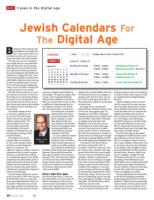
I started using an electronic version
of the luach back in 1997 when I got my
first Palm Pilot, which was one of the
first personal data assistants (PDA) on
the market. While there were several
luach apps available to install onto the
Palm Pilot, the most advanced version
26 June 26 • 2014
Calendar
Today
•
CREATE
<
>
SMTWT
F
27 28 29 30
1
2
3
4
8
9
10
6
7
>
Sunday, May 18, 2014 (18 lyar 5774)
Expand All Collapse All
• May 2014
5
<
Sun May 18 (18 lyar)
S
Mon May 19 (19 lyar)
11 12 13 14 15 16 17
8:00am — 9:00am
E) Breakfast at Tiffany's tt
6:00pm — 8:00pm
ID Bowling at the mall - the mall CT
7:30am — 9:00am
ID Danny's Bar Mitzvah CI
8:00pm — 10:00pm
Watch the game CI
18 19 20 21 22 23 24
25 26 27 28 29 30 31
1
2
3
4
5
6
Tue May 20 (20 lyar)
was from a company named Penticon
Technologies. The app was simply called
"Luach," and it integrated flawlessly
with the native calendar on the device.
What was so great about Luach was that
in addition to converting any date on
the Gregorian calendar to the Jewish
date, the app also kept a record of spe-
cial events such as relatives'
yahrtzeit dates and it then
synced those dates with the
device calendar. So rather
than depend on the post-
card reminders from funeral
homes and synagogues about
upcoming yahrtzeits, one
could simply set an alarm
reminder on the PDA.
As a new rabbinical student
at the Jewish Theological
Seminary in the late 1990s, I
found myself being the go-to
techie for my fellow students
who wanted the mobile luach
installed on their pocket data organizer.
Penticon's Luach quickly became the
killer app for anyone in the Jewish pro-
fessional world. The dean of the rabbini-
cal school at the time, Rabbi William
Lebeau, told the senior class that they
could not be ordained as a rabbi from
the seminary unless they had a PDA
with Luach installed.
Newer, High Tech Apps
Fast forward more than 15 years and
those Palm PDAs now seem archaic by
today's technology. Just about every-
one now carries a smartphone in their
pocket with a fast Internet connection.
Determining a Hebrew date or ascer-
-
1:00pm — 2:30pm
8 Lunch with work buddies CI
7
taining when a Jewish holiday will occur
several years from now is as simple as a
Google search. However, those who pre-
fer to have a luach app at the ready on
their phone have a plethora of good apps
to choose from.
For Apple devices running iOS,
Tebeka Software Solutions' Pocket Luach
is one of the most popular apps. For
smartphones and tablets running the
Android operating system, Simple Luach
and AvivoNet's Luach Hebrew Calendar
are popular and work pretty well.
RustyBrick, one of the most success-
ful developers of Jewish mobile apps,
released a luach app that is a siddur
(prayer book) as well as a Jewish calen-
dar with what are known as z'manim, or
specific times for Jewish prayer through-
out the day, including Shabbat and holi-
day candle lighting and Havdallah times.
I reconnected with Howie Hirsch
of Penticon in December 2012 in
Jerusalem. It had been many years since
he worked on his company's Luach app
because Palm Pilots were out of produc-
tion and everyone had shifted to Apple,
Android or Windows mobile phones.
He told me he was working on an Apple
iOS version of Luach and asked if I'd be
willing to join his team of beta testers.
I told him I'd be happy to. A new beta
version of Luach will soon be available
for downloading. Hopefully this will be
the last beta version. We are now in the
process of submitting Luach to the App
store and making it available to the gen-
eral public. The official release will be
within the next few weeks.
In mid-April, Howie sent out a beta
version of Luach for iOS that has the
final fine tuning in order to be ready for
an official release, which means it could
be available before the High Holidays
this year.
Like the original versions of Luach,
the iOS version will let users enter spe-
cial events like yahrtzeit dates, anniver-
saries, birthdays and bar/bat mitzvahs.
It will also allow users to customize the
Shabbat and holiday times based on
their location and communal customs
(i.e., how long to wait until making
Havdallah). It's great to see Howie back
in action with Penticon's Luach, and I
think it will quickly become the most
downloaded luach app in the Apple App
Store when it's finally released.
All of the luach apps on the market
are designed for traditional Jews, mean-
ing Orthodox and Conservative Jews
who, in the diaspora, observe an extra
day of major holidays. Reform Jews, who
do not observe the extra day of holidays
in the diaspora, have struggled to find a
luach app that allows for the customiza-
tion they desire. However, Rabbi Leon
Morris is hoping to change that with
the Reform Luach app he is currently
developing (www.reformluach.com ).
Rabbi Morris, who is making aliyah with
this family, and I began discussing his
idea for a Reform version of a luach app
in early 2013, and he has made great
strides in bringing it to fruition.
"Jewish professionals have long relied
on the luach in planning community
programming and observances," Morris
explained. "Reform Jewish professionals
had no calendar resource geared specifi-
cally toward us; our only option was to
consult a luach from another denomina-