

metro
1 ‘1
t
01
rE
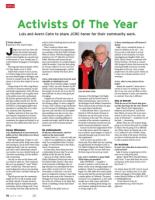
Lois and Avern Cohn to share JCRC honor for their community work.
Vivian Henoch
Special to the Jewish News
j
udge Avern and Lois Cohn will
receive the Jewish Community
Relations Council's 2014 JCRC
Activist Award together at a special event
in their honor at 7 p.m. Sunday, June 22,
at Adat Shalom Synagogue in Farmington
Hills.
The program's featured speaker will be
U.S. Rep. Sander Levin, D.-Mich.
Asked what it means to be an activist,
U.S. District Judge Avern Cohn, the old-
est active federal judge in Michigan, said,
"Activist is a loaded word, but I think it
means to do more than simply sit on your
fanny."
Going strong at 90, with a long history
of activity in numerous political, secular
and Jewish organizations, Cohn still man-
ages a full caseload. Lois is equally active
in the public arena with a professional
life that has spanned education, public
television, politics and the arts. For the
past 29 years, she has been proprietor of
ARTSPACE, a Birmingham gallery that
specializes in reselling fine art to collec-
tors, museums and corporations.
Together, and each on their own, they
have enjoyed a long history of achieve-
ment, activism and philanthropy in the
community, the region and beyond. In an
interview, they talked about their lives of
giving.
mind to a life of thinking about social and
political issues.
Then I worked at Wayne State
University, which led to my appointment
as coordinator of the first Public Defender
Office in Detroit. With that background, I
started my own TV talk show on Detroit
Public Television and became the pro-
ducer and moderator of a weekly program
called Newsmaker. I kept that show going
for 10 years. Believe it or not, I was very
shy, but I loved meeting people. And the
experiences! I should write them down
one day.
Avern, what projects have been the most
enjoyable or satisfying for you?
Avern: Once I became a judge, I stopped
saying I "enjoy" my work. Because, by def-
inition, some of the things I do as a judge
hurt people. It's not for me to say, but I've
been told that I've done a fairly good job
of judging.
I suppose out of the 60 some years in
my career, I've gotten the most satisfaction
out of being a judge. I've been a judge for
35 years. And I continue to get satisfaction
out of it because it's challenging, interest-
ing work, and I feel that I am accomplish-
ing something every day, in every case.
From situation to situation, conflict to
conflict, there's something different to
consider and weigh. And all of the cases
involve some form of human dynamic
interaction.
Career Milestones
On Achievements
Lois, thinking back on your journey in
public service, what projects are closest
to your heart?
Lois: My beginnings. I began as a sub-
urban wife and mother doing some substi-
tute teaching in a local school where I had
taught previously. I got my community
start with a radio commentator named
Lou Gordon. Lou was a family friend and
I loved his muckraking, Lincoln Steffens-
style of reporting.
One day, we were out for dinner with
Lou when he asked me, "How would you
like to be my gumshoe?" I said, "What's
that?" And he said, "Why don't you do
some background work on my reporting
on the radio show," and that's what got me
started.
That job got me into the community,
taught me how to talk to people, made
me think critically. I became involved
politically, began to understand people's
motivations and how things work. It was
very exciting work that really opened my
Of all your achievements, what has
made you the most proud?
Avern: I don't try — and can't really rate
— what I've accomplished as a judge and
what I've accomplished before I became
a judge. I've been fortunate to have had a
variety of experiences.
In some sense, there always has been
a relationship between what I've accom-
plished and the fact that I'm Jewish.
I grew up in what I call the Golden
Ghetto [Northwest Detroit] and went to
the Detroit Public Schools. I then went
to the University of Michigan. My col-
lege education was interrupted for three
years while I served in the U.S. Army.
Fortunately, or otherwise, I was never
given an assignment overseas. I came back
from the army, went to the University of
Michigan Law School, began practicing
law in the city of Detroit as my father did,
which is something I always had looked
forward to.
I worked in the public sector as
16 June 12 • 2014
Is there something you still dream of
doing?
Lois: I have a wonderful project in
mind for children in the city — but
it's too early to talk about it, at least
publicly. In the meantime, I'm enjoy-
ing plugging my daughter Julie's new
book, Canvas Detroit, co-authored with
Nicole Christian. The book is a beauti-
fully designed volume that showcases the
stunning breadth of artwork currently
being done in the city. And, as many
people know, I'm still an active Democrat.
I write a lot of checks and lick a lot of
envelopes.
Lois and Avern Cohn
chairman of the Michigan Civil Rights
Commission and the Detroit Board of
Police Commissioners. I also served on
the Michigan Social Welfare Commission.
Those extracurricular activities also gave
me a great deal of satisfaction.
I would add that when I came back to
Detroit in 1949, the Junior Division of
Federation was my first center of activ-
ity. Sometime in the early '50s, I became
a member of the executive committee of
the Jewish Community Council (now the
Jewish Community Relations Council).
Council was the first organization where
I was really active, and it's the organiza-
tion in which I stayed longest, so today it's
especially pleasing to get an honor from
that organization.
And, of course, my activity in the
Democratic Party didn't hurt me in getting
my appointment by President Carter as
U.S. District Judge for the Eastern District
of Michigan in 1979. For me, that's been
the brass ring on the merry-go-round.
Lois, you've worked in so many fields.
What makes you proudest?
Lois: ARTSPACE — my gallery —
because I created it. And it's mine, for
better and for worse, through progress and
problems. I think it's a wonderful place. I
began it in 1984, didn't have much capital,
but my sister had the concept and started
a similar gallery in California. The entire
inventory is on consignment, so all I really
needed was to find a space and build it
out. There's something about having your
own business, making the decisions, right
or wrong, tough or not.
Avern, what is your primary focus
today?
Avern: My caseload. I always have a
variety of cases I'm working on. Every
day or two, new cases are filed, so there
are new disputes to settle, new situations
to confront. Every day is different.
City of Detroit
What do you see in Detroit that gives
you the most hope for the city's future?
Lois: There's what's happening in
Midtown and Downtown. And there's
Dan Gilbert, of course. But in my view,
Detroit is still a tale of two cities. One
swipe of Woodward — wonderful. Go off
the path — devastating.
Avern: There are a lot of great things
going on in Detroit that point to a bright-
er future. But it's going to be a different
city. When I grew up, Detroit was a city
of 1.2 million; it's now 750,000. Today,
when you think of the future of Detroit,
you have to think beyond the city limits
to what a greater Detroit can be.
On Activism
In your view, what does it mean to be a
social activist?
Lois: It means recognizing how fortu-
nate you are and giving back.
Avern: I think Oliver Wendell Holmes
said it best: "A man shall share the action
and passion of his times for fear not to
have lived:'
❑
For details about the JCRC Activist Award
event at 7 p.m. Sunday, June 22, at Adat
Shalom Synagogue in Farmington Hills,
contact Beverly Phillips at (248) 203-1527
or phillips@ffmd.org.
Vivian Henoch writes for
myjewishdetroit.org, where this first
appeared.