

metro >> on the cover
Rare Mitzvah
Orthodox community comes together for redemption of a firstborn donkey.
Keri Guten Cohen I Story Development Editor
CONTINUED FROM PAGE 1
tractate in the Talmud and thought it was a
nice event to do. They bought one donkey
and got a healthy firstborn the first time.
Wow! The mitzvah excited the community
— so many Jews coming together just for the
sake of connecting with God:'
Rose took up the cause for Detroit about
21/2 years ago. He contacted Lori Babcock-
Largo, a breeder of miniature Mediterranean
donkeys used by the Cleveland Heights
Kollel, but didn't have the same luck with the
first-time pregnant female donkey she had
then. Largo told him about Becky Labs, a
breeder in Mattawan in western Michigan.
"Lori was instrumental; Rose says. "She
tried to help me to find donkey breeders in
Michigan, searching on wwwgotdonkeys.
com. And she helped Becky understand what
we wanted. How do I describe this without
sounding too odd? It's even strange to Jews:'
The Mitzvah
Pidyon Peter Chamor has Passover roots
and is akin to Pidyon HaBen, the redemp-
tion of the firstborn son, a mitzvah prac-
ticed today that recalls God's Tenth Plague
and the slaying of firstborn Egyptians,
with Jewish firstborns passed over for
death because of lamb's blood on the door-
posts of their homes.
The redemption of the firstborn donkey
is one of the 613 biblical commandments,
appearing in Torah verses during the first
day of Chol HaMoed (the intermediate days of
Pesach) and also on Shabbat Chol HaMoed.
"The donkey is very, very unique; it's the
only non-kosher animal with a degree of
sanctity:' Rose says. "One reason is that when
the Jews left Egypt, they had donkeys carry-
ing the wealth of Egypt with them. We pay
the donkeys back and have a special mitzvah
unique to them:'
The Pidyon Peter Chamor requires an
Israelite to own the donkey and a kohen
(priest) to receive the sheep to redeem the
firstborn. In this case, the Israelite was
Rabbi Doniel Neustadt, head of Detroit's
Orthodox Council of Rabbis. The kohen
was Rabbi Dovid Kahn, principal of
Yeshivas Darchei Torah in Southfield. As
in Pidyon HaBen, the redemption is not
required of kohens or levites.
But first, there were trials and tribulations
in obtaining a firstborn male donkey. At
Labs' farm in Mattawan, contracts establish-
ing ownership were executed according to
secular and Jewish law.
8
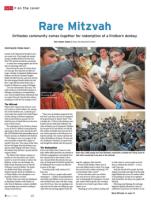
Children enjoy petting
the young donkey 1
used in the mitzvah. -"
"There were six donkeys pregnant for the
first time," says Rose, who was accompanied
by his good friend, Dr. Robert Tawil. "This
is donkey No. 5. [Three of the firstborn were
females and one male died suddenly.] The
value of donkeys can be thousands of dollars,
but we gave her $5 and told her we will sell
[the mother and baby] back to her for $5. It
was a down payment on the full price if we
kept the animals. The contract said that she
makes all healthcare decisions. We also rent-
ed a small piece of property [a square foot]
and brought the animals onto the property:'
The Redemption
Prior to the Pidyon Peter Chamor in Oak
Park, rabbis talked about the rare mitzvah in
Orthodox congregations, and yeshivah boys
had a special class to learn about it, Rose
says. And just before the mitzvah, the sanc-
tuary at Young Israel of Oak Park (which lent
its building for the occasion) was filled for
lectures on the topic.
"Learning really, really enhanced it:'
Rose says.
Closer to 6:30 p.m., people really started
streaming in — mothers and grandmothers
with babies and children in tow, and men in
suits and black hats, many with their young
sons. By 6:45 p.m., there was standing room
only and even the aisles were filling up, espe-
cially with men pressing eagerly toward the
More than 1,200 people from the Orthodox community crowded into Young Israel of
Oak Park's social hall to be part of the mitzvah.
stage for a glimpse of the mitzvah.
Because of the holiday, visitors were in
town and children had no school. Two young
boys raced to their mother, exclaiming, "We
saw the donkey with a crown!"
On the men's side, amid a sea of black
hats, men stood on chairs to get a better
view to photograph the redemption. On their
side, women tried to get the men crowding
the aisle to sit or kneel to give them a better
chance to see.
"Standing up on the podium, looking wall
to wall, corner to corner, people were just
there to celebrate the mitzvah — it was a
rush;' Rose says.
Amid the tumult of the people, the baby
donkey stood quiet and regal in its fine gold-
edged blanket and crown. Its mother waited
in the parking lot. Except for an appropri-
ately timed bleat, the sheep was equally well-
behaved.
Following some blessings, the exchange
happened quickly, followed by a burst of
celebratory music from Avi Schreiber on the
Rare Mitzvah on page 10
May 1 • 2014