

arts & entertainment
The Novel As Archive
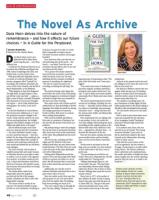
Dara Horn delves into the nature of
remembrance — and how it affects our future
choices — in A Guide for the Perplexed.
Sandee Brawarsky
Special to the Jewish News
D
ara Horn's latest novel is pro-
pelled forward by ideas about
preserving the past — over three
different eras.
A Guide for the Perplexed (Norton) is set
in present-day California and Egypt, late-
19th-century Cambridge and Cairo, and
further back, in 12th-century Cairo.
With great skill and originality, she lay-
ers stories of a software developer who
invents a program called "Genizah" for
recording a life, Solomon Schechter's dis-
covery of the Cairo Genizah, and the life of
Moses Maimonides, or the Rambam.
"What happens to days that disappear?
The light fades, the gates begin to close,
and all that a day once held — a glance, a
fight, a taste of bread, a handful of braided
hair, thousands of worries and triumphs
and regrets — all of it slips behind those
closing gates:' she writes, as the novel
opens.
In the first flashback to recent history,
the inventor Josie Ashkenazi is a 13-year-
old, pictured at summer twilight in the
woods, "thick with the smell of wet wood
and encroaching darkness, the twilight
fragrance that children imagine to be pos-
sibility and adults know to be regret"
Like the biblical Joseph, Josie is left
alone in a deep pit when her tormentors
— her sister and fellow summer camp-
ers who caused her descent — leave her
behind. On the sides of the muddy pit, she
imagines drawers filled with a jumble of
memories and would have preferred they
were sorted and labeled like an old library
card catalogue.
The Cairo Genizah, with its piles of
valuable manuscripts and scraps of paper,
as Schechter discovers more than a centu-
ry earlier, is not an archive ("the opposite
of an archive as scholars would say) but
a pit, "a deep and bottomless well of lives,
the lives of everyone who had left a name,
and everyone who had perished as though
they had not lived:'
The scholar finds a letter from
Maimonides about the tragedy at
sea that took the life of his younger
brother. Schechter also finds a note with
Maimonides' musings:
"We choose what is worthy of our
memory. We should probably be grate-
ful that we can't remember everything as
48
May 1 • 2014
God does, because if we did, we would
find it impossible to forgive anyone.
The limit of human memory encourages
humility:'
In an interview, Horn says that the cen-
tral motivating idea of this novel — her
fourth — was about "how the way we
remember the past affects who we are and
our choices for the future:'
"I'm a person who always wanted to
turn my life into an archive. Social media
made my dream come true she says,
admitting that the constant recording of
memory is something of a nightmare.
"The way we control our past is not
recording everything but selecting:' she
says.
The award-winning writer began this
novel before the events of the Arab Spring
(and had imagined a revolutionary Egypt)
and before Google Glass was invented, so
she had to do some rewriting.
Horn spins stories with richness and the
authenticity of a deep knowledge of Jewish
languages that makes her stand out among
the younger generation of American
Jewish novelists. She's never at a remove
when writing about Judaism.
Well-versed in Yiddish and Hebrew,
Horn also is a professor of literature, but
she says that she doesn't write fiction as a
professor.
But perhaps being a writer has changed
the way she looks at and teaches literature;
she's much more aware of the motivations
of the writer. She published her first novel
at age 25.
All of her books, including All Other
Nights and The World to Come, have
stealth Jewish titles, she says, drawn from
Jewish literature. The title of her new work
is also the name of the major philosophi-
cal work by Maimonides.
Writing about Maimonides made her
anxious. Horn says that people don't think
of him as a person, but rather as a set of
ideas. She felt fortunate that so much had
been written about him and came to hear
his voice.
Additionally, she read the work of
Solomon Schechter and found him to be a
great writer with a lot of wit.
Since her earlier novels, Horn says that
she has grown to care a lot more about
plot. (For the reader's sake, I'm holding
back from revealing too much of it.)
"The way I express ideas is through the
plot:' she says, adding, "Suspense is an
A GUIDE
7;
NI FOR THE
I•Or
,1
Wf
*
' rO
• ''. 4 n
! ° . ■
DARA
HORN
AUTHOR OF
THE WORLD TO COME
Dara Horn
important part of expressing an idea:' The
plots of her first books were "more jerry-
rigged:'
"I am much more aware of making the
plot more original, avoiding contrivance,
having the story matter much more she
says. "I used to think more about symbols
consciously. Now I think much more about
the story:'
The novel's intertwining stories involve
several sets of siblings, including two sets
of twins — Schechter and his brother, and
two sisters in Cambridge who encourage
Schechter's work — along with Josie and
her envious sister Judith, and Maimonides
and his brother.
Horn understands the way siblings talk
to one another. In fact, she credits her
own three siblings with teaching her about
storytelling at their nightly sessions at the
dinner table when every child had 5 min-
utes — regulated by a kitchen timer — to
describe the adventures of the day.
Now, her two sisters, Jordana and Ariel,
are successful writers, and her brother,
Zach, won his second Emmy Award last
year.
Yet the novel is not based on her sib-
lings, who are actually very close and part
of each other's day-to-day lives, even as
grown-ups.
"I'm not mining my own life for my
books:' Horn says, noting that her own life
would make for a "boring novel:'
"Sibling relationships figure in a lot
of my books:' she says. "You don't often
see relationships between adult siblings
explored in fiction:' She is drawn to them
because "siblings share a past but not nec-
essarily a future:'
Horn, born in 1977, is the mother of
four children all under 10 and is raising
them in the same town that she grew up
in, Short Hills, N.J. They go to the same
school she attended, have some of the
same teachers and even go to the same
pediatrician.
And just as her parents read to her and
her siblings at every meal, she reads to her
kids at every meal, too.
Her kids go to Hebrew school at the syn-
agogue where she grew up. On Sundays,
they go to Sunday school, but during the
week the teacher comes to her house and
teaches some other kids, too.
"It's a cheder in our dining room:' she
says. Sometimes on Friday nights, the kids
make up plays based on the Torah reading as
she did as a kid, encouraged by her parents.
"It's a lot harder when you're the adult:'
she says.
Horn is loyal to the Conservative move-
ment and is grateful for her education
at her synagogue, Jewish Theological
Seminary's Prozdor High School and
Camp Ramah.
In an author's note, Horn, who was
selected as one of Granta's "Best Young
American Novelists:' pares some of
the fact and fiction related to the Cairo
Genizah and to Maimonides, directing
readers to other sources.
And with the recent release of the
novel in paperback, she has written a
39-page e-book prequel, a novella called
String Theory: The Parents Ashkenazi,
about a physicist and a mathematician,
the mother and father of Judith and Josie,
whose insights into the world's repeating
patterns fuels the story in A Guide to the
Perplexed.
❑
Temple Israel Libraries and the
Cohn-Haddow Center for Judaic
Studies at Wayne State University
present a lecture by Dara Horn
at 7 p.m. Thursday, May 8, at
Temple Israel. Free and open to the
community. RSVP requested to Kate
Boman at (248) 661-5700 or kate®
temple-israel.org .