

metro >> cover story
Survivors' Stories
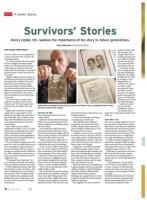
Henry Upfall, 101, realizes the importance of his story to future generations.
Stacy Gittleman
CONTINUED FROM PAGE 1
survivors, Pinsky is in a race against time
to preserve her loved one's stories for the
coming generations.
"As a kid, my brother Yale and I remem-
ber lots of laughter and joking around"
Pinsky said. "We heard stories of Europe
in bits and pieces. We knew there were
subjects that were off-limits; we just didn't
go there because it caused my parents too
much pain"
Stephen Goldman, executive director at
the Holocaust Memorial Center (HMC) in
Farmington Hills, said that in the imme-
diate years after the Holocaust, many
parents were afraid to tell and children
were afraid to ask about the horrors of the
Holocaust. As time passed, more survivors
began to tell their stories. They must be
told and recorded to preserve their mem-
ory, he said.
"As survivors age, it becomes more
urgent for us to preserve their stories"
Goldman said. "If we don't capture their
memories now, they will be lost to the
ages:'
Upfall's story, retold here, was pieced
together from a recent interview at his
apartment and a 2006 video testimony he
gave at the HMC. There, Upfall's account,
along with 500 additional area survivors,
are recorded with attention to the most
accurate detail.
Henry Upfall was born Gedalye
Augustowski on April 14, 1913. As a child,
he grew up in a comfortable and "cosmo-
politan" household in Warsaw with his
mother, sister and maternal grandparents.
His parents divorced and his father left to
settle in Detroit in the 1920s.
He was an athletic teenager and an avid
boxer. For a time, he traveled from town to
town competing in boxing tournaments,
where he eventually suffered an injury to
his right eye causing permanent blindness
in it. When retelling even a few sentences
of his story, that eye swells shut under the
weight of its tears.
"We had good lives" Upfall said. "We
were well dressed. My sister never left the
apartment without a fine hat on her head:'
In 1938, Upfall met his future wife, Dora
Rajf, through one of her six brothers. After
a year of courting, the two set a wedding
date for Sept. 6, 1939. Through the help
of their families, they purchased a small
building where they would work as a bar-
ber and a beautician and live in the apart-
ment upstairs.
10 April 24 • 2014
Contributing Writer
condition that he would
take a passport. Sure
enough, within days of
accepting a Russian pass-
port, Upfall was drafted
into the army and put
onto a train headed for
the frontline of the war.
"I remember sitting
next to another Jewish
guy named Moskowitz"
Upfall said. "In Yiddish,
he joked with me, 'They
are sending us to the
slaughterhouse: So,
when the train stopped
at a station, I said I
was getting off to get a
hot drink. At the sta-
tion, there was stopped
another train going west.
I got on it and deserted
the Russian army. I never
saw Moskowitz again:'
Somehow, he made
Upfall holds a photograph of himself and his sister from Warsaw. Top: An engagement photo of Dora
his way to Jambul,
and Henry; bottom: their ketubah.
Kazakhstan, where he
was reunited with his
Coming Of War
fall of 1940, the Nazis ordered all Jews into family. They remained there until the end
Then, in September of 1939, the Nazis
the Warsaw Ghetto.
of the war.
invaded Poland.
"He just had no idea how bad things
Upfall, like all other able-bodied young
Post-War Life
were going to get" Pinsky said.
Polish men, was ordered at age 26 to the
After making it back to Bialystok,
When the war ended, Upfall, his wife and
border at Bialystok in an attempt to thwart he and Dora were arrested and sent to
son went back to Poland, first to Kracow,
the Nazi invasion.
Posolek, a Russian labor camp near the
then Warsaw, where they were spirited out
Two months later, Upfall returned to
town of Vologda in White Russia to work
of Poland by Betar, the Revisionist Zionist
Warsaw and reunited with Dora. In just
harvesting trees in the forest.
youth movement, and taken to Vienna,
Austria. Dina was born in Vienna in 1947.
those short months away, Upfall recalls the
Conditions were harsh. There was little
shock of seeing a change in Dora's physical food and only straw to sleep on in the bar-
From there they went to a displaced per-
state and the destruction in the city.
racks. Upfall, raised in an Orthodox home, sons camp, Munchenberg, in Germany.
"I didn't recognize her" Upfall said. "In
recalls feigning illness and fever with some
In 1949, the family immigrated to the
only two months, her face was so drawn,
other men in the camp so they would not
United States, joining his father in Detroit.
so black from the soot of the bombings:'
have to work on Yom Kippur.
After receiving his license, he operated a
On Nov. 6, 1939, Upfall and Dora broke
Though they were under the watchful
barber shop. He became a U.S. citizen and
changed his name to Henry in 1954.
the 7 p.m. curfew imposed on all Warsaw
eye of Russian guards, somehow Henry
Jews to sneak away to the rabbi's study at
and Dora escaped through a passage in the
Upfall said it is important to tell stories
Nozyk Synagogue. There, with no guests
forest. After traveling, they were reunited
like his for the future because "people
or witnesses, a rabbi married them in a
with Dora's parents in Vitebsk in Belarus.
who are free do not understand how we
secret ceremony. An engagement photo
For a while, they lived in relative peace.
endured what we went through during the
and a ketubah bearing the date and their
Henry worked as a barber and the couple
Holocaust:'
names, survives to this day, lovingly pre-
had a child, Yale, born in 1941.
"The Jewish nation is strong" Upfall
served in a frame in Upfall's apartment.
Shortly after Yale was born, Upfall's fami-
said. "We have to stick together no mat-
"There were just the rabbi, Dora and I,"
ly again uprooted as Soviet forces evacuated ter what. As long as we have places like
Upfall tearfully recalled.
civilians to Tashkent, capital of Uzbekistan.
America and Israel, a Jew will never have
The two fled that evening from Warsaw
Here Soviet authorities demanded that
to ask again 'vu ahin zol ikh geyn' (Where
and headed back to Bialystok, walking the
civilians acquire Russian passports.
can I go?)"
whole way at night, hiding by day in the
Refusing to get a passport because he knew
On April 28, Upfall and two other Holocaust
survivors living at Meer Apartments in West
woods and in barns. Upfall still has pain-
it meant he would be forced into the army,
Bloomfield will complete letters in a Torah
ful regrets about leaving his sister, grand-
Upfall was imprisoned.
commissioned by Temple Shir Shalom.
parents and mother. That next year, in the
Dora begged for his release under the
❑