

metro >> on the cover
BDS Soundly Defeated
Passionate U-M Hillel students worked hard
to combat on-campus anti-Israel resolution.
Ronelle Grier I Contributing Writer
CONTINUED FROM PAGE 1
were violating the human rights of
Palestinians by engaging in military con-
tracts with Israel.
While dissention over the issue spread
across campus, U-M Hillel student leaders
were hard at work behind the scenes, advo-
cating for the defeat of the resolution while
striving to keep the growing acrimony at bay.
"The resolution has caused a divided cam-
pus; it's very polarizing," said Becca Levin of
Cleveland, a sophomore and Israel Cohort
Chair at U-M Hillel. "We came together to
figure out how we could work together:'
The controversy escalated following a
student government meeting on March 18,
where members voted 21-15 to table the
divestment resolution indefinitely.
Before that meeting, U-M Hillel student
leaders were prepared with speeches and
support, but made a conscious decision not
to give attention to the divestment campaign
through social media and other means. That
soon changed.
After the March 18 meeting, disgruntled
members of SAFE and other groups staged a
weeklong sit-in at the CSG chambers, insist-
ing that their voices be heard. Some students
who had voted for indefinite postponement
said they received threats; others became
worried about their safety on campus.
CSG President Michael Proppe met with
sit-in organizers and agreed to present a
motion for reconsideration of the resolution
at its next meeting on March 25.
Hillel student leaders and staff members
again swung into action, holding brainstorm-
ing sessions late into the night to determine
the best way to gain support and encourage a
large number of people to attend the March
25 meeting.
They sent letters to CSG representatives
outlining problems with BDS and made let-
ter templates so other students could also
reach out to representatives. They also made
lists of friends and classmates who could
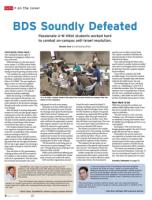
At U-M Hillel, student leaders talk about how to ease tension on campus after the
defeat of the resolution.
help spread the word across campus.
Ultimately, more than 4,000 people were
invited to the meeting via scores of emails,
text messages and a special Facebook group
called "Invest in Peac' Speakers were
enlisted to prepare comments for the public
comment portion of the meeting, where both
sides would have the opportunity to present
their respective opinions. Each side also was
allotted 30 minutes for a guest speaker.
According to junior Michele Freed of Ann
Arbor, U-M Hillel Governing Board chair,
the group worked carefully to choose the
speakers and to ensure the various speeches
conveyed the appropriate messages without
insulting those in favor of the resolution.
"We discussed the words being used; we
took out any accusatory language Freed
said. "Through that process, people grew and
learned to think critically:'
While several students had differing opin-
ions about how to accomplish their mutual
goals, everyone was treated with respect.
SAFE and other organizations also pub-
"Stand With Us was happy to partner with Hillel and U-M
students, with leadership from SWU Emerson Fellow Molly Rosen,
to provide educational materials, help with strategy and guidance
from our research and campus staff, who have been involved in
successfully defeating more than 15 divestment resolutions since
last spring.
"The U-M students were beyond impressive, preparing educational
packets for student government representatives and rallying hundreds of pro-
Israel students to lobby their representatives and show a forceful presence at
the vote."
— Brett Cohen, StandWithUs national campus program director
8
April 3 • 2014
licized the need to attend the March 25
meeting, resulting in more than 800 people
lining up inside the Michigan Union, where
the CSG chambers are housed. The general
assembly room, which holds 400, was filled
to capacity, while 200 people watched the
proceedings from an overflow room. More
than 300 others were turned away. There was
a live stream feed, which Freed believes was
seen by an estimated 4,000 viewers.
The students encountered a few unpleas-
ant surprises prior to the meeting. According
to Freed, their group had been told that no
one could line up before 7:30 p.m., but by
6:45 a long line had already formed, consist-
ing mainly of supporters of the resolution.
"The audience who got inside was not
representative of the general student popula-
tion:' she said. "The majority of those who
were left out were opposing the resolution:'
Another unexpected occurrence was the
announcement that a lottery would be held
to determine who would be allowed to speak,
so that many of those who had prepared
speeches were not able to present them.
The students scrambled to distribute the
prepared speeches to those who had been
selected by the lottery.
Freed, selected during the lottery, read a
speech written by another student and added
some of her own thoughts based on research
she had done about the companies targeted
by the resolution.
"Some of those companies did really
incredible things. GE is involved in medical
research, and Caterpillar helps with disaster
relief and also builds houses:' she said.
The meeting began at 8 p.m. and lasted
until 2 a.m., culminating in a vote of 25-9
to defeat the resolution. Five CSG members
abstained. Due to the proliferation of threats
after the vote to indefinitely postpone the
resolution, a silent ballot was used to allevi-
ate fears of potential repercussions to voters.
More Work To Do
While they are happy the resolution was
defeated, Hillel student leaders made it clear
they do not consider the vote a victory or
cause for celebration.
"We don't see this as a win," Levin said.
"Nothing is over. The majority of students
are interested in having conversations about
the Middle East and figuring out how we can
work together"
Freed agreed. "This is the first step in
bringing students together; she said. "A lot of
people still don't feel safe on campus:"
Freed believes the current controversy
was sparked by an incident at the end of last
year, when students in six residence halls
received mock eviction notices created and
distributed by members of SAFE'S Boycott,
Divestment and Sanctions (BDS) committee.
"The notices were intended to simulate
those received by Palestinians:' Freed said. "It
was very concerning and caused a lot of fric-
tion. The dorms are supposed to be a place
Soundly Defeated on page 10
"I was very proud of the U-M students who came together
to defend the State of Israel. 1 spoke to a group about the
different perspectives of the involved parties. Jewish students
generally seek dialogue, attempt to hear the other side and
try to understand their viewpoint. The anti-Israel side seeks to
delegitimize Israel and belittle Israel's suffering at the hand of
Palestinian terrorists.
"We should always extend a hand for peace, but I am concerned that the
Israeli narrative is not heard enough on campus, particularly in relation to the
Palestinian narrative."
— Kobi Erez, Michigan ZOA executive director