
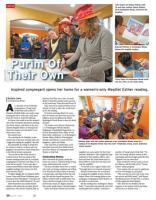

Left: Ayelet and Hadas Pollock, both
14, and their mother Allison Pollock,
all of Huntington Woods, read from the
megillah.
Deborah Rittman of Huntington Woods
follows the megillah reading.
Aviva Cohen of Huntington Woods holds
her son, Adin, as she reads along.
Inspired congregant opens her home for a women's-only Megillat Esther reading.
Barbara Lewis
Contributing
Writer
I
s a member of two Orthodox
congregations, Young Israel
of Oak Park and nearby Or
Chadash, Michelle Sider was used to men
running the show. Only men could read
from the Torah or chant the haftarah.
At Purim, she would sit on the women's
side of the mechitzah, the barrier dividing
men from women, and listen as the men
chanted Megillat Esther. At Young Israel,
where the women sit in the back, it was
often hard to hear.
She wanted more.
At a meeting for Or Chadash, we dis-
cussed ways to increase women's roles, and
I suggested reading the megillah," she said.
It's permissible according to Jewish law
for women to read to a women-only con-
gregation, she said, but it wasn't being done
in the Detroit Jewish community
"You see this in New York; you see it
in Israel, but we don't see much of this
[women reading sacred texts in a women's
congregation] in Detroit:' said Sider, 53, an
artist and art teacher. "A few years ago, a
woman named Shana Schick held women's
megillah readings in her home, but she's
since moved to Israel:'
To Sider's delight, the Or Chadash rabbis,
Azaria Cohen and Eliezer Finkelman, gave
the project their full support. "It meant a lot
to me to have the rabbis behind it:' she said.
Sider doesn't have any nearby female
relatives with whom she can share Jewish
experiences. She and her husband, Bill, an
A
20 April 3 • 2014
attorney, have three sons. Josh, 19, made
aliyah to Israel last summer and is serving
in the Israel army. Twins Ben and Eli are 16.
Sider sent out an email invitation to her
friends, but had no idea who would show
up for the reading.
On Purim morning, March 16, more
than 50 women and girls from across the
religious spectrum gathered at Sider's
Huntington Woods home to hear the Book
of Esther.
The readers were Miriam Chesterman,
17, of Huntington Woods; Marilyn
Finkelman of Southfield; Noga Gazit, 14,
of West Bloomfield; Elaine Kahn of Oak
Park; Eden Lichterman, 15, of Huntington
Woods; Allison Pollock of Huntington
Woods; and Pollock's 14-year-old twin
daughters, Ayelet and Hadas.
They read from a handwritten scroll
that Sider borrowed from Rabbi David
and Alicia Nelson of Congregation Beth
Shalom in Oak Park.
Celebrating Women
Sider welcomed the guests, saying the
event was a way to "celebrate being strong,
smart, dedicated Jewish women:'
The story of Esther shows how a woman
who starts out being compliant and willing
to be directed by others learns to become
a strong leader, said Sider before the read-
ing. She said she hoped her guests, like
Esther, would be able to define their own
values, find the strength to live by them
and become aware of a higher purpose
that would enable them to become leaders.
Ayelet and Hadas Pollock had read the
Michelle Sider tells the women gathered in her Huntington Woods home for a
reading of the Megillat Esther that the event "celebrates strong, smart, dedicated
Jewish women."
megillah two years earlier for their b'not
mitzvah celebration. They taught the trope
(melody) to their mother, Allison, who
had read from the Torah before and is a
fluent Hebrew reader but who had never
read the megillah.
"It was fun to do it again:' Hadas said.
"It brought back a lot of good memories:'
Miriam Chesterman was accustomed
to reading the megillah. In fact, she had
helped chant it the evening before at her
synagogue, Congregation Beth Shalom, as
she had for several years.
But the reading was a challenge for Elaine
Kahn. "I never had a bat mitzvah, never did
anything like this in public:' said Kahn, a
member of Young Israel of Oak Park. "We
have very strong, talented women in this
community and not enough events like this.
I figured if not me, then who?"
Kahn worked for several weeks to learn
the Hebrew, with the help of the "Virtual
Cantor" online program.
Even women who are used to egalitarian
services were happy to participate.
"This was the one time I sat in the wom-
en's section and didn't mind:' said Sheyna
Wexelberg-Clouser of Oak Park, a member
of fully egalitarian Beth Shalom.
Sider said she was thrilled with the
response to her project, which she hopes
will become an annual event. ❑