

Boom I Senior Travel
My Jewish Stories
Irene Shaland { Contributing Writer
y husband and I have been travel-
ing the world together for more
than 30 years, ever-attuned to
the Jewish story that, more often than not,
seemed to be an endless chain of persecu-
tions, humiliations and mass murders: from
century to century, from country to country.
When we went to Africa, our friends joked:
"It will be a challenge to find your Jewish
AFRICA AS A PERSONAL JOURNEY
My father led me to Africa. This is how my
first African Jewish story began, almost 50
years ago, in Soviet Russia.
I grew up surrounded by hundreds of
books collected by my parents over the years.
IRENE SHALAND
M
stories among the wildebeests!" "You'll see,"
I said. "I'll find a few good ones."
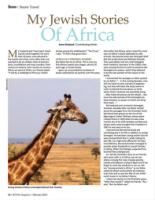
Among animals of Africa at Serengeti National Park, Tanzania
18
BOOM Magazine • February 2014
And within this library, what I loved the most
was my father's books dedicated to wild
animals. My favorite book was Serengeti Shall
Not Die by Bernhard and Michael Grzimek.
They were father and son, both biologists
from Frankfurt, Germany. In the 1950s, they
were among the first to work to preserve the
Serengeti eco-system, which they believed
to be the last wonder of free nature in the
world.
I memorized the passages so often quoted
by my father: "... in the coming decades, men
will not travel to view marvels of engineer-
ing, but they will leave the dusty towns in
order to behold the last places on Earth
where God's creatures are peacefully living
... Man-made structures can be rebuilt ... but
once the wild animals of the Serengeti are
exterminated, no power on Earth can bring
them back ..."
My husband and I arrived in Serengeti,
Tanzania, decades after my father recited
aloud the passages from the Grzimeks' book.
We found their graves on the rim of the
Ngorongoro Crater: Michael, whose plane
crashed there in 1959 when he was a few
months shy of his 25th birthday and Bernard,
whose ashes were brought from Frankfurt in
1987 to rest next to his son.
I learned that Bernard Grzimek did
something else in his life in addition to saving
Serengeti. He had been saving Jewish lives for
years during World War II, while risking his
own life. As a high-level official for the Nazi
Food Ministry, Bernard Grzimek managed to
provide stolen foodstuffs to Jewish families
in hiding. When the Gestapo suspected him,
Grzimek fled underground.
As I tell the Grzimeks' story to our friends
who came with us to Africa, we can see
zebras crossing the road, impalas grazing
nearby and baboons trying to figure out if we
forgot to close the windows in our car. We
are "among animals in Africa," as my father
called his dream world where all creatures
roam free and as was the title of one of Ber-
nard's books in my father's library.
I place two stones on the Grzimeks' grave.
"Were they Jewish?" asked my friends. "No, I
said. "But my father was."