

metro >> on the cover
A Mother's
View
Author Judi Markowitz offers a peek
into her world of raising a child with
a rare disorder.
Robin Schwartz I Contributing Writer
CONTINUED FROM PAGE 1
heard of" Markowitz explains in the book's
introduction. "And, there are 30 million
mothers who, like me, were informed of
the syndrome their baby was born with
in words that sounded something like
this: Your child is not normal. Blah, blah,
blah. Your child will be different from all
the other children. Blah, blah, blah. Those
eyes you're staring into right now belong to
someone who's damaged. It is not your fault.
Or, maybe it is your fault. Blah, blah, blah.
You have just delivered a functioning baby,
but you have also delivered yourself a life
sentence:'
Doctors told Markowitz most people
born with Marshall-Smith Syndrome don't
live past age 2. But Lindsay is living proof
that medical professionals don't always
have all the answers. Judi says despite the
overwhelming diagnosis, she proceeded
with life as if Lindsay wasn't disabled,
determined to make each day beautiful for
her child. She temporarily stopped teaching
and focused on her daughter's well-being.
"Don't think I was in denial" she writes.
"We all have our battles; some are minor
and others are fought on unforgiving ter-
rain. We also have choices ... For me, it
basically boiled down to two: I could allow
myself to be consumed with grief, or I
could face the hard, cold facts and move
forward. There was no gray area here. I
chose to enjoy life with Lindsay, whatever
that might hold:'
Overcoming Challenges
Over the years, Markowitz has had to
overcome some seemingly insurmountable
challenges. She's dealt with grief, anger,
pain and fear, the breakup of her first mar-
riage, the trials and tribulations of finding
the right doctors for Lindsay, and the cru-
elty of strangers.
"It took me a long time to reconcile my
outrage at the ignorance of people, at their
uncomfortable stares and rude comments"
she says. "This didn't happen overnight:'
She also has experienced incredible joys
— marrying Jeffrey Markowitz (her best
friend in high school whom she dated in
college), watching her children grow, tak-
ing family trips and carving out a life that
works for all of them.
"To us, this is our normal," Jeffrey
explains. "We've never looked at it as a bur-
den the way other people might"
Judi adds, her sons grew up with accep-
tance, love and compassion for their sister
and their actions taught others to be more
insightful.
"Lindsay helps me to look at people with
understanding and a nonjudgmental atti-
tude," Chad says.
Judi's eldest son, Todd, a rabbi in Israel,
says his relationship with his sister helped
him find his calling.
"Through contemplation of my sister's
condition and circumstance in life, I
became profoundly cognizant of Divine
providence, gaining an understanding that
HaShem alone runs the world" he says.
"My mother also lives with these ideals"
In the book, Markowitz recounts her
own deeply personal religious journey.
Initially, she became disillusioned with
Judaism and lost faith. She looked at other
religions including Jehovah's Witnesses and
Jews for Jesus, but grew disillusioned with
these groups as well and returned to her
Jewish roots.
At one point she sought answers in
Rabbi Harold Kushner's 1981 book, When
Bad Things Happen to Good People. The
rabbi's son, Aaron, was born with Progeria,
a rare genetic condition that causes chil-
dren to age rapidly and to die young.
"[Rabbi Kushner] deviated from tradi-
tional beliefs and came to the conclusion
that God does not let these things happen,
that he is limited" she says. "But, after soul
searching for many years, I simply could
not abandon the notion of a God who is
in total control of this universe, whether
we like it or not. Now, 30 years later, I have
finally surrendered to the belief that I may
not know God's purpose, but I do know
that God is with me and my family"
Markowitz and her family belonged
to Temple Emanu-El in Oak Park where
Lindsay had a bat mitzvah. They now
attend the Woodward Avenue Shul in Royal
Oak or Aish HaTorah in Oak Park. She says
she's become more religious over time.
"I truly believe that due to all of my
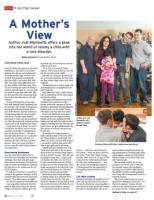
Jeffrey and Judi
Markowitz with
children Lindsay,
Eli and Chad
I
Brothers Chad and Eli give Lindsay hugs and kisses.
prayers — and anyone else who prayed
for Lindsay — that I was given a miracle
she writes. "It just took a while to recog-
nize this. There were only 18 cases of MSS
reported in the world's medical literature
by 1982, when Lindsay turned 5 — and
she was alive. By beating these statistics,
God had granted her the opportunity to
be something special and that was the
miracle"
Life With Lindsay
Markowitz describes her daughter as "ener-
getic" and says she loves to be on the go.
She says her family has worked together to
give Lindsay an action-packed life. Lindsay
has taken ice skating lessons with an alu-
minum walker, attempted horseback rid-
ing, participated in a bowling league using
special adaptive equipment, and traveled
with her family to more places than most
able-bodied people.
She constantly requires one-on-one
assistance and cannot read or write, but
has attended various school programs,
including one at Andover High School in
Bloomfield Township. Lindsay graduated
from Wing Lake Developmental Center for
impaired students.
"She is non-verbal but she can answer
questions by shaking her head 'yes' or 'no"'
Markowitz explains. "Lindsay will also
walk us to her desired location in order for
her needs to be met. Nothing makes her
Mother's View on page 10
8
February 27 • 2014
Jh