
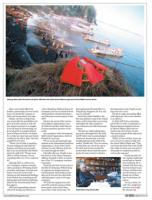

Cleanup efforts after the massive oil spill in 1989 when the tanker Exxon Valdez ran aground at Prince William Sound, Alaska.
After a year, David offered his
brother a partnership, but was turned
down. He started the company in
1968, and incorporated a year later.
Charlie, who lives in Royal Oak,
was named after his grandfather and
grew up in the business as well. He
also strayed, moving to Los Angeles
to try his hand at screenwriting, but
got a job at the Los Angeles Depart-
ment of Water and Power. He stayed
for a while, but came back and started
working for his dad in 1984. He's been
president for 10 years.
"There's a lot of pride in spending
30 years helping my dad build the
business, and these are my people;
this is my second family;' said Charlie
about the staff of 60. 'We get many
offers to sell the business. It's not
something either one of us would ever
do."
Although MPC is a full-service,
24/7 emergency response company
with a specialty in off-loading strand-
ed tankers and barges, its bread-and-
butter work is less newsworthy —
cleaning up old, abandoned buildings
in the Detroit area, including an old
plating plant and Dearborn Refining
plant for the Environmental Protec-
tion Agency.
MPC has longstanding contracts
with DTE Energy and Chrysler, as
www.redthreadmagazine.com
well as Marathon, Shell and Exxon oil
companies, and has a General Services
Administration schedule that allows
any federal government agency to hire
MPC.
David is also proud of the interna-
tional alliance organizations, some
of which he founded, which help oil-
cleanup operations anywhere in the
world.
He is president of the International
Spill Control Organization, which he
founded 30 years ago.
'We are a non-governmental orga-
nization to the International Maritime
Organization, a body of the United
Nations;' he said. 'All laws of the sea
are made through the IMO."
Like father like son: Charlie is also
the director of the Marine Response
Alliance, founded in 1994, an associa-
tion of five U.S. emergency maritime
responders.
David has also been an innovator in
the field of oil cleanup. With the help
of engineers, he designed and pat-
ented hydraulic submersible pumps
that can be lowered onto ship decks
with helicopters or put in air-cargo
containers.
'e built the equipment in 1973
and 1974, made the pumps and the
power packs, and we have them
around the world:' David said. 'We
keep equipment all around the U.S.,
Hong Kong, Singapore, the U.K. and
soon in Australia."
David also created Buddha 1, the
first anti-pollution vessel in the United
States, and his latest idea is recovering
submerged oils with a small two-
man submarine tied with their pump
systems.
"My dad was really pushing clean-
ing up the submerged oil in the Gulf,
but BP didn't want to acknowledge it
whatsoever, because they were busy
enough cleaning up the stuff on the
surface," Charlie said. "Now it's coming
out that there are a lot of tar mats in
the Gulf. And it turns out that the
product that Chevron had been push-
ing for 30 years, Corexit, to dissolve
David Usher in his Detroit office
this dispersant is toxic. People are get-
ting sued over it now"
The job is tough, demanding, filled
with long hours, and a team member
is on call 24/7.
In 1989, MPC had a contracting
job for the U.S. Navy in Antarctica. A
Russian ship got stranded in the ice
at Palmer's Station, filled with eco-
tourists and a few drums of waste.
They got the people off the ship and to
a research station.
Within 12 hours of their return, the
crew was put on a plane to help with
the Exxon Valdez, Charlie said. "They
went from the South Pole to the North
Pole within 24 hours and were part of
100 people we employed up there to
work on the response."
Charlie has three sis-
ters, and his mother just
moved back to Detroit
from California. He is
married with three sons,
but doesn't know if any
of them will follow him
into the business, even
though two of them
have worked there off
and on.
"It's up to them:' he
said. "It's a tough busi-
ness, but we're tough,
like Detroit." RT
Rth IMOD I March 2014 37