
Boom I Senior Travel
CONTINUED FROM PAGE 19
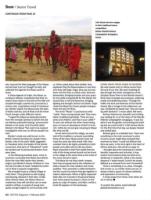
Left: Masai warriors engage
in their traditional dance
competition.
Below: Nairobi Hebrew
Congregation Synagogue,
Kenya.
yika, learned the Maa language of the Masai,
earned their trust (or thought he did), and
collected the legends the Masai cared to
share.
In these legends of origin, the Masai, ac-
cording to Merker, maintained that their an-
cestors were slaves in the land of the Nile and
escaped through a parted sea, pursued by a
vicious ruler. Long before arrival of missionar-
ies, Merker stated, the Masai knew the tales
of Adam and Eve, and of Noah and the Great
Flood, though under different names.
"I regard the Masai as being descended
from the nomadic Semites to whom the old-
est Hebrew pastoralist belong," pronounced
Merker in his study. Lord Churchill called
Merker's Dei Masai "the most truly inspired
investigation that ever an African people has
had."
Merker's study was well-known to the
British Colonial Secretary Sir Joseph Cham-
berlain, who in the early 1900s suggested
to Theodore Herzl, the leader of the Zionist
movement, that parts of "Masailand" could
be handed over to persecuted Eastern Euro-
pean Jews.
In the following hundred years, most re-
searchers concluded that Masai have Nilotic
(from the river Nile) rather than Semitic
origins, but Merker's theory of Masai as "one
the lost 10 tribes of Israel" stubbornly contin-
ues to float in popular imagination.
We arranged to go to a Masai village to
meet them. They greeted us with singing
and dancing, dressed in their best. Unlike
other African tribes, the Masai refuse to
modernize; they will not drive cars or wear
western clothes. A couple of young men
spoke enough English to communicate with
20
BOOM Magazine • February 2014
us. When asked about their beliefs, they
explained that the Masai believe in one God
who they call Engai. Engai, they say, has two
faces: the first face is a black color, kind and
benevolent, bringing thunder and rain, grass
for the cattle and good life for the Masai; the
second face is red and fearsome, bringing
lighting and drought, famine and death. Engai
made the Masai his chosen people and gave
them the land of Africa.
The word "Masai" is synonymous with
"cattle," these young people said. They trans-
lated a traditional greeting: "How are your
wives and children, and how is your cattle?"
To own one without the other means being
poor; to have an abundance of both is to be
rich. Cattle do not just give meaning to Masai
life; they are life.
As we went around the village, we were
told of the traditions curiously resembling
those of the Jews: Masai would never eat
meat the same day they drank milk; they
consider that to be highly unhealthy to both
people and cattle whose milk was drank.
More important is their firm belief that the
milk of the living animal should not be drunk
in the village at the same time as the meat of
the same animal is eaten.
The Masai do not have chiefs. Instead,
their lives are governed by the collective of
elders chosen for their wisdom and moral
qualities. Their assembly is called Sanhedrin
and the round but where they get together is
called a tabernacle. When a highly respected
elder dies, he is buried in the ground facing
east. Every passer-by places a stone on the
grave as a sign of respect, and after a while a
small hill appears on the landscape.
HOME AWAY FROM HOME IN NAIROBI
My next Jewish story in Africa comes from
the end of our trip. We were traveling all
day through the exotic strangeness of the
Zanzibar Stone Town to the Nairobi airport's
thick mess of people and suitcases, sickening
smells and deafening noises. Through the
traffic and dust and darkness of the Nairobi
streets, like a mirage in the wilderness, we
saw a brilliantly lit Jewish star. "Are you meet-
ing with Barbara?" a voice asked. We were.
Barbara Steenstrup, beautiful and smiling,
was waiting for us on the steps of the Nairobi
Hebrew Congregation synagogue. It was too
dark to see the garden surrounding the build-
ing but we could smell it. It felt almost divine.
For the first time that day, we deeply inhaled
and smiled back.
Barbara gave us a detailed tour. There was
something in the main sanctuary's colors
of warm wood, bright blue and gold that
warmed my heart. I could not believe that
here we were, in the shul right in the heart of
African darkness. (See photo on page 3.)
I thought about the meaning of a Jewish
identity: expansive and inclusive, it may
stretch much beyond what we think of as
Ashkenazi or Sephardic. What is the Jewish
diaspora? I asked myself. Could it be simply
defined as a removal from one's homeland?
There is something in us, Jews, I thought,
that moves us, no matter where we are, to
always create a space of cultural solidarity
and expression of community.
A home away from home. Even when we
are in Africa.
■
To contact the author, email editor@
globaltravelauthors. corn.
Scanned image of the page. Keyboard directions: use + to zoom in, - to zoom out, arrow keys to pan inside the viewer.
February 27, 2014 - Image 100
- Resource type:
- Text
- Publication:
- The Detroit Jewish News, 2014-02-27
Disclaimer: Computer generated plain text may have errors. Read more about this.