

metro >> Jews in the digital age
Bridging The Tech
'Generation Gap'
F
or the second year, Adat Shalom
Synagogue brought two genera-
tions together for "Tech Connect"
This program, conceived of by Charlotte
Dubin and endowed in memory of her late
husband, Harold, has Jewish teens teach-
ing the older generation about new tech-
nology. Tech Connect II took place on two
Sundays at the Farmington Hills-based
Conservative synagogue.
As I did at the
inaugural Tech
Connect, I opened
the program with
some thoughts on
how technology has
changed our lives.
After speaking about
how the Internet
can be used these
days to purchase
an airline ticket,
order photo prints
of grandchildren or
download a new pat-
tern for the sewing machine, I watched as
savvy teens assisted computer-challenged
boomers with notebook computers and
tablets. It struck me that this program
should be replicated around the world
because there are many boomers and
seniors who do not have young grand-
children around to help learn today's tech
gadgets.
In her book Dot Complicated, Randi
Zuckerberg writes about something that
many of us have recognized. The older
generations learn from the younger gen-
erations when it comes to computers and
technology. I can't count the number of
times an adult has remarked to me how
a child taught them to use a new smart-
phone. Perhaps this is no different than
generations ago when adults couldn't
program a VCR or answering machine and
relied on their children to do it.
Today, I'm seeing that more than just
relying upon the younger generation to
simply set up a computer or program a
new phone, older adults are looking to
teens to educate them. Adults realize that
they don't merely need young people to
complete a technological task for them
(e.g., book a flight online), but they need
to learn how to do these tasks themselves.
As I explained to the older folks in
the Adat Shalom youth lounge at Tech
Connect, decades ago if you wanted to
see photographs of the grandchildren
you could rest assured that your children
18
February 6 • 2014
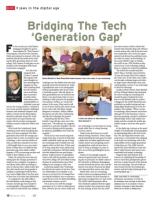
Suzie Mitchell of West Bloomfield helps boomers learn the ropes of new technology.
would give you the doubles that were auto-
matically printed by the photo lab. Today,
if grandparents want to see photographs
of their grandchildren they need to have
a Facebook account. After all, photos of
their grandchildren are on Facebook and
there's a very good chance that no one is
thinking to order prints for the grandpar-
ents anymore. Further, as I warned the
seniors in the room, if they want to talk
to out-of-town relatives they need to learn
how to video chat with Skype, Google
Hangouts or Facetime. Today's children
have grown up with video conferencing
and take this technology for granted.
Zuckerberg tells the story of her
friend's 2-year-old who came over to her
home once. "The child saw my computer,
pointed to it, and said, 'Grandpa!' The boy
is so used to Skyping with his grandpa,
he thinks his grandfather lives inside the
computer:'
There's just no way around using tech-
nology these days. It used to be that older
adults could fairly easily opt out of using
new technology and it wouldn't have any
negative effect on their lives. If they want-
ed to keep using their rotary phones they
could still communicate with their family
who had adopted the new push button
phones. Today, however, if a grandfather
wants to talk with his grandson who just
went off to college, he's more likely to keep
the lines of communication open if he's
willing to text message or video chat.
Zuckerberg explains that "technology
has altered every aspect of our lives, from
our relationships to our families to our
careers to our love lives. It's changed how
we celebrate birthdays, how we announce
major life news, how we define friendships
and demand customer service'
This is just as true with the younger
generations as it is with our oldest genera-
tions. However, the use of new media and
A teen and senior at Adat Shalom's
Tech Connect II
new technology is second nature to young
people while there is a sharp learning
curve for seniors.
Today's teens don't know of a world
without texting, Facebook, Twitter, Skype
and downloading the latest game for under
a dollar from an online application store.
Today's seniors were just getting used to
managing their email and now have to
learn to setup an Instagram account so
they can see their granddaughter's prom
photos.
Seniors are increasingly using the
Internet in general and social network-
ing sites in particular. Dr. Sheila Cotton at
the University of Alabama, Birmingham,
recently showed that seniors who used the
Internet were about 30 percent less likely
to be depressed than seniors who didn't.
Rather than curse new technology,
today's seniors are jumping onboard. And
an entire industry has been launched to
help seniors navigate their new tech world.
The AARP's chief information officer,
Terry Bradwell, explained that the organi-
zation's members have expressed a desire
for tech training. In that vein, the AARP
has entire sections of their website that
include video tutorials, blogs and webinars
to assist seniors who wish to become more
tech comfortable. Since 2010, the organi-
zation's book division has published seven
new titles on seniors and technology. At
the recent Life@50+ Expo in Atlanta,
the AARP set up a TEK Pavilion to help
seniors learn to use technology, linking
them to a whole new world of possibilities.
The AARP also recently launched
Takei's Take, a YouTube series hosted by
76-year-old George Takei of the original
Star Trek series. In the video series, Takei
cuts through confusing jargon and indus-
try lingo to give older people clear, trust-
worthy guidance on how to use technology
to their best advantage.
Locally in Metro Detroit, Suzie Mitchell
of Clear Writing Solutions has developed
her entire writing and consulting firm
around the goal of making the transi-
tion to a tech lifestyle easier for seniors.
A blogger for the AARP, Mitchell focuses
exclusively on mobile training and mar-
keting digital health products to the 50+
audience. She explains, "When it comes
to technology, many boomers and seniors
often get lost in the directions or have a
hard time grasping a product's usefulness:'
Mitchell helps seniors with mobile tech-
nology and also consults the mobile app
makers trying to reach the older genera-
tions.
As the digital age continues at the speed
of light, it's essential that all demographics
are participating fully in this tech revolu-
tion. We can't forget that boomers and
seniors have a much harder time adapting
to all of this new technology, and it's the
responsibility of the younger generations
to help them out. The AARP and tech
experts like Suzie Mitchell are ready and
able to make boomers and seniors more
comfortable with today's technology.
Programs like Adat Shalom's Tech
Connect are exploiting the knowledge of
teens to teach their grandparents' genera-
tion how to make the most of the Internet
and new technology. The end results are
closer bonds between the bookend gen-
erations and the further bolstering of our
amazing digital age.
❑
Rabbi Jason Miller is a technologist,
entrepreneur and educator. He writes for
the Huffington Post and blogs at http://blog.
rabbijason.com . He is president of Access
Computer Technology in West Bloomfield.
Follow him on Twitter at @RabbiJason.