

oints of view
>> Send letters to: letters®thejewishnews.com
Should conversion to Judaism culturally - not religiously - be allowed?
Point
Counterpoint
Another Path To Join
The Jewish People
'Cultural' Alternative To
Conversion Is A Bad Idea
JTA
JTA
Judaism as an exclusive religion so as not to
ight now, there is just one way
offend their parents or other family mem-
for someone who is not Jewish to
bers, or because conversion requires aban-
M become Jewish in a publicly rec-
donment of religiously grounded customs
ognized and officially authorized fashion:
and holidays like Christmas.
undergo religious conversion under the
Even though significant numbers of Jews
auspices of a rabbi.
are secular, atheist or
Whether the
celebrate Christmas
path to Jewish
as a seasonal holiday,
identification fol-
holding such positions
lows Orthodox,
and observing such
Conservative,
practices present pro-
Reform,
spective converts with
Reconstructionist or
insurmountable barri-
other auspices, con-
ers to conversion.
version is explicitly
As a result, many
and entirely reli-
would-be members
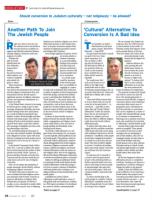
Professor Stev en M. Cohen
gious in nature.
of the Jewish people
and Rabbi Ke rry Olitzky
These movements
have no possibility of
and their rabbis
engaging in a course
vary both in the preparation they demand
of study and socialization that would lead
and the religious commitments they seek
to public recognition of their having joined
of potential converts. But all require a
the Jewish people, and they have limited
significant measure of religious education,
access to enriching their familiarity with
practice and expressed commitment to a
"lived Judaism" — the actual culture and
Jewish way of life.
ethos of Jewish life as lived in families and
In the United States, interest in becoming communities. And we know that most
Jewish has grown, owing in part to inter-
people live out their Judaism more in the
marriage, intergroup friendship, and more
informal context of family and friends than
positive feelings about Jews and Judaism.
in the more formal context of religious
As a result of Judaism entering the mar-
institutions.
ketplace of ideas, Jewish thought and ideas
In theory at least, broader access to
resonate with many people. And with the
Judaism beyond that already offered by
melting of hard social boundaries separat-
rabbis, congregations and religious move-
ing Jews from others, many have entered
ments could result in more non-Jews in
into marriages, friendships and close work-
Jewish families and friendship circles
ing relationships with Jews.
building Jewish homes.
Yet, notwithstanding the thousands of
To provide a viable alternative to a reli-
non-Jews who maintain familial, friendship gious route to becoming a Jew, we propose
and collegial ties to Jews, many with some
a second explicitly cultural pathway to join
interest in joining the Jewish people may be the Jewish people. This pathway, which we
disinclined to do so for any of a variety of
call Jewish Cultural Affirmation, would be
reasons.
clearly distinguished from Jewish religious
In the Jewish Community Study of New
conversion. Religious conversion would
York: 2011, 7 percent of adults who identi-
remain a rabbinic prerogative, and Jewish
fied as Jewish reported that neither of their
Cultural Affirmation would not assume an
parents were Jewish. Of the 7 percent, 2
anti-religious ethos. Nor are we suggesting
percent said they formally converted and
that Jewish Cultural Affirmation undermine
5 percent said they became Jewish by per-
or obviate the traditional path to conversion.
sonal choice and not by way of religious
Rather, by offering an additional vehicle
conversion.
to acquiring a Jewish social identity, Jewish
How can we explain the popularity of
Cultural Affirmation would allow prospec-
people assuming a Jewish identity without
tive Jews to acquire a measure of familiarity
undergoing religious conversion?
with being Jewish and to undergo a non-
We believe that some prospective con-
religious pathway toward membership in the
verts to Judaism feel that religious conver-
Jewish people.
sion demands what for them would be an
Candidates for Jewish Cultural
insincere affirmation of religious faith.
Affirmation would undertake a course of
Perhaps they are agnostic or atheist or
self-guided study and experiences, outlined
secular, or even committed to another faith
in a Web-based curriculum to be developed
tradition. Others may be wary of adopting
by a panel of scholars, communal profes-
I
Point on page 37
36
December 12 • 2013
f
l he reputable car dealer's
advertisement in the local
paper screams "Brand New
Mercedes — Only $500!"
You get excited but think it sounds
too good to be true. Upon
closer inspection, it is.
The car dealer is offer-
ing only the hubcaps of
the Mercedes for $500. If
you want the whole car,
it will cost the standard
price. Suddenly the car
dealer doesn't sound so
reputable.
You would never find
such an ad because no car
dealer in his right mind
would make such an offer.
Yet hubcaps masquerading as the car
is exactly what Steven M. Cohen and
Rabbi Kerry Olitzky offer in their
op-ed.
Cohen and Olitzky bemoan that
as of now, there's only one way for
a non-Jew to become Jewish — i.e.
conversion — and offer an alter-
native they call "Jewish Cultural
Affirmation." Under this scheme,
those who are not interested in
Judaism as a religion, and even
those who follow a different religion,
could choose the Jewish Cultural
Affirmation path.
To achieve this lofty status, they
suggest that the candidate undertake
a Web-based self-study course along
with undefined "experiences of lived
Jewishness." Candidates could sample
Jewish topics ranging from politics
to comedy to social action and text
study. They then would be eligible
to receive a "certificate of member-
ship in the Jewish people:' much like
my certificate from the American
Legion.
As someone who is married to
a convert, who has spent the bet-
ter part of his professional life as a
Jewish communal leader and coun-
seled a wide range of sincere people
in intermarriages who seek entry
into the Jewish people, I find such
a proposal shallow, impractical and
offensive.
To reduce membership in the
Jewish people to a shallow "cultural
affirmation" completely misses the
point of being Jewish. To put it blunt-
ly, herring is not a religion.
We are a people who, despite our
small size, have for 3,500 years had
a critical mission in the world. As
Christian scholar Paul Johnson wrote
in his seminal History of the Jews,
"The Jews stand at the center of the
perennial attempt to give
human life the dignity of a
purpose
Judaism addresses the
most pressing life-and-
death issues, teaches us
how to infuse the sacred
into all of existence and
presses us to strive to
become a "light to the
nations." To reduce all of
that to a mere cultural
affirmation is to say that
the most profound ele-
ments of Judaism are unimportant.
The proposal is impractical. People
who wish to convert can and will
do so. The myriad approaches to
American Jewish life offer a range of
conversion options, from traditional
conversions that require years of
preparation and a commitment to
all of the mitzvahs, to conversions
that can be completed in a matter of
months with minimal lifestyle chang-
es. If someone is uninterested in
following even a minimal conversion
route, why would they be interested
in "affirming" a Jewish identity at all?
And just what would such an affir-
mation accomplish? There already
are a number of non-Jews in inter-
marriages who are attempting to
raise Jewish children, who serve on
synagogue boards, and who observe
some Jewish holidays with their
Jewish spouses even as they celebrate
Christmas and go to church. Jewish
educational opportunities are readily
available to them. Rabbis and other
Jewish leaders often praise their
efforts.
All this has happened without an
affirmation process or completion
certificate. Creating a new process is
superfluous; it would do nothing to
change the reality on the ground.
Finally, Cohen and Olitzky's pro-
posal is offensive. In my experience,
Jewish leaders who propose novel
conversion procedures almost never
consult with the end users — con-
verts themselves, who could tell
them from deep personal experience
what is and isn't needed.
Counterpoint on page 37