

metro
Mameloshen Lives! from page 8
Detroiter Aaron Egan who led informal
Yiddish conversational sessions on alternate
weeks with Mechnikov. A professional chef
who has arranged several "Dinner with
Bubble" dinners in private homes for WC/
AR, Egan studied Yiddish at U-M.
"Having my son, Aaron, connected to
and interested in the language has brought
me great joy," Frank said.
Yiddish At Universities
Deborah Dash Moore, director of U-M's
Frankel Center for Judaic Studies, said the
Jewish Federation of Metropolitan Detroit
(JFMD) established and funded a posi-
tion in Yiddish language and literature in
the early 1980s, which was filled by Anita
Norich, Ph.D. The native Yiddish speaker
studied Yiddish literature at YIVO Institute
for Jewish Research in New York and
Hebrew University in Jerusalem.
Her students included Adat Shalom
Synagogue Rabbi Aaron Bergman, who
taught a FedEd class, "Yiddish Poetry,
Songs and Curses:' last month for
Federation's Alliance for Jewish Education.
Moore said 15 students are enrolled in
U-M Yiddish classes, a number holding
steady.
"Last year, a student graduated who
wrote an honors thesis on a Yiddish social-
ist movement in New York:' she said.
"Graduate students of literature also study
Yiddish, perhaps as part of the Comparative
Literature program':
Avery Robinson, 24, of Franklin, a Judaic
Studies master's student at U-M, is in his
third semester of Yiddish instruction with
Alexandra "Sasha" Hoffman, Ph.D. Misha
Krutikov, Ph.D. is another U-M Yiddish
teacher.
"The Yiddish-speaking
world may not be as
robust as it once was,
but that does not make
this language useless:'
Robinson said. "There
is still a large population
of speakers and a wealth
Avery
of literature and other
Robinson
historical information in
Yiddish ... very relevant
to Jewish identity and peoplehood."
Joanna Mazurkiewicz of Poland is tak-
ing advanced Yiddish during her first year
of a doctoral program in U-M's Slavic
Department. She formerly worked at the
Jewish Theater in Warsaw.
"I am specializing in Yiddish theater; she
said, "because [it] is a 'rejected daughter' of
Jewish culture. My aim is to attract people
to get to know it. I am currently writing a
play in Yiddish that I hope to be staged at
U-M in 2014:'
Howard Lupovitch, Ph.D., director of
Cohn-Haddow Center for Judaic Studies
at Wayne State University, said he and
Margaret Winters, Ph.D., the univer-
sity's provost and senior vice president of
Academic Affairs, "have discussed in a
10 December 5 • 2013
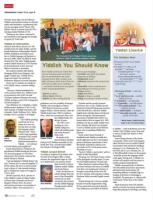
The Freylekhe Fraynt (Happy Friends) group was
formed in 1983 to perpetuate speaking Yiddish.
Yiddish You Should Know
Many Yiddish words have worked their
way into everyday speech. Even those
who are not Jewish know the words
chutzpah, kvetch, klutz, mentsh, nosh,
ship, schmooze, shtick and oy! Here are
a few more to add to your vocabulary
— and maybe remind you of your grand-
mother or great-grandmother:
• Maven: an expert.
• Bisl or bissel: a little bit.
• Bupkes: less than nothing (literally
preliminary way the possibility of having a
Yiddish course or program at Wayne
WSU Board of Governors member
Eugene Driker, a Detroit attorney, chairs the
Yiddish Book Center (YBC) in Amherst,
Mass., which has rescued more than a mil-
lion Yiddish books over
the last 30 years.
"The YBC is now
working on a new
Yiddish college text,
which will combine print
and online features,"
Driker said.
He speaks at the
Eugene Driker
annual Sholem Aleichem
Institute (SAI) Holiday Assemblies for the
Jewish New Year, currently held at Hillel
Day School in Farmington Hills.
Yiddish Around Detroit
According to longtime SAI president Alva
Dworkin of Farmington Hills, a retired
educator, the organization began in 1926
as an independent, non-partisan Jewish
shule (school) in Detroit.
Children studied Yiddish
and Jewish history.
Under the direction of
scholar Moishe Haar, SAI,
now in West Bloomfield,
evolved into an adult
community that perpetu-
Alva Dworkin
ates the Yiddish language
through Jewish cultural,
educational and social activities.
horse or goat droppings).
• Gornisht: more polite, but another
strong sense of nothing.
• Mishpocheh: family.
• Shlimazel: someone with constant bad
luck.
• Shmendrik: a jerk or stupid person
• Gey Avek: get out of here, go away.
• Grepse: to burp.
• Pupik: belly button.
• Shanda: a shame, a scandal.
• Zaftig: juicy, plump, a buxom woman.
Dworkin and the recently deceased
Jack Boxer, who co-led a Yiddish class for
Institute for Retired Professionals members
at the Oak Park JCC, sold their Yiddish-
English book, Gefrishte Mayses (Freshened
Stories) during the 14th International
Association of Yiddish Clubs (IAYC) con-
ference held in Novi in August 2011. IAYC
publishes Der Bay, an Anglo-Yiddish news-
letter. Attendee Sid Simon was intrigued
to meet a Yiddish teacher in his 40s from
Japan, who is translating Yiddish into
Japanese.
Social worker Naomi Pinchuk of
Southfield made Yiddish accessible dur-
ing the eight years she led a conversation
group at Hechtman Apartments in West
Bloomfield. Eichenhorn started as the
new leader on Oct. 24; the group meets
Thursdays at 2 p.m.
"Naomi's Yiddish is spectacular," said Lee
Henkin of West Bloomfield.
The group was "free form because a third
of the participants [usually about 15] were
not real Yiddish speakers," Pinchuk said.
When Hechtman residents Meyer King
and Yona Friedman told stories in Yiddish
from their own background or history, or
brought in interesting articles from the
Forverts, Pinchuk, and sometimes resident
Shoshona Wolok, provided English transla-
tions.
Despite having only 5 percent eyesight
because of macular degeneration, King,
96, has memorized and recited speeches
from Shakespeare and Gilbert & Sullivan
The Shabbes Meal
Mir benchn di licht* un di challah
ud vine**
Di tishtakh*** is white un di
glasslakh**** will shine.
Di kreplakh geshmak***** and
the soup is so good
There's nothing that tastes like
the Shabbesdikeh****** food.
So kum gikh tzum tish,******* we're
ready to dine.
* Mir benchn di licht — I bless the
candles
** un di challah un vine — and the
challah and wine
*** di tishtakh — the tablecloth
**** di glasslakh — the little glasses
***** Di kreplakh geshmak — the
kreplach are tasty
****** Shabbesdikeh — of Shabat
******* kum gikh tzum tish — come
quickly to the table
- Rachel Kapen's Yiddish limericks
appear in the JN around holidays.
in Yiddish — both at Hechtman and at the
Yiddish Vinkl (Yiddish Corner) that used
to meet at Temple Shir Shalom in West
Bloomfield.
Noemi Herzig, director of the Jewish
Community Center's Active Life program,
asked Pinchuk to lead a monthly Yiddish
Conversation Club at both JCC buildings,
starting at 1 p.m. Wednesday, Dec. 11, in
Oak Park and at 2 p.m. Monday, Dec. 23,
in West Bloomfield. Seniors in the program
"would like to hear the language of their
youth again; Herzig said. A Yiddish con-
sortium with speakers and discussions is
another program being planned.
Yiddish conversation also is offered at
West Bloomfield-based Meer Apartments,
administered by Jewish Senior Life.
Something different is Yiddish bingo on
Sundays at the Park at Trowbridge in
Southfield. The game goes on without staff
involvement; Vivian Kean is the weekly
caller.
About 60 percent of the 220 residents
identify as Jewish, but anyone interested in
bingo likes playing Oy Vey Bingo, according