

Cashless Commerce
Trade exchanges are a winning strategy for local businesses.
W
By Shari S. Cohen
hen children
trade a juice
box for a cookie,
they are barter-
ing to acquire
something that
they want with-
out any money.
Adults trade goods and services
one-to-one as well, but during the
past several decades, many busi-
ness owners have used organized
bartering through trade networks
an important part of their business
strategy.
When a business experiences a
lull in customers, fixed operating
costs can be a drain on cash flow.
That's where trade networks fill a
gap — providing new customers
who pay for products or services in
trade credits through a membership
exchange.
Trade exchanges or bartering
networks facilitate business-to-
business sales among members who
use trade credits rather than cash
to buy from each other. The credits
received for a sale are banked for
that company and can be used any
time for purchases from another
exchange member.
Trade networks are a significant
force in the economy — the Inter-
national Reciprocal Trade Asso-
ciation, which works to establish
trade network standards across the
globe, reported $12 billion in trades
through exchanges during 2012.
The Detroit area is the headquar-
ters of two trade exchanges that
began in the 1970s —TradeFirst and
Metro Trading. TradeFirst (www.
tradefirst.com) has 5,000 mem-
bers and has achieved more than a
half-billion dollars in trades since its
establishment in 1978. Metro Trad-
ing Association (www.metrotrading.
com) has more than 3,000 mem-
bers in a wide range of businesses.
Each exchange has a significant
number of Jewish-owned businesses
as members.
Adrienne Lenhoff, owner of
Shazaaaml, a public relations and
marketing firm, uses TradeFirst to
offset business expenses such as
computer repairs, office furniture
and phones through trade dollars.
In addition, the firm's trading dol-
lars have been used for employee
outings and entertaining clients.
Shazaaam I is also a member of
Trade International Exchange,
which helps cover travel expenses to
visit clients in other countries. Her
agency, based in Novi, has traded
approximately $500,000 in volume
since joining Trade First in 2001.
"Barter groups are sales teams,
and they have kept us visible in
front of our target market. Our first
client was a barter company, and I
saw a great opportunity. Some trade
clients have retained us and some
have referred their clients to us," she
said.
Another trade exchange feature is
the ability to combine trade cred-
its with a line of credit for larger
purchases. She says that the trade
company charges interest compa-
rable to that for a credit card.
How It Works
TradeFirst clients are assigned a
broker who helps them identify
other members who offer needed
services.
"When we decided to move, I
called my broker and asked about
movers and storage companies.
When we were planning my daugh-
ter's bat mitzvah, I contacted my
broker to talk to a possible venue,"
Lenhoff explained.
While trade credits can be used
for non-business expenses, their
dollar value is personal income
subject to income taxes. Bartering
networks are legal and recognized
by the Internal Revenue Service,
notes Marshall Schwartzman, CPA,
of Randall, Frank, Schwartzman,
CPA, PLLC in Bingham Farms.
He points out that federal income
tax forms have a section for barter
transactions. Trade exchanges pro-
vide members with 1099 forms for
the services they sell.
Businesses usually pay a one-
time membership fee that provides
a trade exchange directory listing,
access to a Web-based directory, and
the services of an in-house bro-
ker who helps them find products
and services they need. Computer
capabilities have simplified and
enhanced the bartering process over
the years.
When Darrell Marx, owner of
Darrell's Firestone in Farmington,
provides car repair services for a
TradeFirst member, the transac-
tion is based on actual retail value
even though it's a non-cash sale.
The transaction amount for the car
repair is credited to his account at
TradeFirst, and the trade credits are
available for him to use with any
one of their members.
"It's like a little bank account,"
Marx said. "I use it every day for just
about anything from a coffee service
to cleaning to carpeting. I used it for
a b'nai mitzvah at the Roostertail
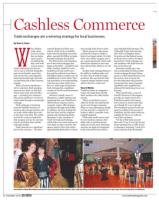
Darrell Marx of West Bloomfield used trade for the b'nai mitzvah of his children, twins Jade and Chase, at the Roostertail in Detroit four years ago. The event took place on Halloween.
42 December 20131
RED THREAD
www.redth read magazi ne.com