

metro >> on the cover
Seeking Cures
Israeli and American medical researchers
connect at U-M symposium.
Ruthan Brodsky I Contributing Writer
CONTINUED FROM PAGE 1
Israel Partnership for Research. Topics
included advances in cardiovascular, can-
cer and neurobiology research.
"The symposium gave us additional
opportunity to develop relationships with
Israeli faculty and researchers at Technion
[Israel Institute of Technology], Haifa, and
the Weizmann Institute, Tel Aviv:' Saltiel
says. "Each institution shared its strengths
and expertise. Israel is home to some of
the world's most advanced scientific and
technical research, and our alliances with
Israeli researchers have accelerated the
development of new medications and
treatments:'
Larry Jackier of West Bloomfield, chair
of Technion's international board, says,
"The late D. Dan Kahn's passion for the
State of Israel, Technion and U-M was
evident to all who knew him. It was his
tenaciousness, vision and generosity that
was the impetus for the first symposium
in 2011 between U-M and Technion, with
continued support from the D. Dan and
Betty Kahn Foundation. This year, the
Weizmann Institute of Science joined the
collaboration:'
"When my mother became ill, my father
was very involved with her treatment and
made a generous donation to the U-M
Cardiovascular Center:' says Andi Wolfe,
daughter of the late Betty and D. Dan
Kahn. "My parents raised us to be proac-
tive, and my hope is that we can continue
what my dad started, although it won't be
easy to follow in his footsteps:'
Collaborative Research
One reason for the collaborative trend is
that the movement toward more inter-
disciplinary research continues as ques-
tions become more complex and answers
require expertise in different subjects.
"One of my responsibilities is to provide
the best opportunities for our research-
ers:' says Eliezer Shalev,
M.D., dean, Technion
faculty of medicine.
"For example, one of our
research projects deals
with producing women's
eggs from embryonic
membrane. We need
to collaborate with life
Dr. Eliezer
sciences researchers
Shalev
12 November 7 • 2013
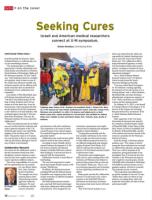
Tailgating: Boaz Golany, Ph.D., Technion vice president; David J. Pinsky M.D., direc-
tor, U-M's Samuel and Jean Frankel Cardiovascular Center; Israel Bar Joesph, Ph.D.,
Weizmann vice president; Ira Jaffe, U-M alumnus and tailgate party co-host;
Melvin Lester, M.D., special assistant to U-M executive vice president for medical
affairs and a tailgate co-host; and Eliezer Shalev, M.D., Technion, dean, faculty of
medicine.
and brainstorm with other institutions.
This symposium is the means to better
research because of our mutual support.
It's wonderful being here because we feel
genuinely wanted:'
Collaboration also works because public
funds for research have been reduced.
According to Aaron Westfall, chief of
research business development at U-M's
Life Sciences Institute, the National
Institutes of Health (NIH) have reduced
their funding by 22 percent and more is
expected with the sequestration.
Collaborative research is more likely to
find funding.
"It's even more important for institu-
tional and privately funded research to fill
the gap:' Westfall says.
In addition, the federal government,
including NIH and the National Science
Foundation, now supports projects that
include researchers in different disciplines
working together.
New telecommunications technolo-
gies, email and Web-based technologies
make these collaborative efforts possible
and productive. They changed the way
researchers communicate and compile
research data by inputting and manipulat-
ing data in shared databases.
"Creating this partnership with the
best academic institutions in the world
helps us make new discoveries because
we offer different perspectives based on
our different backgrounds and training:'
explains Professor David Pinsky, M.D.,
chief of cardiovascular medicine and
director of U-M's Samuel and Jean Frankel
Cardiovascular Center.
"Researchers need complementary
skills, and our match-making efforts with
Technion and Weizmann have helped us
generate better projects that are more apt
to be funded:' Pinsky says. "This is a sci-
ence learning symposium and, fortunately,
we have supporting contributors for our
efforts:'
Pinsky points out that this collaboration
between U-M and Israel is also a direct
response to the Global BDS (Boycott,
Divestment and Sanctions) movement
that proposes that stores boycott all Israeli
products.
"Part of the boycott includes an aca-
demic and cultural boycott, which was
responsible for Stephen Hawking's deci-
sion to cancel his recent trip to Israel,"
Pinsky says. "Our collaborative efforts
bring international legitimacy to Israel.
Our partnership includes joint research
projects, exchange of scientists for learn-
ing and research symposiums, and clinical
educational exchanges:'
The A. Alfred Taubman Medical
Research Institute at the U-M Medical
School recently joined the Israeli-
University Michigan partnership.
"I am very excited about the progress
Dr. Eva Feldman is making regarding
the treatment of ALS, also known as Lou
Gehrig's disease:' said A. Alfred Taubman,
Bloomfield Hills, real estate developer,
philanthropist and generous supporter of
U-M. "These researchers are incredibly
creative and have amazing ideas:'
Dr. Feldman, M. D., Ph.D., is the Russell
N. DeJong Professor of Neurology at U-M,
director of the Program for Neurology
Research & Discovery and director of the
A. Alfred Taubman Medical Research
Institute.
Other supporters of the U-M-Israel
Partnership for Research who attended
the conference included Stanley Frankel
of Bloomfield Hills; Arthur Weiss of Jaffe,
Raitt, Heueer, & Weiss in Southfield; and
Ira Mondry of Bloomfield Hills, member
of the national and executive boards of the
American committee for the Weizmann
Institute of Science.
Israel Bar-Joseph, a Weizmann physics
professor, says, "The volume of activity
among the three institutions has increased
as collaborations take place among equals.
There was a call for proposals at the
symposium, giving partnerships of one
investigator from U-M and one from the
Technion or the Weizmann the opportu-
nity to apply for research grants. Awards
of $50,000 will be distributed. Fellowships
of $10,000 for research trainers, such as
graduate students, will also be rewarded.
The proposals are peer reviewed.
"The symposium and collaborations
are perfect examples of win-win," he says.
"Rather than scatter our efforts to raise
funds we are pooling them, which will
benefit the universities, the State of Israel
and human health:'