

business & professional
Designs On Detroit
Practice.Space helps Detroit entrepreneurs who want
to reclaim old city buildings for new purposes.
Ryan Fishman I Special to the Jewish News
CONTINUED FROM PAGE 1
A look inside
Practice.Space
Kronig, who spends a lot of time at the
Isaac Agree Downtown Synagogue, said,
"I started working at Avalon Bakery in
Midtown just to pay the bills and then had
a conversation with my business partner —
31-year-old Justin Mast, formerly of Grand
Rapids — about wanting to find a home
base for all of these ideas we had percolat-
ing: ,
That conversation led to the creation of
Practice.Space, a place where they could
build a development hub Kronig describes as
a "shared studio and collaborative space:'
Knowing there were similar develop-
ments popping up across the city, like the
Green Garage in Midtown or Ponyride in
Corktown, Kronig understood Practice.Space
had to offer something unique.
"There has been this growth of 'co-
working' developments, and we wanted to
specialize and be different, marrying our
passion for architecture and entrepreneur-
ship, seeing this redeveloped garage space
as a home base for architects, designers and
urban thinkers who could reimagine space
and development in Detroit:' Kronig said.
Kronig met Mast, now a resident of
Pingree Park, north of Indian Village, as the
two pursued their education in Ann Arbor.
With Kronig's business background and
Mast's master's degree in architecture, they
saw a way to build a model for a sustainable
business that could also give something back
to the city they now call home.
"We came up with this concept for a
residency at an incubator where we could
invite and attract the most exciting projects
in Detroit and pair them with a group of cre-
atives seeking new opportunity in the city:'
Kronig said. "We started testing that out with
people we knew, and we decided to go with
it, put together a concept book, raised the
financing necessary and negotiated a lease,
picking up the keys in August and doing a
complete build out in about a montiC
Practice.Space operates out of the former
Joe's Auto Body Shop at the corner of 14th
and Perry streets off Michigan Avenue, until
now an abandoned Art Deco garage space in
the heart of Corktown.
Their unique approach to the now-
popular co-working concept is to pair the
projects of entrepreneurs with incubator
"residents" who pay $500 each month as
they learn, grow and better understand their
8
October 31 • 2013
own strengths and weaknesses working on a
new business concept. The business owners
in turn pay $2,000 for a dedicated working
space in the garage and the help of the resi-
dents for a four-month term.
"We operate as a fully integrated incubator
program and residency, with the incuba-
tor geared and targeted toward businesses
in Detroit led by entrepreneurs looking to
revamp, renovate and rehabilitate old spaces
for new uses," Kronig said.
"We invite the entrepreneurs to participate
in the program and guide them through a
four-month architectural, business and com-
munity development course, and we help
as the project gets to the next level to raise
financing, enabling them to articulate a full
business plan:'
First Project
Their "pilot project" is the North End Food
Hub, a development backed by two New
York expatriates, Eleni Zaharopoulos and
Jenile Brooks, who partnered to renovate
and rehabilitate an old convenience store
attached to a home on the north end border
of Highland Park and Detroit.
The pair plans to convert the store into a
bodega retail space with a deli counter, gro-
cery delivery and a commercial kitchen that
will be leased to entrepreneurs. They will
turn the house into an art space, cafe and
library, with art therapy and youth program-
ming in mind. They also plan to develop the
home's second level into an apartment.
"The building was purchased from a
Wayne County tax auction two years ago,
but as they tried to make strides on their
own to get it off the ground they hit an
impasse," Kronig said.
"They hired an architectural firm to do
cost estimating, and the price tag for the
necessary renovations was $200,000. They
didn't have access to the funds nor the full-
bodied vision, business plan and materials
to communicate to a bank or stakeholder,
and that was the inspiration for them to
join Practice.Space. So they reached out
and they're spending the next four months
focusing on this pre-design and develop-
ment stage:'
At the end of December, Zaharopoulos
and Brooks will "graduate" from the pro-
gram, moving onto their mobilization
phase, and in January, Practice.Space will
add two new development projects and
new residents, scaled to their growth. In
a year, Kronig and Mast expect to help
grow and develop nine projects. If success-
ful, Kronig doesn't dismiss the potential for
growing Practice.Space across the state or
region.
"We definitely realize we have a unique
concept, and Detroit probably has the most
interesting ground for doing this work, so we
see ourselves planting roots here, but we've
definitely thought if this works in Detroit it
can work elsewhere Kronig said.
Austin Kronig
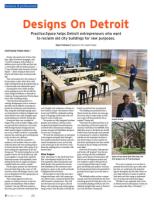
Home of the North End Food Hub, the
first project out of Practice.Space
"If we were to expand, as we see there is
potential down the road to go to other satel-
lite cities, we would look at the industrial
legacies throughout the Rust Belt, where we
see a huge inventory of vacant or underuti-
lized space and cities trying to understand
how to revamp and reclaim their legacy.
"We'd like to start regionally with a focus
on Detroit, but if we did expand, we have our
eyes on places like Flint or Cleveland:'
❑