

oints of view
>> Send letters to: letters@thejewishnews.com
Essay
Change Is Inherent In
Moishe House Model
T
he closing of the two Moishe
Houses within the borders of
urban Detroit and the opening of
one of these Jewish young-adult communal
homes in suburban Royal Oak is hardly a
rap against the central city.
It's nice to have a such a residence in the
city of Detroit, already suffering a reputa-
tion complex over its bankruptcy proceed-
ings; but a short hiatus without one should
not be considered a knock.
Moishe Houses, in order to fulfill their
international intention of inspiring Jewish
living and programming opportunities
where young adults want to be, are, by their
nature, mobile. Neighborhoods change and
so do young adult priorities.
To succeed for a year or more, Moishe
Houses have to locate where prospective
residents, who will hold the lease portfolio
with the landlord, want to live. The organi-
zation is not the leaseholder; it taps donor
contributions to give residents a rent subsidy
and a Jewish activities budget.
The organization gives residents $375
per month to host Jewish programming,
from Shabbat dinners and Jewish text study
to guest speakers and community service
projects. One Shabbat dinner at Motor
City Moishe House in Midtown Detroit
included Israeli graduate students from the
University of Michigan, giving them a rich
perspective on Detroit and its Jewish com-
munity.
A Moishe House surely will return to
the Motor City given the stirrings among
Jewish young adults in rejuvenating the
gritty city. Moishe House's presence in
Southeast Michigan is enhanced over the
long haul when groups of passionate and
committed young adults, supported by
the larger Jewish community and its phi-
lanthropy, continue to want to reside and
engage within the city limits.
More important than where a Moishe
House is located, however, is what it
achieves while operating.
The seven-bedroom Motor City Moishe
House opened on East Ferry Street near
Wayne State University in the summer of
2011. It quickly became a hotspot for events
(typically five or six per month) for Jewish
20-somethings. But groups of
Moishe House residents typically
stay for an average of 1.5 years
before moving on; Motor City
Moishe House was no exception.
Young Jews still live in the
Midtown Detroit house and con-
tinue to plan Jewish programs in
an informal way, underscoring
Moishe House's positive ruboff
Robe
effect. While ever evolving, as so
Contr
many Jewish community initia-
Ed
tives are, the house, under the
Moishe House rubric, clearly was
a catalyst for some of the innovation going
on in Downtown and Midtown Detroit. The
house was unique in the city and helped
refocus the larger Jewish community on
contributing to its rebirth.
The Repair the World Moishe House in
Detroit's Woodbridge area also closed this
summer after about a year when its service
organization sponsor chose a different struc-
tural model to promote young adult service.
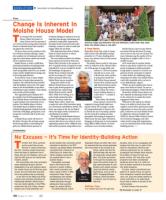
American reggae and alternative rock star Matisyahu, center, lower step, visits
Motor City Moishe House in July 2011.
A Good Match
Meanwhile, Royal Oak, a hub of young
adult activity with affordable housing,
proximity to 1-75 and a bustling down-
town, is an obvious choice for the newest
Moishe House.
The Moishe House model is truly grass-
roots; it's reflective of the collective inter-
ests of the groups of young adults who
embrace it. The best locations
typically are in areas, such
as Royal Oak, where pockets
of young Jews already live.
Both Detroit houses opened
because their residents specifi-
cally desired urban locations.
Attracting young suburban
Jews to central city events —
beyond walking distance or
a short drive — certainly is
beneficial.
When Motor City Moishe
House opened, it stood at the
vanguard of young Jewish adults mov-
ing into Detroit. It's no longer a novelty
for young professionals to choose to live
in Detroit; the city is becoming a destina-
tion for young Jews seeking an urban
atmosphere and wanting to invigorate it.
What's more, the Isaac Agree Downtown
Synagogue is doing more in-town program-
ming. Hillel of Metro Detroit, of course,
continues to serve its urban students.
Moishe House is part of a pro-Detroit
movement that has led about 50 young
Jews to move to the city over the past two
years. Estimates peg the number of Jews
living there at roughly 1,000, so 50 is a
notable increase.
All it would take for another Moishe
House to open there would be for a small
group of outgoing, Jewishly passionate
young adults to commit to it and for our
generous Jewish community to support
it. Adam Finkel, the trailblazing young
ambassador for Motor City Moishe House,
could offer invaluable advice on how to
secure philanthropic support.
"If there are great residents that want to
open a new house in Detroit, I'm sure we
could make that happen:' Finkel told the IN.
Meanwhile, Moishe House alumni can
draw stipends for planning Jewish events
in the central city to sustain the Jewish
engagement flame there.
While part of the appeal of a Moishe
House is its ability to touch those who
might be turned off by mainstream Jewish
organizations or those who seek a secular
path, it behooves our local Moishe Houses
to collaborate whenever feasible with
NEXTGen Detroit, Hillel of Metro Detroit,
the Downtown Synagogue and other
wider, Jewish young adult organizations
so all can maximize their Jewish identity-
building prowess.
❑
Commentary
No Excuses — It's Time for Identity-Building Action
he New York Times summed
up the recent Pew survey:
Portrait of Jewish Americans
like this: "[Among Jewish Americans,
there has been] a significant rise in
those who are not religious, marry out-
side the faith and are not raising their
children Jewish."
Not surprisingly, the study prompted
many despairing articles, and the
blogosphere lit up with opinions about
the Jewish future and all that has gone
wrong. The only thing that surprises
me is why people were so surprised.
As far back as the 1960s and 1970s,
research was emerging indicating the
relationship between Jewish educa-
tion and Jewish identity. In the 1970s,
researchers like S.M. Cohen, Howard
Shapiro and Arnold Dashefsky con-
40
October 31 • 2013
ducted studies that connected Jewish
education to identity. In his 1975
research, sociologist Milton Himmelfarb
concluded that a minimum of
3,000 hours of Jewish edu-
cation (religious instruction)
are needed before it has a
positive impact.
Himmelfarb concluded
back in 1975 that for 80
percent of Jewish children,
their Jewish education had
been a waste of time. In 1981,
researchers Sigal, August
and Beltempo were already
establishing that full-time
Jewish education through
adolescence had a positive
impact on Jewish identity.
The 2000 National Jewish
Population Study and other later stud-
ies reported that day school graduates
were more likely to be involved in all
things Jewish and that the
intermarriage rate was low-
est among day school gradu-
ates. This study and others
in the past two decades also
report the positive impact of
day school education in com-
bination with Jewish summer
camp and informal Jewish
experiences, such as USY or
BBYO. Synagogue/temple
religious school education,
in isolation, has not been as
effective.
Shifting Tides
It is evident that over the past two
decades, many of our synagogues and
temples lost their way. In spite of the
need for meaningful, effective edu-
cational experiences for our children,
synagogues and temples have reduced
the number of hours for their pro-
grams; further, USY and other youth
programs have been considerably
weakened across the U.S., while mil-
lions of dollars continue to be poured
into failed programs.
To foster Jewish commitment and
patterns of Jewish living, we need to
raise competent, inspired and literate
Jews, not Jews who simply identify as
Jewish with little or no understand-
ing of what it means to be part of the
Jewish people.
As Mark Kramer, the executive
No Excuses on page 41