

>> on the cover
CONTINUED FROM PAGE 1
'As a coach, guide and teacher I empower my clients to
become their own best advocates," she says. "I help them
find second opinions, decipher their medical records, and
understand their test results and why specific treatments are
recommended. I teach them to communicate effectively and
establish better relationships with doctors so they're com-
fortable with the medical decisions they make."
Patient advocacy has emerged as one of the fastest-
growing professions of the decade in the health industry.
The need is huge simply because the healthcare system has
changed to the point where most of us don't recognize it
and are afraid that we won't get the care needed. As a result,
patients and their caregivers are increasingly reaching out to
patient advocates for help.
The purpose of the patient advocate is to help patients
become informed about what's happening to them and to
have a voice in their own healthcare decision-making.
Over the last 20 years, there's been an interest in expand-
ing the care team so that patients have a professional's exper-
tise in dealing with the complexities of their illnesses. Given
the decreased time for medical office visits and the trend
toward chronic disease management via phone and Internet,
more patients look to professionals who can provide a more
personalized assistance in their health care.
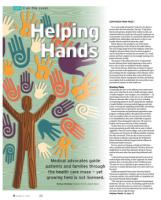
Medical advocates guide
patients and families through
the health care maze — yet
growing field is not licensed.
Ruthan Brodsky I Special to the Jewish News
8
Growing Pains
Complicating the issue are the different terms patient advo-
cates use for what they do such as health advocates, patient
or health navigators, case managers, care coordinators — all
representing someone who works one-on-one with patients.
Moreover, advocates offer a range of services, including
accompanying patients to doctors' appointments, sitting by
a hospital bedside, reviewing medical diagnoses and treat-
ments, reviewing and negotiating medical bills, and training
family members how to advocate for sick relatives.
Several universities and professional organizations have
programs certifying studies in the patient advocate field.
Some are excellent, others not very good, but since there
is no standardization, they aren't a nationally recognized
credential. Those hiring patient advocates will want to be
familiar with the pros and cons of these credentials.
To date, there are no curricula requirements and no
license guaranteeing specific skills, and no state or federal
regulations. There are several colleges, such as the University
of Wisconsin and University of California-Berkley Extension,
that offer coursework. There are also at least two associa-
tions offering certification and training: the Professional
Patient Advocate Certificate Program and the Alliance of
Professional Health Advocates.
Even so, anyone can hang up a shingle and title them-
selves a professional medical advocate. However, the bar for
qualifications is raised when physicians decide to become
medical advocates rather than practicing traditional medi-
cine.
"I call myself a personal medical advocate because of my
medical degree and training, so that I approach my clients'
situations from a doctor's point of view," Schildcrout says.
"It's easier for me as a physician to get a response from a
researcher or another physician than if my client tried to do
the same."
Schildcrout attended Wayne State University Medical
School and completed her residency and was board certified
in internal medicine. She worked briefly as a hospitalist and
then started Practical Medical Insights.
"This work gives me immense personal and professional
satisfaction:' she says. "In fact, I'm finishing a guide book for
people who find themselves or a loved one in a hospital. I
want my clients to have the information they need to make
the choices that are right for them.
Helping Hands on page 10
October 3 • 2013