

metro >> Jews in the digital age
'Techonomy' Confab
Inspires Joel Tauber
T
he recent Techonomy confer-
ence on the campus of Wayne
State University was not much
different than last year's event, the first of
its kind here in the Motor City. Tech lead-
ers and business icons from around the
country converged on Detroit for a series
of conversations and workshops discussing t
how technology and innovation can boost
American economic growth, job creation
and urban revival.
This year's conference emphasized the
national challenge of inadequate and
inequitable education. Speakers discussed
the role of entrepreneurs and industry, as
well as how technology can be creatively
applied to help revive America's physical
and social urban infrastructure, to reignite
competitiveness and economic growth.
The majority of the speakers were under
age 45 and so it is noteworthy that one
of the Detroit Jewish community's major
philanthropists and a world-renowned
business leader was one of the panel-
ists. Among the prominent speakers at
Techonomy, such as Twitter founder
Jack Dorsey, Etsy CEO Chad Dickerson,
Quicken CEO Dan Gilbert and Michigan
Gov. Rick Snyder, was Joel Tauber.
Tauber, founder of Tauber Enterprises,
has been involved in Jewish philanthropy
for more than five decades, serving as
president of the Jewish Federation, chair-
man of the United Jewish Communities
and vice chairman of the United Jewish
Appeal Young Leadership Cabinet. At the
University of Michigan, he created the
Tauber Institute for Global Operations,
which was why he was included at the
event.
Joining Nolan Finley, editorial page edi-
tor and columnist for the Detroit News,
Felix Ortiz, the founder, chairman and
chief product officer at Viridis Learning
Inc., and Carol Williams, executive vice
president of Dow Manufacturing &
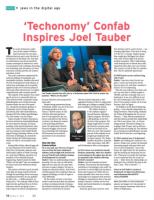
Engineering, Tauber's panel was titled
"Where Are the Jobs?" and was moderated
by Susan Lund of the McKinsey Global
Institute.
The premise of Tauber's panel was that
many jobs are being created in Detroit
through the technology boom, but many
unemployed Detroiters are not qualified
for these jobs — a skills mismatch. As
Finley put it, "We could get 5,000 of these
high-tech jobs and drop them in Detroit
tomorrow, and it's not going to have a
major impact on Detroit unemployment
14 October 3 • 2013
they develop can't be used in Israel — not
enough people there. They have to bring
it to the U.S. or Europe. Snyder's going
there might give Michigan first choice
with some of these high-tech and bio-
medical companies. Other relationships
could develop here in Detroit that could
expand the ideas that come out of Israel.
The country's so full of ideas it's unbeliev-
able. There's unlimited opportunity.
Q: Will Detroit recover and how long
will it take?
Tauber: I was here when Detroit was
Joel Tauber, second from left, sits on a Techonomy panel that tried to answer the
question, "Where are the jobs?"
because Detroiters aren't prepared for
those jobs"
Despite having pneumonia during
Techonomy, Tauber was one of the more
interesting speakers at the con-
ference. I had the chance to talk
with him afterward and learn
how he was inspired by the con-
ference and believes that Detroit
can learn a lot about job creation
in the technology field from
Israel. We spoke about Detroit's
financial struggles, how becom-
ing a technology hub will impact
the Downtown sector and his
assessment of our educational
system.
One-On-One
Conversation
Q: As you said, your 50 years of experi-
ence are from the basic smokestack
industry and not high-tech, but how do
you see Detroit's tech industry turning
the beleaguered city around?
Tauber: I have an understanding of manu-
facturing. You can come up with all the
high-tech you want, but you need infra-
structure to make it happen. We have to
change our education system. And if we're
seriously going to have employees that can
support technology, we have to begin to
teach differently.
For the worker, we have to turn from
words to action because there are solutions
out there in technical schools. In Europe,
the technical schools do quite well. College
education is revered here in America
whereas technical education is well-
regarded in Europe. In the U.S., high school
kids either go to college or nothing. They're
great candidates for technical schools.
The Tauber Institute at
U-M combines engineer-
ing and business, offering a
master's program. We've had
1,000 graduates in the first
20 years of the program. The
things taught there are what
the Internet economy needs.
These are the kinds of stu-
dents you want. One hundred
percent of the students in our
program get employed with
six-figure salaries. The Tauber
Institute should be a model for
other universities. Only MIT
and Northwestern offers such programs.
Q: You've been very involved in Israel's
business community. After Gov. Snyder's
recent mission to the region, how do you
see potential trade relations affecting
Detroit's economy?
Tauber: I saw the transition in Israel
firsthand. They became the third-largest
contributor to technology in the world. I'm
an investor in several high-tech startups in
Israel, and it amazes me. Before the eco-
nomic downfall, there were two or three
Israeli high-tech companies that moved to
Michigan to manufacture close to the auto
industry. Detroit is a fertile area for Gov.
Snyder and Israeli industries to strengthen
our local economy.
Israel has great ideas; however, what
great. I used to go Downtown all the
time by street car. And then I watched it
decline. It's very depressing.
Then the auto industry went down and
our city went from 2 million people to
700,000, and that eventually took us to
bankruptcy. It was very difficult to put
the city in bankruptcy, but it had to be
done if we're going to climb out of it and
become a fine city again.
I'm thrilled to see the kind of things hap-
pening — I love what the entrepreneurs are
doing Downtown. They're doing a fantastic
job. Today, all throughout the city you see
vibrancy... I hope that the entrepreneurs
don't lose interest and that their capital holds
out. This is not a three-, five-, or 10-year
change around. The kind of change I see
is going to take 20 years, and we will once
again become an exciting city. The elements
are occurring now and bankruptcy was part
of that. Now it's time for a new beginning.
Q: What inspired you at Techonomy?
Tauber: Just walking the conference was
electric. People were excited. Six hundred
interesting people with great ideas and
a lot of cross fertilization. I was at the
dinner the night before for the speakers,
and the meeting and mentoring was ter-
rific. What goes on outside the meetings
is more important than the actual ses-
sions — that's where the relationships are
developed. You could feel the buzz in the
halls. I said, "This is Detroit?"
❑
Listen to Joel Tauber's session at
Techonomy at: http://new.livestream.
com/techonomy/detroit2013/
videos/30266696
Rabbi Jason Miller is a local entrepreneur,
educator and blogger. He is the president of
Access Computer Technology. Follow him on
Twitter at ®RabbiJason.