

arts & entertainment
CAMPO. 1E14;a
Air
WANOr PAPINTIN
Jewish heritage and IDF service
shape the work of Homeland creator.
Robert Gluck
I JNS.org
I
sraeli-born writer and director Gideon
Raff knows the cost of war. That
knowledge, as well as his Jewish back-
ground, helped him create two of televi-
sion's most compelling dramas.
Raff's Prisoners of War series on Israel's
Channel 2 won the Israeli equivalent of
an Academy Award for best TV drama in
2010 and was sold to 20th Century Fox.
Originally titled Hatufim ("Abduction")
in Hebrew, the show was adapted into the
acclaimed Showtime series Homeland in the
United States. Its third season starts at 9 p.m.
Sunday, Sept 29, on Showtime.
"Judaism affected the way I write, the way
I see the world:' Raff told JNS.org. "It's in my
education; it's in my history
and in the way I was raised.
First and foremost, Jews are
storytellers. I can't think of
a time my mother wouldn't
shove a book in my hand
demanding that I read."
Starring Claire Danes and
Damian Lewis, Homeland
broke viewership marks for
Showtime and won multiple
Golden Globes and Emmy
awards.
It stars Danes as Carrie
Mathison, a CIA officer with
Gideon Raff
bipolar disorder who comes
to believe that Nicholas Brody
(Lewis), a U.S. marine who was held captive
by Al-Qaida as a prisoner of war, was turned
into a traitor by the enemy and now threat-
ens America. Mandy Patinkin plays Saul
Berenson, CIA division chief.
Set in 2008, Prisoners of War depicts three
Israeli soldiers captured 17 years earlier
while on a secret mission with their unit in
Lebanon. The story begins with their return
home after years of negotiations for their
freedom. Nimrod Klein and Uri Zach return
alive while the remains of Amiel Ben-Horin
come back in a coffin.
The series explores the reintegration of
Nimrod and Uri into a society that has made
them national icons and into an interrupted
family life, all while working through the
trauma of being held captive and tortured.
Born and raised in Jerusalem, Raff served
in the Israel Defense Forces, moved to Tel
Aviv and then completed a degree in direct-
ing at the American Film Institute in Los
Angeles.
His Jewish heritage, especially his military
service, influenced his writings and is evi-
dent in the themes of Prisoners of War and
Homeland. One major difference in the two
shows involves their depictions of society's
feelings about war.
"The main reason for this difference is
because military service is not mandatory in
the U.S. but is in Israel; Raff said. "Because
service in the army is mandatory in Israel,
and because it's such a small country and
such a tight community, whenever some-
thing happens to a soldier in Israel, it hits
close to home in every household:"
When he wrote Prisoners of War, Raff was
living in Los Angeles and was influenced by
how the Iraq and Afghanistan wars played
out for American soldiers who served.
"You heard that soldiers were hurt and
dying, but you never saw
the funerals, never saw the
coffins coming back home,
and this was intentional;
Raff said.
"In Israel, it is exactly the
opposite. We are very well
aware of the price that the
boys — sons and daughters
— pay for our freedom. We
are asked to pay that price.
So whenever something
happens to a POW, Israel
campaigns for his return
because next time it could
be me, it could be my broth-
er or sister:'
Raff's writing addresses a topic he said
isn't usually covered on screen — how pris-
oners deal with post-traumatic stress disor-
der (PTSD).
"Most people don't deal with it:' Raff said.
"When we try to deal with it, there is no
one cure; there is no one way to get better.
Captivity especially has a very unique PTSD.
We do not deal with it because the people
themselves, coming back from war, don't
understand that it takes time to realize they
have a problem.
"They want to forget about it and move
on with their lives. It is an illness that is very
hard to diagnose and see how to help. There
are different ways of dealing with it, but there
is not one cure, no secret or magic pill for
this."
Ran Tellem, vice president of program-
ming for Keshet International, which pro-
duced Prisoners of War, enjoyed working
with Raff because he is "not only a great guy,
but an extremely talented writer, producer
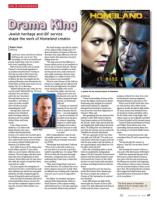
A poster for the second season of Homeland
and director.
"Under his stewardship, Prisoners of War
became the highest-rated drama for Keshet
Broadcasting and, alongside its acclaimed
multi-award-winning U.S. adaptation
Homeland, has been sold to several coun-
tries all over the world from Afghanistan to
Vietnam:' Tellem said.
After graduating from the American Film
Institute in 2003, Raff worked as director
Doug Limaris assistant on the blockbuster
Mr. and Mrs. Smith, which starred Brad Pitt
and Angelina Jolie. Raff's feature directorial
debut, The Killing Floor, was distributed in
more than 40 countries and was acquired by
ThinkFilm for domestic distribution.
"AFI was a great part of why I am where
I am right now:' Raff said. "You study in an
environment where later you grow and work
with the same people in the real industry. It
was a good program, and it helped me a lot.
I'm still in touch with AFL"
Raff is also a bestselling author in Israel,
where he completed his undergraduate
degree at Tel Aviv University. He interviewed
prisoners and their family members as part
of his research for Prisoners of War, which
also has won nine Israeli awards equivalent
to Emmys, including best director and best
drama.
Raff attended this year's San Francisco
Jewish Film Festival, where attendees got
the chance to explore the evolution of
Prisoners of War, learning how it morphed
into Homeland.
In late 2009, Keshet and Raff sold the
format rights for Prisoners of War to 20th
Century Fox. Raff collaborated with Howard
Gordon and Alex Gansa, creators and
producers of the hit U.S. show 24, to write
and develop the American adaptation.
Homeland debuted on Showtime in 2011.
What is next for Raff? David Yates, direc-
tor of the last four Harry Potter movies,
signed on to helm the pilot for high-profile
FX drama Tyrant, from Homeland execu-
tive producers Gordon and Raff as well as
Six Feet Under writer Craig Wright. Yates
replaces Ang Lee, who originally committed
to Tyrant but pulled out for personal reasons.
Created by Raff and developed by Gordon
and Wright, Tyrant tells the story of an
unassuming American family drawn into
the workings of a turbulent Middle Eastern
nation.
The Fox 21-produced project has a big
commitment from FX and is expected to go
to series.
"We shot the pilot this summer in
Morocco. That's all I can say about Tyrant:'
Raff said.
Also shooting this summer in Morocco
were parts of the third season of Homeland.
It had been announced that parts of the
third season would be filmed in Israel as
were parts of the first and second seasons.
The filming was switched at the beginning
of the summer to Morocco due to concerns
over the uncertain situation in Syria, accord-
ing to Ynet. The Israeli production company
that arranged the Israeli location shots
reportedly lost tens of thousands of dollars
on the cancellation.
❑
The third season of Homeland
debuts at 9 p.m. Sunday, Sept. 29,
on Showtime.
JN
September 26 • 2013
47