

>> ... Next Generation ...
From Detroit To Sarajevw
Creating pathways to peace between Muslims and Jews.
M
ore than 100 Muslims and Jews from 39
countries met in Sarajevo this summer to
exchange ideas, discuss hot-button issues
and unite for the sake of uniting. Many
of these conference participants would not have met
in their lifetime had it not been for the Muslim Jewish
Conference (MJC), hosted this year in what Bosnia and
Herzegovina call the European Jerusalem. I was one of
the Jewish participants from the U.S.
I attended the conference
as part of the American
Jewish Committee's ACCESS
delegation. This was my second
international conference as
part of ACCESS, my first being
an all-women's delegation to
the Women as Global Leaders
Conference at the Zayed
University in Abu Dhabi, UAE.
I came with an academic
background in Muslim
and Jewish studies and in
diplomacy.
During committee sessions at MJC, I was reminiscing
about my experience in the Tectonic Leadership
Conference (TL) where young professional and
student Muslims, Christians and Jews, all from Metro
Detroit, spent five days and nights together to create
united groups from opposite sides of the conflict who
become leaders fully committed to transforming it. Our
discussions on identity, Zionism, the Holocaust and the
plight of the Palestinians were similar to those at MJC.
I found that locally, perhaps, our most obvious obstacle
to mutual understanding is our lack of engagement. For
the most part, Muslims in Dearborn and Jews in some
pockets of Metro Detroit do not share daily experiences.
Even on college campuses, these two groups seem
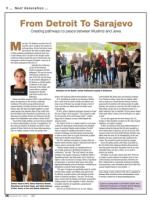
Andrea Varad of NYC, Metro Detroiters Brenda
Rosenberg and Ariana Segal, and Samia Bahsoun
of New Jersey at the AJC Global Conference
38 September 26 • 2013
JN
Attendees of the Muslim Jewish Conference praying at Srebrenica
distant until clashing political demonstrations ensue.
At TL something as simple as my showing a Muslim
that I could write his name in Arabic and Hebrew and
share a love of theater was enough to begin a level of
trust. From there we talked about hot-button issues
pragmatically.
At MJC, when a Pakistani participant showed an Israeli
the top of Page 3 of his passport: "This passport is valid
for all countries of the world except Israel," I smiled,
happy that in Sarajevo we were united despite the
exclusion policy.
The mission of MJC is to deepen interest in and evoke
curiosity for intercultural communication and interfaith
issues, in particular Muslim-Jewish relations. The MJC
seeks to expand its visibility and extend its vibrant
network of dialogue and intercultural communication
in order to move closer to its goal of becoming a global
think tank for Muslim-Jewish interests.
This MJC statement provoked my curiosity. What are
Muslim-Jewish interests exactly? I asked Ilja Sichrovsky of
Vienna, Austria, the founder of MJC.
"Muslim-Jewish interests are something that we
are strongly working on identifying throughout our
conferences," she said. "The most obvious one today
probably is the danger of losing our traditional rights to
slaughtering kosher and halal meats, and to losing our
rights to male circumcision in Europe, where a big debate
is taking place on several of these issues. Also, jointly
fighting Islamophobia and anti-Semitism is something we
identified as crucial for both communities.
"This year in Sarajevo we specifically looked at conflict
transformation, gender and religion, hate speech and
its influence on public opinion, and education and the
effects of historical narratives," she said. "All of those
topics concern both the Muslim and Jewish communities.
Finding answers to them together is what is fostering
innovative networks of cooperation, going beyond
borders and religion."
Some of our shared interests are, at core. religious
commonalities like dietary laws and dressing modestly.
As an American today, I never felt our religious rights
were at stake, but a Somali-Muslim living in Germany
expressed her frustration with German policy for public
teachers. She chooses to cover her hair with a hijab, face
fully visible, and yet, she is not allowed to teach in a
public setting for lack of neutrality. The line where religion
meets state values is blurry. Jews and Muslims can agree
on that.
Can we also agree that for those living in the U.S.,
Europe or other pluralistic countries, for the sake of good
neighbors, we ought to engage?
At MJC we learned of Jews that sheltered Muslims in
Sarajevo during the Bosnian War. We also traveled to a
more solemn place, Srebrenica, the site of the July 1995
massacre where more than 8,000 Bosnian Muslims were
killed under the nose of U.N. Peacekeeping. At this site,
Muslims and Jews, united by the MJC, prayed for the
victims. This powerful moment bonded two peoples.
Across the globe, policies and history may divide us.
But let's think of the righteous Muslims that protected
Jews during the Holocaust. Remember that at our most
vulnerable times, we rely on others. Let us unite to
protect one another.
And lastly, we can take a lesson from MJC: There are
no simple or quick solutions for problems such as non-
communication and miscommunication; therefore, the
MJC is determined to consistently exchange knowledge
and experiences, share information about each other and
nurture truthful interest in one another. ❑
Ariana Segal, 2Z lives in Beverly Hills. She is a graduate of
Michigan State University and the interdisciplinary center
in Herzliya. Contact her at Segal.Ariana®gmaiLcom.
If you're a young leader in the Metro Detroit area,
interested in being part of Muslim-Jewish dialogue,
contact Kari Alterman at Detroit@ajc.org .