

Nothing To Be
Ashamed Of
I
Parodist Allan Sherman helped
invent the American Jew of today,
says biographer Mark Cohen.
David Holzel
Washington Jewish Week
F
fifty years ago, a bittersweet nov-
elty song about a boy at summer
camp hit the airwaves and caught
fire across the globe. Just two weeks after
its release, "Hello Muddah, Hello Faddah"
had sold 300,000 copies. But its writer and
singer, Allan Sherman, was no one-hit
wonder. Over the previous year, he had
become stratospherically famous.
Sherman's 1962 Jewish-inflected albums
of song parodies, My Son, the Folk Singer
and My Son, the Celebrity, were back-to-
back comedy hits. In a world that had not
yet met the Beatles, mania for Sherman's
comedy was unprecedented.
Now, in 1963, he was turning his tal-
ent for finely tuned wordplay to the new
obsessions of the American middle class,
which happened to be the new obses-
sions of Jews: suburbia, lawns, television
commercials and technology. In "Hello
Muddah," he defined summer camp anxi-
ety for at least a generation.
Sherman was a self-destructive talent.
One of the greatest decisions he ever
made was to marry his girlfriend, Dee
— a very important step in the direction
of sanity and health. Then he became
famous, and when he had the opportunity
through fame and money, when he was
going on tour, to indulge all his vices —
drinking, smoking, whoring around, gam-
bling — it became the best thing that ever
happened to him and the worst thing that
ever happened to him.
By the time he died in 1973, days before
his 49th birthday, both his talent and bank
account were tapped out.
Yet, he always maintained a philosophy
that childlike innocence was the best way
to approach the world.
Mark Cohen tries to make sense of this
funny, talented and troubled man and his
meteoric rise and sad fall in his new biog-
raphy, Overweight Sensation: The Life and
Comedy of Allan Sherman (Brandeis).
A New Generation
With his deceptively simple parodies of
well-known songs, Sherman was at the
head of a new generation of American
Jewish entertainers, born in this country
and American in every way. Their task,
according to Cohen, was to figure out what
it meant to be a Jew in a society that was
quickly dropping its barriers to them.
"Sherman helped to invent the
American Jewish personality that we see
everywhere today" — consciously Jewish,
56
September 12 • 2013
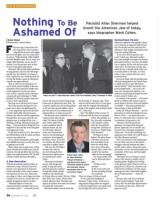
"How's by your': Allan Sherman meets First Fan President John F. Kennedy in 1963.
yet not self-conscious about being Jewish,
anced parody of a popular song. "They
Cohen says by phone from New York. "It's
work so well because they're at such great
a normal, regular part of everything about
odds with the original, but keeping the
us. It's not some special, hidden, weird
theme of the original, and turning it inside
part that we have to be embarrassed or
out:' Cohen says.
ashamed about, or make excuses for."
Take "The Ballad of Harry Lewis:' In
But Sherman never would have suc-
it, Sherman tells the story of a garment
ceeded beyond what Variety
worker who perishes in a
called "the Miami-Catskills
fire, heroically remaining
axis" if there hadn't been
at his machine cutting
a mass market for Jewish-
velvet for his employer,
inflected humor. My Son,
Irving Roth. Sherman set
the Folk Singer debuted
his lyrics to "Battle Hymn
at the exact moment that
of the Republic:'
America was developing an
"He keeps, in mock
acceptance of and appetite
fashion, the whole theme
for ethnic culture. In its first
of heroism and martyr-
two months, the album sold
dom and death, but he
more than a million copies.
turns the whole thing
"[My Son, the Folk Singer]
into a story of this poor
revealed that when no
shnook, Harry Lewis, who
one was looking, the line
stood by his machine
while the fire was raging:'
between Jews and everyone
Author Mark Cohen
else had blurred:' Cohen
The song contains what
on Allan Sherman:
writes.
may be Sherman's finest
Though ultimately a
"Sherman's tremendous
pun:
self-destructive talent,
success with the general
Oh Harry Lewis
"Sherman helped to invent
public at large also antici-
perished
the American Jewish
pated the general acceptance personality that we see
In the service of his lord
of explicitly Jewish comedy,
He was trampling through
everywhere today."
whether it was Mel Brooks
the warehouse
or Woody Allen or today's Old Jews Telling
Where the drapes of Roth are stored
Jokes show:' says Cohen, whose books
"It was a personal challenge to
include Missing a Beat: The Rants and
Sherman:' Cohen writes, "to discover a
Regrets of Seymour Krim and Last Century song parody hiding within the original ...
of a Sephardic Community.
so that the original lyrics are transformed
into straight lines for his punch line:'
Sherman's medium was the finely bal-
Dysfunctional Parents
Sherman's explosion into popular culture
was so big that he appeared fully formed.
But Overweight Sensation describes the
influences, both malign and salutary, that
went into making Sherman.
"It was clear that his parents were
crazy:' Cohen says. Sherman's mother,
Rose, had multiple marriages and seemed
particularly drawn to con men. His father,
Percy Copelon, left his wife and son when
Allan was 8. To determine custody, they
asked the boy to decide which of the two
he would prefer to live with. As Cohen
writes, it was a trauma Sherman never
recovered from.
He found refuge with his grandparents,
who had immigrated to the United States
as adults and never quite left Eastern
Europe behind. "They had all the immi-
grant paraphernalia — the accent; the
very, very strong Jewish identity; com-
pletely un-Americanized despite decades
in this country," Cohen says.
In contrast to his parents — who immi-
grated as children and wanted to put as
much distance between them and Judaism
as possible — Sherman's grandparents
were at home in their Jewish skin.
Unlike all of them, Sherman — and the
generation to which he belonged (he was
born in 1924) — was American to his
bones. So what kind of Jew would he, and,
by extension, his generation, be?
"Sherman rejected his parents'
approach, was inspired by his grand-
parents' approach, but he couldn't just
pretend to be a European immigrant;
Cohen says. "So his did something very
important, and I think we're still living in
the Allan Sherman moment."
This is the moment of the hyphenated
Jew, in which each part of the identity
struggles with and enriches the other —
and the wider culture. Sherman's Jewish
personality was free of sentimentality and
saccharine, Cohen says, and thoroughly
contemporary.
"Sherman's Jews are living in contem-
porary 1962 America, whether they're
speaking dialect English and working
in the garment center (Marry Lewis') or
going down to Miami on a business trip
(`The Streets of Miami'). Or they speak
contemporary New York Jewish English
like in 'Sarah Jackman' — 'How's by
you?"
Sherman also took aim at suburbia
("Here's to the Crabgrass") and what
Cohen calls "the love/hate affair between
the suburbs and the cities. That's still
going on today:'