
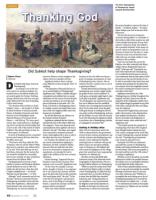

The First Thanksgiving
at Plymouth by Jennie
Augusta Brownscombe
Did Sukkot help shape Thanksgiving?
Robert Gluck
I JNS.org
D
id Sukkot help shape America's
Thanksgiving?
According to one of the fore-
most experts on American Judaism, Dr.
Jonathan Sarna, the biblical holiday did
not exactly guide the Puritans' thinking
during colonial times, but they were gen-
erally influenced by the idea of thanking
God for their bounty.
"The Puritans did not believe in fixed
holidays:' Sarna — the Joseph H. & Belle
R. Braun Professor of American Jewish
History at Brandeis University and chief
historian of the Philadelphia-based
National Museum of American Jewish
History — told JNS.org . "If it was a good
season, they would announce a thanksgiv-
ing, but it's not like the Jewish holiday that
occurs on the 15th of the month of Tishrei
(Sukkot). They did not believe in that. So,
in that respect, it's different:'
In terms of thanking God for a bountiful
harvest, the Puritans did learn that from
the Bible, Sarna said.
"They knew what they called the Old
Testament, what we call the Hebrew Bible;
they knew it, and they were influenced by
it:' he said. "Now they didn't go out and
build huts, obviously. But the notion that
one would be thankful for a bountiful
harvest was certainly one they would have
learned from the Hebrew Bible:'
Thanksgiving did not become a fixed
holiday in America until President Abraham
Lincoln declared it as such in 1863. The
holiday also did not have a firm date until
Congress established one — the fourth
Thursday of each November — in 1941.
Although "you'll commonly read all over
the place" about the connection between
Thanksgiving and Sukkot, Sarna said that
Diana Muir Applebaum, a Massachusetts-
based historian who wrote the book
Thanksgiving: An American Holiday, An
40 September 12 • 2013
American History, set him straight on the
subject when he consulted with her.
Applebaum believes there is always
some difficulty in discovering the "first" of
anything.
"The Separatists at Plymouth did not cre-
ate an annual holiday [of Thanksgiving]:'
Applebaum said. "Rather, a holiday that grew
in popularity and stabilized into an annual
celebration over the course of several decades
was later traced back to an event that took
place at Plymouth in December 1621. The
thesis of my book on Thanksgiving is that it
is a holiday rooted in the deeply held convic-
tions of the New England settlers and in the
human love of a holiday"
But did the Bible have any influence on
the Puritans' festival of thanks?
Applebaum explained that the Puritans
separated the laws of the Hebrew Bible into
two categories. "Some were deemed moral
commandments; these applied to all men at
all times:' she said. "The others were regard-
ed as ceremonial or temporal command-
ments, which applied only to Jews or only to
the olden days, but not to Christians:'
For Puritans, the Sabbath was an eter-
nal, moral commandment applying to
Christians, but they considered Sukkot,
Passover, Shavout, kashruth and other
laws to be ceremonial or temporal com-
mandments, not intended by God to
apply to the children of the new covenant,
Christians.
Puritan theology "supported the proc-
lamation of special days of prayer when
unusual events occurred:' Applebaum said.
"In the event, for example, of an epi-
demic, drought or famine, it was appropri-
ate to call a special day of prayer and fast-
ing in the hope that if the people repented,
God would grant relief' she said. "In the
event that God did grant a special provi-
dence, such as the lifting of a drought or
famine, a special day of prayer and thanks-
giving would be proclaimed."
There were robust debates among the
Puritans in the mid-1600s over the pro-
priety of issuing a proclamation of a day
of thanksgiving every autumn. Was an
ordinary harvest a routine event or was it
a special providence?
"[People feared that] proclaiming a day of
thanksgiving every autumn might 'harden
the people in their carnal confidence' of
God's grace, and people might begin to take
God's gifts for granted:' Applebaum said.
"If a proclamation was expected every year,
how was it different from the unbiblical
Catholic error of creating fixed annual holi-
days? On the other hand, [some thought]
God's great bounty in sending the harvest
was surely worthy of thanksgiving. And peo-
ple like holidays. In years when the General
Court (the Massachusetts legislature) failed
to proclaim a day of thanksgiving, individu-
al congregations sometimes did."
Setting A Holiday Date
After 1676 in Connecticut, and by the
1690s in Massachusetts, the government
of each of those colonies proclaimed a spe-
cial day of prayer and thanksgiving every
autumn. It was celebrated by families
returning home to celebrate with special
dishes (mince pie and plum pudding)
eaten at Christmas in old England and
with events like ballgames on the village
green that would have been inappropriate
violations of a Sabbath day.
But there are those like Rabbi Elias
Lieberman, leader of the Falmouth Jewish
Congregation in Massachusetts, who see a
stronger biblical influence on Thanksgiving.
"While we cannot be certain about what
motivated those Pilgrim settlers to initiate
a feast of thanksgiving, it is likely that they
consciously drew on a model well-known
to them from the Bible they cherished:'
Lieberman said. "Seeing themselves as
new Israelites in a new 'promised land;
the Pilgrims surely found inspiration in
the Bible, in the Books of Leviticus and
Deuteronomy, in which God commands
the ancient Israelites to observe the Feast of
Booths — in Hebrew, Sukkot =To rejoice
before Adonai, your God' at the time of the
fall harvest:'
The fact that Jews eat in temporary
structures during Sukkot "is a reminder of
the booths in which their ancestors are said
to have dwelled during their 40-year Sinai
sojourn:' Lieberman noted. The sukkah is
also a powerful reminder "of the many rea-
sons for which we feel grateful to God, not
the least of which is for the other 51 weeks
of the year most of us are blessed to have
solid roofs over our heads, clothes to wear
and food to fill our bellies.
"Such was not always the case for the
Pilgrims, who often contended with illness,
meager rations, disappointed hopes and
death:' Lieberman said. "During that very
hard winter before the first Thanksgiving,
it is recorded that food became so scarce in
some settlements that the daily ration of food
per person per day was five kernels of corn.
In order to remember those harsh times and
maintain their gratitude for the plenty they
now enjoyed, some New Englanders started
the custom of putting five kernels of corn on
each plate at their feast:'
Applebaum said that by the 1700s,
Thanksgiving was a holiday throughout New
England, and that it spread west with the
migration of New Englanders. Settlers from
New England largely populated the top third
of the states, starting with Ohio and rolling
west, she explained.
"Because New England had a precocious
public school system, it also disproportion-
ately supplied schoolteachers, ministers,
lawyers, journalists and shopkeepers to
the entire country, north, south and west,"
Applebaum said.
"This helped spread the popularity of
Thanksgiving when these New England-
born thought leaders backed the early
19th-century campaign led by Sarah Hale
to make Thanksgiving a national holiday:'
she said. "Thanksgiving proclamations
were issued by state governors:'
During the Civil War era, southerners
associated the concept of a thanksgiving
holiday with Yankee abolitionists, and there-
fore the holiday "did not become popular in
the South until the end of the 19th century:'
according to Applebaum.
Whether or not its formation was actually
influenced by Sukkot, the parallels between
the holidays serve as meaningful symbolism
for individuals like Rabbi Lieberman.
"Both of these splendid holidays encour-
age us to stop and acknowledge the manifold
blessings God bestows upon us each and
every day," Lieberman said. "Whether we
accomplish that stock-taking over a slice of
Thanksgiving pumpkin pie or beneath the
leafy branches of a sukkah roof — or both
— we understand and embrace the impulse
that inspired our Pilgrim and our Israelite
ancestors:'
❑