
health & wellness
'Gifts' Of The Experience
Ovarian cancer survivor advocates for greater awareness, better treatments for disease.
Lessons For Life
Elizabeth A. Katz
Special to the Jewish News
M
arcie Paul's ovarian cancer diag-
nosis, as with many incidences
of the elusive disease, occurred
in a round-about manner. When she found
a mass in her abdomen in 2009, she first
consulted a gastrointestinal doctor.
"The mass would be there one day and
then gone after a few days, but it was
always in the mid-abdominal area, so I
immediately thought it was a GI issue
said the 55-year-old West Bloomfield resi-
dent. "It never occurred to me that I would
be diagnosed with ovarian cancer."
Following a few bouts of intense abdom-
inal pain that were later identified as tor-
sion, Paul's internist ordered a CAT scan
that revealed the tumor. Her symptoms,
however, remained difficult to identify and
when her OB/GYN examined her, her doc-
tor still couldn't clearly feel the mass even
after the CT confirmed its existence.
It wasn't until five months after first
feeling the mass that Paul, 51 at the
time, finally learned that she had Stage
IIIC ovarian cancer in June 2009. The
American Cancer Society (ACS) describes
Stage IIIC ovarian cancer as cancer of
one or both ovaries that has spread to the
lymph nodes or tumors measuring larger
than 2 cm in the abdomen. It's estimated
that 22,240 new ovarian cancer cases will
be diagnosed in 2013, according to the
ACS.
For all types of ovarian cancer, the five-
year relative survival rate is 44 percent.
If ovarian cancer is found and treated
before the cancer has spread outside the
ovary, the five-year relative survival rate
is 92 percent. However, only 15 percent of
all ovarian cancers are found at this early
stage, the ACS states.
Paul began treatment at the Barbara
Ann Karmanos Cancer Center in Detroit,
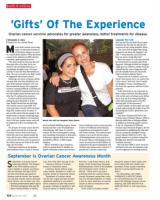
Marcie Paul with her daughter, Shera Shevin
which included debulking surgery, chemo-
therapy and then a year of maintenance
chemotherapy with Taxol. As a Jewish
woman, she also received genetic testing
and counseling at Karmanos to determine
if there was a genetic link to her cancer,
specifically a BRCA1 or BRCA2 gene
mutation.
BRCA1 and BRCA2 gene mutations,
which are passed down in families, are
linked to Hereditary Breast and Ovarian
Cancer Syndrome and are more prevalent
in those of Ashkenazi Jewish descent,
a population concentrated in Central
and Eastern Europe. The syndrome puts
women at up to an 87 percent chance
of developing breast cancer and up to a
44 percent chance of developing ovarian
cancer at some point in their lifetime as
compared to the general population risk
of breast and ovarian cancer, which is 12
percent and 1 percent, respectively.
Paul learned that she didn't have a gene
mutation but that did not alleviate her
concerns for her young daughter, Shera.
"One of my first thoughts after being
diagnosed was about my daughter;' she
said. "I was primarily concerned with
how my cancer would affect her."
Shera was nearly 13 at the time and had
her bat mitzvah two months after Paul's
diagnosis. Although terrified her daughter
might grow up without a mother, Paul also
realized that her cancer diagnosis could
provide valuable lessons for them both.
Paul is married to Stewart Shevin.
"Pretty early on, I realized I can't con-
trol if I have cancer, but I can control how
I have cancer:' Paul said, "and I wanted
my daughter to learn something posi-
tive from the experience and how to face
adversity.
"I also found that it was important to
find a balance between marching ahead
with my life and not letting cancer define
me or stop me from doing something,
while still remaining open to the life-
altering 'gifts' of the experience."
Some examples of those 'gifts' she cited
include appreciating the people in her life
and having the need to spend time "pur-
posefully."
That sense of purpose led Paul to the
Ovarian Cancer National Alliance, which at
that time didn't have a Michigan affiliate.
In addition to becoming a grant reviewer
in the U.S. Department of Defense's
Ovarian Cancer Research Program, she was
instrumental in establishing the statewide
advocacy nonprofit, Michigan Ovarian
Cancer Alliance (MIOCA) in 2011. The
group's mission is to promote saving lives
through early detection and improved
treatment outcomes.
Not only does MIOCA serve survivors
and their loved ones, its volunteers take
an active approach to teaching medical
September Is Ovarian Cancer Awareness Month
S
eptember is Ovarian Cancer
Awareness Month. The disease
is the fifth-leading cause of
cancer deaths in women, and those
who are between the ages 35-74
are the most likely age group to
develop ovarian cancer. Any woman
can develop ovarian cancer, although
these factors can increase your risk:
• Starting menstruation before age 12
• Starting menopause after age 50
• Never having children or having
104 August 29 • 2013
your first child after the age of 30
• Having a history of ovarian,
breast or colorectal cancer
• Having a family history (espe-
cially mother, daughter or sister) of
ovarian, breast or colorectal cancer.
"Symptoms of ovarian cancer
can be very vague and may include
abdominal swelling or discomfort;
pelvic pressure or pain that doesn't
go away; changes in appetite or get-
ting full easily; or feeling tired all
the time," said Robert Morris, M.D.,
leader of the Gynecology Oncology
Multidisciplinary Team at the Barbara
Ann Karmanos Cancer Center in
Detroit. "There are no accurate
screening tests for ovarian cancer,
though Karmanos researchers right
now are working diligently to create
a test for early detection of ovarian
cancer as well as innovative treat-
ment strategies.
"Until a test is in place, women
should be aware of their bodies and
be in touch with their health care
providers if they suspect anything
that isn't normal health-wise for
them."
For information, call 1-800-
KARMANOS (1-800-527-6266)
or visit karmanos.org . For more
about the Michigan Ovarian Cancer
Alliance, call (734) 645-5473 or
(248) 212-4447 or visit www.mioca.
org .
❑
Scanned image of the page. Keyboard directions: use + to zoom in, - to zoom out, arrow keys to pan inside the viewer.
August 29, 2013 - Image 104
- Resource type:
- Text
- Publication:
- The Detroit Jewish News, 2013-08-29
Disclaimer: Computer generated plain text may have errors. Read more about this.