

>> ... Next Generation ...
The Bully Book
Writer turns tormented childhood memories of being bullied into a book.
LESLIE SPECTOR I JN INTERN
t all began in third grade — the
tormenting, the name calling, the
bullying — and only got worse as the
years progressed. For Eric Kahn Gale,
life in his Southfield elementary school was
challenging and hard to forget.
"I remember the first day of
fourth grade; the bullying happened
immediately," said Gale, who now lives in
Chicago. "This guy, Jason, was the worst.
He was very mean-spirited in the way he
treated me. The bullying got more intense
in fifth grade. The kids were always the
same each year so the patterns of bullying
grew and reinforced themselves over the
years."
Gale didn't tell his parents that he was
bullied; he was embarrassed. He felt like
school was a dungeon, and his home was
a safe haven.
"I didn't want the bullying to affect my
home life; I wanted to keep it separate,"
Gale said. "I thought I should just accept
the bullying because I thought it was
normal; I thought this was who I was.
"My parents moved to [West
Bloomfield] between fifth and sixth grade.
I thought there was something wrong with
me or there was something about me that
kept drawing in all this negative attention.
I thought this would happen to me at
my new school. When I got there, no one
treated me the way I was treated at my old
school.
"After about a week at the new school,
I noticed a few kids who were being
bullied and tortured. I was relieved that
this space was already occupied. I didn't
do anything to help these kids, but it stuck
with me. It seemed like there might be
a need for kids to target someone and
make them feel low. This seemed to be the
system of the school at the time, which is
why I've always wanted to write about it.
It's a strange idea that there is a need to
have someone that everyone just walks all
over."
Art Imitates Life
"It's interesting; Eric has this experience
in fifth grade but when he moved to a
new school, he got involved in the theater
program and just blossomed," said his
father, Allen Gale, associate director of
the Jewish Community Relations Council.
"He got one of the leads in his first play;
the scarecrow in The Wizard of Oz. Ever
since then, he blossomed socially as a
performer and as a person."
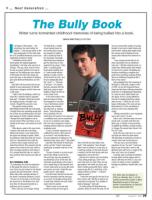
When Gale was 24, he began writing
The Bully Book, a middle-
school mystery based on
true events about a young
boy named Eric Haskins,
who is bullied by three of
his classmates. Eventually,
these three boys manage to
get the whole class to turn
against him by using a "bully
book," a puzzling guide
that teaches students how
to "make trouble without
getting in trouble, rule the
school and be the man" and
how to strategically select
the "Grunt" — "the loser
of all losers." Eric Haskins
becomes obsessed with the
bully book, going to great
lengths to figure out why he
is the chosen Grunt.
"A lot of the events in the
book are based on things
that happened to me when
I was in elementary school,"
said Gale, who invented
the bully book as a literary
device. "Every Monday, we
had a substitute. The sub
would give each person in the classroom
a vocabulary word, and we would have
to use it in a sentence. Every single
kid in the class managed to create an
insulting sentence about me using their
vocabulary word.
"It was a traumatic experience and
a difficult five weeks. I didn't want to
go to school. I was shocked that no
one was stopping it or helping me. The
substitute never said a word," Gale added.
Gale didn't like himself in elementary
school, and the "hatred I had toward
myself grew as people made fun of me,"
he said.
"Groups of people in my class would
chant mean things and yell at me.
The word 'gay' was very prevalent in
my elementary school at the time. My
classmates would always call me gay. It
was a stupid thing to call someone, and
it never made sense to me why this word
was used as an insult. I hated the way
people used it," Gale added.
In his first draft, Gale left out the fact
that his classmates used the word gay
as an insult. He thought writing about
it would only reinforce the insult, which
wasn't what he wanted.
"When I wrote it out and read
it without having the word gay in
there it felt like the book didn't have
teeth," Gale explained. "Even though I
didn't want to reinforce it, it was true, so
I ended up putting it in the book because
I wanted to tell the truth about what was
happening to me at the time."
Gale has Eric Haskins say to the bullies,
"Stop calling people gay. I don't even
know why that's an insult. There are real
gay people in the world, you know, and
there's nothing wrong with them. Calling
someone gay, like it's a bad thing, is like
calling someone a dentist — it doesn't
make any sense!"
"I heard the word gay for the rest of my
life in school, and I feel like it needs to be
confronted, not ignored. It's a problem in
today's language," Gale said.
For Gale, writing The Bully Book was
cathartic. Before he wrote the book, he felt
insecure around other people. He always
thought it was hard to make friends and
meet women. Seeing other people made
him nervous, and his feeling of social
anxiety often followed him wherever he
went.
"I was carrying around with me all
these insecurities from my childhood,"
Gale said. "I felt like it held me back in a
couple ways. Writing about them helped
me work out my issues. Storytelling can
transform something so negative and
painful into something amazing. Writing
about my childhood changed my life in
terms of my career."
Gale graduated from the University of
Michigan in 2008 with a degree in film.
In 2007, he won the Hopwood Drama
Award and the Dennis McIntyre Award for
Distinction in Undergraduate Playwriting
for a play he wrote called Marlin and
the Jaguar. He has a strong affinity for
the arts; he started performing in plays
when he was 11. When he was 14, he
began writing plays of his own and was
fascinated by it. To him, the feeling of
writing is much more satisfying than
acting.
"Writing seemed like a more integrative
way to tell a story," he said.
Gale is now a full-time writer. His most
recent work, co-written with Nick and
Matt Lang, is Twisted, a musical parody
of Aladdin and Wicked, currently running
in Chicago. The musical stars Darren Criss
from TV's Glee.
Earlier this year, Gale went on a seven-
city book tour where he spoke about
The Bully Book at bookstores and also at
schools, which was his favorite part.
"The tour was a cool and intense
experience for me," he said. "I had never
been to any of the cities I went to. My
girlfriend came with me to a couple of the
cities, and I met a ton of people."
Currently, Gale is working to transform
his play Marlin and the Jaguar, which is
about a little boy who lives in a zoo, into
a book. He hopes to have it published
through his publishers, HarperCollins, next
year. ❑
Eric Kahn Gale will appear at
5:30 p.m. Monday, Nov.11, at the
Jewish Community Center in West
Bloomfield as part of the local
authors' presentations at Detroit's
annual Jewish Book Fair.
August 8 • 2013
29