
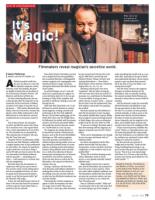

Ricky Jay is one
in a long line of
Jewish magicians.
Filmmakers reveal magician's secretive world.
Naomi Pfefferman
Jewish Journal of Greater LA
A
British journalist recalls how
she once sat down at a cafe with
the legendary magician, author,
historian, actor and, perhaps, the great-
est sleight-of-hand artist on the planet in
the documentary Deceptive Practice: The
Mysteries and Mentors of Ricky Jay.
On that sweltering afternoon, Jay was
at first grumpy after the long drive to the
restaurant, but he turned into a brilliant
raconteur as he began to describe one of
his heroes — 19th-century illusionist Max
Malini, who once borrowed a woman's hat,
placed a silver dollar underneath it, then
lifted the hat to reveal that the coin had
transformed into an enormous chunk of
ice.
And at that moment, the journalist
recounts, Jay lifted his menu with a flour-
ish to reveal his own 1-foot-square block
of ice, which materialized as if out of thin
air. The journalist was so astounded by
"this supreme piece of artistry:' she says,
that she "burst into tears."
Deceptive Practice, by filmmakers Molly
Bernstein and Alan Edelstein, unfolds like
a magical mystery tour of Jay's professional
art and artifice. On camera, he transforms
a paper moth into a real insect, flings a
card at 90 miles per hour to pierce the skin
of a watermelon and dazzles audiences
with his specialty — astonishing card
tricks — with maneuvers so virtuosic they
defy the imagination.
But don't expect the documentary to
explain just what Jay has up his sleeves.
The secretive artist reveals nothing about
how he accomplishes his feats, nor does
he speak much about personal matters,
except to say that his parents didn't "get"
his obsession with magic.
In fact, the only kind memory he has of
them is the time they hired the acclaimed
Al Flosso, aka the Coney Island Fakir, to
perform at his bar mitzvah.
Born Ricky Potash in Brooklyn, Jay does
wax at length about his late grandfather,
the accountant Max Katz, a distinguished
amateur magician and cryptographer who
introduced Ricky to magic via lessons
with genius illusionists like Slydini and the
Great Cardini.
In archival footage, we see 7-year-old
Ricky turn a guinea pig into a pigeon on
a local television show; by 14, he was per-
forming as Tricky Ricky, complete with
penciled-in sideburns, making a cane waft
through the air.
After Katz died when Ricky was 17, Jay
left home to seek his fortune as a profes-
sional magician, working carnivals and
performing at the New York nightclub
Electric Circus before landing gigs on The
Dinah Shore Show and The Tonight Show.
In Hollywood, he studied with his primary
mentors, Dai Vernon and Charlie Miller,
who made him practice the same maneu-
ver "14,000 times in a row:' Jay says.
The magician also speaks about how
he learned the routines of historical per-
formers, such as the 28-inch-tall Matthias
Buchinger, an 18th-century magician
who awed spectators (and fathered 14
children) despite having neither arms nor
legs; about his scholarly books on arcane
subjects, including cannon-ball catchers,
hoaxers, living skeletons and acid drink-
ers; as well as his collection of obscure
manuscripts and antique dice. In between,
he performs card tricks for audiences
of his one-man shows as well as for the
filmmakers, who capture his illusions in
extreme close-up.
During a conference call from New
York, Bernstein and Edelstein admitted to
studying those tricks in slow-motion in
the editing room, but said they still have
no idea how Jay effortlessly transforms one
card into another.
Convincing the reclusive magician to
appear in their documentary was akin
to a magic trick in itself. The process
began about 15 years ago, when Bernstein
became mesmerized with Jay after read-
ing his 1986 book, Learned Pigs and
Fireproof Women: Unique, Eccentric and
Amazing Entertainers — Stone Eaters,
Mind Readers, Poison Resisters, Daredevils,
Singing Mice, etc., etc., etc., etc.
Bernstein said she grew even more
"enchanted" with Jay while viewing his
1993 one-man show, Ricky Jay and His 52
Assistants, in a small theater in Manhattan:
"It was his ability to bring you into a
rather obscure, eccentric world — and just
the fact that it was this sophisticated, New
York audience and people were gasping:'
she recalled.
Bernstein teamed up with Edelstein to
pitch the documentary to Jay's manager,
who politely rebuffed their request; finally,
they arranged to meet Jay through journal-
ist Mark Singer, who wrote an exhaustive
profile of Jay for the New Yorker in 1993.
"It was nerve-racking:' Bernstein said of
their first meeting with the magician, in a
Japanese restaurant near the New Yorker's
offices.
"Ricky can be intimidating, even though
he was very open and honest with us,"
Edelstein added.
Jay almost immediately told the film-
makers that the BBC had just done a
documentary on him, and that it had been
a nightmare, so why would he want to do
another film?
"Ricky's life is all about keeping secrets
while a filmmaker wants to reveal
secrets, so our agendas naturally clashed:'
Edelstein said.
Singer helped convince Jay to partici-
pate, and the filmmakers also promised to
focus the movie on Jay's mentors. There
were other (albeit implied) conditions, too:
The filmmakers intuited that they should
not press Jay on private matters, nor pres-
sure him to perform on cue, which was
"key:' Bernstein said.
Even so, Edelstein recalled, "Molly and
I worried quite a bit in the early years that
we weren't going to get close enough to
make something that would work as a nar-
rative film. Especially in the age of Oprah
and confessional television, viewers expect
people to open up about their personal
life at the drop of a hat, but Ricky is not
among those people:'
Over the years, however, the magician
did agree to perform illusions for the
filmmakers, only occasionally checking
the camera's position before filming com-
menced to ensure that no secrets would be
revealed.
And the famously cranky Jay eventually
allowed Bernstein and Edelstein to tape
his one-man shows in New York and at
the Old Vic in London. He also provided
archival materials, as well as access to his
friends Steve Martin and David Mamet,
the latter of whom has directed Jay's
shows; frequently cast the magician in his
films, most notably House of Cards; and
served as best man at his wedding in 2002.
Of Jay's reserved persona, Edelstein the-
orized, "Ricky is a vulnerable person, and
he's protecting himself, like many people
who have boundaries or are defensive. But
he could get very emotional at times while
talking to us about his mentors:'
Jay does provide one moment of
insight early in the film: "Cards are like
living, breathing human beings, I sup-
pose, because they give you real pleasure
he says. "You sit in a room [practicing]
with them 10 to 15 hours a day, and they
become your friends, particularly for very
lonely people."
❑
Deceptive Practice: The Mysteries
and Mentors of Ricky Jay screens
at the Detroit Film Theatre in the
Detroit Institute of Arts at 7 p.m.
Friday and Saturday and 2 p.m.
Sunday, July 26-28; and the follow-
ing weekend at 9:30 p.m. Friday and
Saturday and 4:30 p.m. Sunday, Aug.
2-4. $6.50-$7.50. (313) 833-4005;
tickets.dia.org .
July 25 • 2013
73