

ita
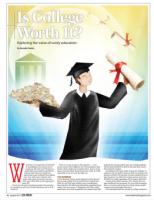
Exploring the value of costly education.
By Marielle Temkin
W
I ould you invest upwards of $20,000
in something if you weren't sure it
would pay off in the end? Would you
spend four years putting yourself into
extreme debt when you could have
spent those years working? Does taking
out a loan with insane interest rates
make sense when you aren't even sure
when you will be able to start paying the
loans off?
Herein lies the gut-wrenching question that prospec-
tive students at any level of their education ask: Is it all
worth it?
40 August 2013 I
RED THREAD
There is no easy answer to this question — every
person comes with a different set of circumstances that
dictate what is right and wrong for them. And so many
times, even after their decision has been made, it is still
impossible to say if it was the right one.
THE NUMBERS
A Pew Research Center study released in 2011 showed
that average college tuition and fees have tripled since
1980 81, and that takes inflation into consideration.
Knowing this, the following information regarding loans
makes a lot more sense: A September 2012 Pew study
stated that one in five households owe student loan debt
-
and that the average public, four-year college graduate
will be about $23,000 in debt by the time they receive
their bachelor's degree.
According to the same study, 52 percent of degree re-
cipients took out student loans in 1996, increasing to 60
percent in 2008. The amount of money students borrow
also has grown. In 1996, the average amount owed was
$17,000; for today's graduates, the average is $23,000.
Despite these bleak numbers, Pew reports that col-
lege enrollment has increased. So, even while emerging
from a recession and facing ever-rising tuition, people
continue pursuing higher education.
Pew speculates that the increase in college students is
www.redthreadmagazine.com