

An Eye-Opening
Experience
The Attack, with a crew of Israelis and Palestinians, gave Ziad Doueiri
a new view of the Jewish state.
George Robinson
Special to the Jewish News
Z
iad Doueiri is nothing if not frank.
"I'm pissed off;" the Lebanese-
born filmmaker says. "They think
they're punishing Israel. Well, they're pun-
ishing me:'
The object of Doueiri's anger is the
entire Arab world, where his new film, The
Attack, has been comprehensively banned,
including the land of his birth.
His sin, apparently, is that he shot the
film in Israel and the West Bank with a
mixed cast and crew. That choice violates
the ongoing economic boycott. Never
mind that Doueiri was providing work for
Palestinian actors and technicians and giv-
ing them experience with the state-of-the-
art Israeli technology.
Or that Doueiri's project had the blessing
of the Palestinian Authority
"The only thing they asked me was not
to portray Nablus in a bad way because
they are trying to improve the city's image
Doueiri said.
Neither the P.A. nor the Israeli govern-
ment had script approval, "and nobody
criticized us:' he added. "We were left alone
to do the film:'
Given the film's subject matter, that in
itself is a surprise. Adapted by Doueiri and
his wife Joelle Touma from a novel by the
pseudonymous Algerian author Yasmina
Khadra, The Attack recounts the story of
Amin Jaafari (Ali Suliman, in a beauti-
fully calibrated performance), a highly
esteemed Palestinian doctor based happily
in Tel Aviv, whose wife, Siham (Reymonde
Amsellem), commits a suicide bombing.
Utterly shocked and baffled, Amin begins
his own investigation of the woman he
thought he knew best. Dragged by his
search back to Nablus, he discovers that his
own divided identity is more complicated
than he realized.
Doueiri readily acknowledges that his
own life experience is not so different from
that of his physician protagonist, minus
the explosions, of course. He divides his
time between France, the United States and
Lebanon.
"I always felt that I've been marginalized
by pulling away from both [American and
Lebanese] cultures:' he says. "I was never
`typical: and this is a situation that attracts
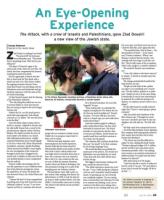
In The Attack, Reymonde Amsellem portrays a Palestinian doctor whose wife,
played by Ali Suliman, unexpectedly becomes a suicide bomber.
Filmmaker Ziad Doueiri
people who are somehow outside society
I didn't do it on purpose; it goes back to
when you're young:'
With his steel-gray long hair, steel-
rimmed glasses and rueful expression,
Doueiri looks like the hard-nosed but
affectionately playful social studies teacher
who tried to inject radical politics into
your high school curriculum from time to
time. He is someone who was trained in
film in the U.S., who worked on the cam-
era crew of films by Quentin Tarantino,
Andrew Davis and Roberto Rodriguez, but
who persisted in trying to be a part of the
emerging post-war Lebanese cinema.
That persistence came with a price, in
fact several. After making West Beirut, his
debut feature, in 1998, it took the director
six years to make another feature, Lila Says
(2004). It took another nine years to bring
The Attack to the festival circuit and theat-
rical release.
He is beyond frustration. It's more like
"anguish:' he says.
"Nine months after we submitted the
original screenplay for The Attack, the stu-
dio that was involved pulled out:' Doueiri
recounts. "I've been told that 'you don't
write in a French way, you can't make these
multicultural films:"
American studios might be willing to
make multicultural films, but they aren't
interested in nuanced ones. The Attack
provides no easy answers and few clear-
cut heroes and villains. Amin's friends are
mostly Israeli Jews, and their reaction to
the events runs the gamut.
The Lebanese film academy decided the
film was "too Israeli" to be their nominee
for the foreign-language Oscar.
The actual shooting was probably the
easiest part of the process. The Israeli and
Palestinian crew got along fine, as usual.
"They deal with each other all the time
Doueiri shrugs.
The biggest consciousness-raising took
place inside the director's head.
"The whole experience opened my eyes,"
he says. "I was a child during the Lebanese
civil war, and I remember Israeli bombard-
ments. So growing up, my view of Israel
was completely negative. I'm not coming
from a neutral place, but with time I've had
to re-examine my thinking. Look, [as we
worked on the film] you're sitting with a
guy in front of you, working with you, and
he's a nice guy. And Israel went way out on
a limb for this film, and I appreciate that.
"The mystified idea I had of Israel — the
demonization of Israel — it just wasn't
true Doueiri continues. "When I was
filming, I realized that the Israelis I was
working with were eager to end this con-
flict. They're fully aware of the occupation.
They're also caught in a sensitive situation:'
The result for Doueiri was transforma-
tive.
"I was a bit calmer as the shoot went on:'
he admits. "I started to actually enjoy this
experience:'
The change undoubtedly benefited the
final product, he says.
"People on both sides of the conflict
are eager to see something new," Doueiri
says. "On this subject, opinion is so polar-
ized. I hadn't set out to do the same thing.
Dramatically it's much more interesting to
be nuanced. It's a relief not having to be
didactic. An audience doesn't want to see a
slogan:'
On the other hand, he readily acknowl-
edges that "I know I wasn't going to please
everyone:'
After the initial early shutdown of the
film, Doueiri says, "I thought my career
was over. I decided I just want to raise my
daughter. My wife told me, 'The hell with
it:"
But help came from unexpected sources
— the Doha Film Institute and an Egyptian
film company. Both subsequently removed
their names from the film, but by then
Doueiri had finished it.
"The Attack was [terribly difficult] to
make he says, shaking his head wearily.
"We had a planned budget of $1.5 million,
and it's not like I have real estate and an
investment portfolio. Hell, I was making
more money as an assistant cameraman in
Hollywood than I've made from the three
features I've directed:'
Why did he keep at it? He laughs.
"I just love the job so much, it makes me
feel it's worth it:' he says. "We can't afford a
house, but it's worth the struggle. I'd die to
do this:'
❑
The Attack currently is showing at
the Uptown Palladium 12, 250 N.
Old Woodward Ave., in Birmingham.
Check your local movie listings.
July 18 • 2013
49