

>> ... Next Generation ...
-
3
Be Young, Jewish And Green
Changing the landscape of Detroit.
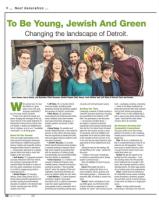
Josh Kanter, Harry Reisig, Jen Rusciano, Eitan Sussman, Rachel Klegon, Blair Nosan, Amit Weitzer and Jeff Klein at Detroit Farm and Garden
ith summer here, it's clear
that Detroit is a great
place to live, work, play
and grow, particularly if
you are young, Jewish and green.
To learn more about the people and
places changing the landscape of the city,
Vivian Henoch of the Jewish Federation of
Metropolitan Detroit went to Detroit Farm
and Garden, a retailer and neighborhood
hub in Corktown, to sit in on a "roundtable
conversation" on all things green.
Boots On The Ground
There were eight representative of the
many up-and-running green businesses,
food enterprises, neighborhood gardens,
farmers' markets and nonprofits working
throughout Metro Detroit in attendance
— all passionate advocates for a greater,
greener Detroit and ready to share their
insights on the city's future:
• Josh Kanter, 27, community outreach
associate, Federation's NEXTGen Detroit,
also working in partnership with the
nonprofit Repair the World on a series of
five micro-grant competitions and events
in an effort to engage young adults in
meaningful service.
• Rachel Klegon, 27, executive
director, Green Living Science (GLS), a
Detroit-based nonprofit organization that
provides recycling and environmental
education to students in the Detroit Public
Schools, reaching more than 40,000
students since 2007.
32 ,
3
• Jeff Klein, 39, co-founder, Detroit
Farm and Garden, providing quality
gardening, farming and landscape supplies
and resources to Detroit's communities.
• Blair Nosan, 28, spontaneous
preservationist and entrepreneurial pickler,
owner Suddenly Sauer, board member
Isaac Agree Downtown Synagogue, co-
founder, gardener and mentor at Eden
Gardens.
• Harry Reisig, 35, president and
founder, Replanting Roots, a new model for
prisoner re-entry, where returning citizens
have the opportunity to develop the skills,
spirit and support network needed to start
new green businesses.
• Jennifer Rusciano, 25, founder,
Detroit Food & Entrepreneurship Academy,
a nonprofit working to empower Detroit
high school students by providing them
with the experience of crafting socially,
environmentally and economically healthy
food from kitchen to marketplace.
• Eitan Sussman, 31, co-director and
manager of Advanced Programs, Keep
Growing Detroit, a network and resource
working to promote a "food-sovereign
Detroit" where the majority of fruits and
vegetables consumed by Detroiters are
grown by residents within the city's limits.
• Amit Weitzer, 27, Detroit programs
coordinator, Student Conservation
Association (SCA), a national conservation
corps that creates opportunities for
young people to play a meaningful role in
protecting and stewarding national parks,
city parks and community green spaces.
Setting the Tone
Comprising a network of friends working in
nonprofits and green businesses, the group
was assembled at the invitation of Jeff
Klein. Two participants in the discussion
— Jen Rusciano and Blair Nosan —
are leaders in nonprofit community
organizations that recently received grants
from the Do It For Detroit Fund. All would
agree that food, justice, security, a sense
of community, and more intelligent and
responsible use of land are central issues
to the resurgence of the city. Each, in his
or her own way, has been inspired to seize
opportunity to bring neighborhoods back
to life.
Setting the tone for the meeting, Jeff
self-identified as the "Dude," opened the
discussion:
"I believe in the power of landscape
to transform communities and to change
people in profound ways."
Here are highlights of what the group
had to say:
Harry: What pulled me back to
Detroit was realizing that there are so
many wonderful, sincere, generous and
hard-working people — businesses and
nonprofits alike, all willing to connect and
share.
Rachel: I think it all depends on how
you define green, too. We tend to think
of green industries as segmented. For
example, my "green" work revolves around
trash —packaging, recycling, composting
— which is not always understood as
being interconnected with other networks
such as food, farming and gardening.
Jeff: For me, it's been enlightening to
find so many young Jewish people doing
"green" work and who share similar
concerns. We're all connected.
On Revenue Streams And
Community Connections
The group would concur that turning
believers into backers is still a challenge.
Funding sources and access to resources
greatly vary:
Blair: We live in a relationship city.
But it's complicated because many of our
networks are still segregated. I know I
have access to certain resources, which
I can get from this network much more
readily than others can.
Rachel: We get the majority of our
funding from the community — from
the recycling center, from the proceeds
of the cardboard that is brought in. We
have a few corporate partners as well as
individual donors. The other large portion
of our funding comes from programming.
Eitan: I would stress the importance
of a diversified revenue stream, including
private foundations, donations, program
fees and other sources of earned revenue,
so that we're not reliant on a single grant
source.
Harry: I've been really fortunate,
connecting to individuals who have led